
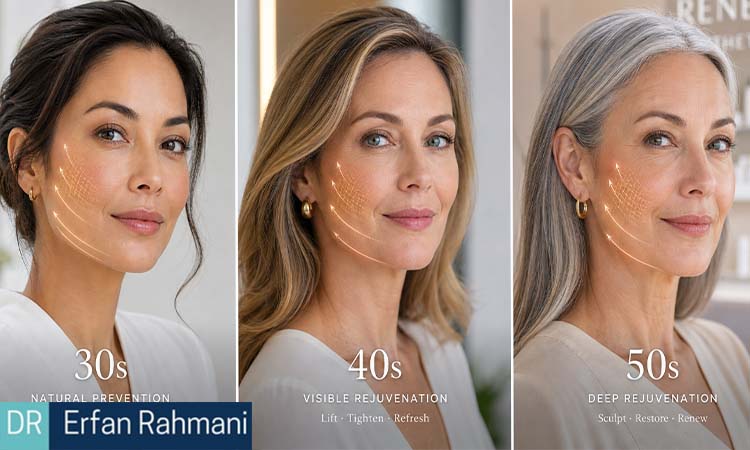
Facial aging does not happen all at once, and that is exactly why a non-surgical face lift should never be treated like a one-size-fits-all solution. The way your skin changes in your 30s is very different from what happens in your 40s or 50s. In the earlier years, the goal is often prevention and subtle refinement. Later, the focus shifts toward restoring volume, improving skin laxity, and creating a fresher, more lifted look without surgery.
That is where understanding how non-surgical face lift treatments vary by age becomes important. Some patients need only light skin tightening and a little support in the right areas. Others benefit more from a combination of fillers, ultrasound-based treatments, radiofrequency, or thread lifting. The best treatment depends less on the number of candles on your birthday cake and more on what is actually happening beneath the skin.In this guide, we will break down the best non-surgical face lift by age, explain which treatments tend to work best in the 30s, 40s, and 50s, and help you understand what kind of results are realistic at each stage.
What Is a Non-Surgical Face Lift?
A non-surgical face lift refers to a group of aesthetic treatments that aim to make the face look firmer, more lifted, and more youthful without traditional surgery. These procedures do not remove excess skin the way a surgical facelift does, but they can improve contour, reduce visible signs of aging, and create a more refreshed appearance. Common non-surgical face lift methods include:- Dermal fillers
- Botox or other neuromodulators
- Thread lifts
- Ultrasound-based tightening treatments such as HIFU or MFU
- Radiofrequency skin tightening
- RF microneedling
- Collagen-stimulating injectables
Non-Surgical Face Lift vs Surgical Facelift
It is important to understand the difference between non-surgical and surgical approaches. A surgical facelift:- Removes excess skin
- Repositions deeper tissues
- Produces a more dramatic and longer-lasting lift
- Requires anesthesia and downtime
- Uses minimally invasive or non-invasive techniques
- Usually involves little to no downtime
- Produces more subtle results
- Works best for mild to moderate aging changes
Why Age Matters in Non-Surgical Face Lift Treatments
Aging affects different parts of the face in different ways. In younger patients, the skin may still have relatively good elasticity, but early expression lines or subtle volume changes begin to appear. In middle age, the face often starts to lose support, and the lower face may become softer or less defined. In the 50s, skin laxity and deeper volume loss are usually more obvious. The main aging changes include:- Loss of collagen and elastin
- Reduced skin firmness
- Volume loss in the cheeks, temples, and under-eyes
- More noticeable folds around the nose and mouth
- Mild to moderate jowling
- Changes in jawline definition
- Drier, thinner, and less resilient skin
Non-Surgical Face Lift in Your 30s: Prevention and Early Correction
In your 30s, facial aging is usually subtle. Many people begin noticing the first signs of volume change, fine lines, or reduced skin glow. The face may still look youthful, but small details start to matter more. This is the stage where many patients choose preventive or maintenance-based treatment rather than corrective treatment.Common Signs of Aging in Your 30s
- Fine expression lines on the forehead or around the eyes
- Early smile lines
- Mild volume loss in the cheeks or under-eyes
- Slight loss of skin brightness or elasticity
- Early signs of tired-looking facial contours
Best Non-Surgical Face Lift Treatments in Your 30s
1. Botox or Neuromodulators
These are often used to soften dynamic wrinkles caused by repeated muscle movement. They do not lift the face directly, but they can make the upper face appear smoother and more rested.2. Light Dermal Filler
If there is real volume loss, small amounts of filler can restore balance and support facial contours. The key is restraint. Overfilling at this age can make the face look heavy rather than lifted.3. RF or Ultrasound Skin Tightening
These treatments are useful if the goal is to maintain firmness and stimulate collagen production. In the 30s, they can be used as a preventative strategy.4. Collagen-Stimulating Treatments
Microneedling, RF microneedling, or biostimulators may improve skin quality and help preserve a youthful texture.Treatment Goals in Your 30s
The goal is usually not dramatic lifting. Instead, it is about:- Preserving facial structure
- Preventing deeper aging changes
- Improving skin quality
- Maintaining a natural, rested appearance
What Results to Expect in Your 30s
Patients in their 30s usually respond very well to conservative treatment. Because the skin is still relatively resilient, the results tend to look fresh and natural. The best outcomes are often the ones that make people look less tired, not obviously treated. A practical example: someone in their late 30s may not need a “face lift” in the traditional sense. They may simply benefit from a small amount of filler in the mid-face and a skin-tightening treatment to keep the lower face crisp.Non-Surgical Face Lift in Your 40s: Lifting, Tightening, and Volume Support
The 40s are often when facial aging becomes more noticeable. The changes are still treatable without surgery in many cases, but the strategy usually becomes more layered. Rather than using one treatment alone, many patients benefit from a combination approach.Common Signs of Aging in Your 40s
- More visible volume loss in the cheeks or temples
- Deeper nasolabial folds
- Softer jawline definition
- Mild jowling
- Early skin laxity
- Tired or hollow appearance in the mid-face
Best Non-Surgical Face Lift Treatments in Your 40s
1. Combination Filler and Botox
This is one of the most common treatment foundations in the 40s. Botox helps soften motion-related lines, while filler restores volume and structural support.2. Thread Lift
For patients with mild to moderate sagging, threads may provide a visible but temporary lift. They are often used in the mid-face or along the jawline.3. HIFU or MFU
Ultrasound-based tightening can be useful for patients with mild to moderate skin laxity, especially in the lower face and under the chin. It works gradually by stimulating collagen remodeling.4. RF Skin Tightening
Radiofrequency treatments are often used to improve skin firmness and texture. They are especially helpful when the goal is a subtle tightening effect with little downtime.5. Biostimulators
These can improve the skin’s structural quality over time by encouraging collagen production. They are particularly useful when the face needs more support but should still look natural.Treatment Goals in Your 40s
In the 40s, treatment often aims to:- Restore lost support
- Soften visible aging
- Improve jawline definition
- Lift the mid-face slightly
- Maintain natural proportions
What Results to Expect in Your 40s
This is often the decade where combination treatment gives the best result. A single method may not be enough. For example, tightening alone may improve firmness but not volume. Filler alone may restore shape but not address laxity. A good treatment plan often combines both. A realistic result in your 40s is a face that looks more rested, slightly more lifted, and better contoured, without looking “done.”Non-Surgical Face Lift in Your 50s: Restoration and Strategic Rejuvenation
By the 50s, facial aging is usually more complex. Skin elasticity is lower, volume loss is more visible, and the lower face may show more sagging. That does not mean non-surgical treatments stop being useful. It means the treatment plan needs to be more strategic.Common Signs of Aging in Your 50s
- Deeper folds around the mouth
- More visible jowls
- Hollow cheeks or temples
- Weaker jawline definition
- Skin laxity in the lower face and neck
- Thinner, less elastic skin
Best Non-Surgical Face Lift Treatments in Your 50s
1. Strategic Dermal Filler
In this age group, filler is often used to restore lost volume in the cheeks, temples, and lower face. The goal is not to overfill but to rebuild support.2. Biostimulators
These can be especially useful because they work over time to improve the skin’s structure and collagen density.3. Thread Lift in Selected Patients
Threads may still help if the patient has mild to moderate laxity and realistic expectations. However, they are not a replacement for surgery in advanced cases.4. HIFU or RF
These treatments can still provide support and skin tightening, especially when the laxity is not severe.5. Combination Plans
Many patients in their 50s benefit from a layered approach over time rather than a single treatment session.Treatment Goals in Your 50s
The goals shift from prevention to restoration:- Bring back facial balance
- Improve support
- Reduce the appearance of sagging
- Refresh the face while keeping it natural
- Avoid a puffy or overcorrected look
What Results to Expect in Your 50s
The results in the 50s can still be very good, but they are usually more subtle than what surgery can achieve. The most successful outcomes are realistic ones. Non-surgical treatment can make a face look better rested, more supported, and less tired. It usually cannot completely reverse deep tissue descent or major skin excess.30s vs 40s vs 50s: Key Differences in Non-Surgical Face Lift Results
When comparing the decades side by side, the biggest difference is not just the visible aging itself, but the kind of correction required.In Your 30s
- Skin elasticity is usually still strong
- Treatment is mostly preventive
- Small adjustments go a long way
- Results are typically subtle and fast
In Your 40s
- Aging becomes more structural
- Combination treatment is often needed
- Both volume loss and laxity matter
- More noticeable improvement is possible
In Your 50s
- Structural aging is more advanced
- Volume restoration and tightening both matter
- Results depend heavily on patient selection
- Expectations should remain realistic
- 30s = preserve
- 40s = correct and support
- 50s = restore and refine
What Is the Best Age for a Non-Surgical Face Lift?
There is no single best age to start. The right time depends on facial anatomy, genetics, lifestyle, sun exposure, smoking history, and how quickly signs of aging appear. Some people begin preventive treatments in their 30s. Others wait until their 40s or 50s, when changes become more noticeable. Neither approach is wrong. The best time to consider treatment is when:- You notice changes that bother you
- The skin still responds well to conservative methods
- You want a natural result with minimal downtime
- You understand the limits of non-surgical options
How to Choose the Right Non-Surgical Face Lift Treatment for Your Age
Choosing the right treatment should be based on your actual concerns, not just your age. A good practitioner will assess:- Skin laxity
- Facial volume loss
- Facial symmetry
- Lower-face sagging
- Neck aging
- Skin quality
- Treatment tolerance
- Budget and downtime preferences
A Few Practical Guidelines
- If the face looks tired because of volume loss, filler may help more than tightening.
- If the issue is mild sagging, HIFU, RF, or thread lifting may be worth considering.
- If the skin is crepey or texture is poor, RF microneedling or collagen stimulation may be useful.
- If aging is advanced, surgery may provide a better structural result.
Are Non-Surgical Face Lift Treatments Enough, or Is Surgery Better?
This is one of the most common questions, and the answer depends on the severity of aging.Non-Surgical Treatments Are a Good Option When:
- Aging is mild to moderate
- The patient wants minimal downtime
- Volume loss is the main issue
- There is only mild laxity
- A subtle and natural result is preferred
Surgery May Be Better When:
- There is significant sagging
- The jawline is heavily jowled
- The neck has excess skin
- Non-surgical options would only produce a limited improvement
Risks, Limitations, and Realistic Expectations by Age
Every treatment has limitations. The safest and most satisfying outcomes come from patients who understand them before starting.Common Side Effects May Include:
- Swelling
- Bruising
- Tenderness
- Temporary asymmetry
- Mild discomfort
- Short-term redness
Important Limitations
- Non-surgical treatments do not remove excess skin.
- Results are usually temporary and maintenance-based.
- Too much filler can distort the face.
- Thread lifts are not permanent.
- Tightening treatments work best in mild to moderate laxity.
Conclusion
A non-surgical face lift can be a highly effective way to refresh the face, but the best approach changes with age. In your 30s, the focus is usually prevention and subtle refinement. In your 40s, combination treatments often provide the best balance of lift, support, and natural-looking correction. In your 50s, the goal becomes restoration, strategic volume replacement, and realistic improvement rather than dramatic transformation. The most important lesson is that aging is not defined by age alone. Skin laxity, volume loss, facial structure, and lifestyle factors all influence which treatment will work best. That is why the smartest non-surgical face lift by age strategy is always a personalized one. If you are considering treatment, start with a professional consultation, ask about combination options, and choose a provider who understands facial anatomy and natural results. The right plan can help you look fresher, more lifted, and still completely like yourself. Ready to take the next step? If you found this guide helpful, share it with someone researching aesthetic treatments, save it for later, or leave a comment with your questions. If you are considering a treatment plan, book a consultation with a qualified provider to find the best non-surgical face lift approach for your age and goals.Frequently Asked Questions
1. What is the best non-surgical face lift treatment in your 30s? In your 30s, the best option is often conservative treatment such as light filler, Botox, or skin-tightening procedures. The goal is usually prevention and subtle enhancement. 2. Is 40 too early for a non-surgical face lift? No. In many cases, the 40s are an ideal time to begin more noticeable treatment, especially if you want to address early sagging or volume loss before it becomes more advanced. 3. Do non-surgical face lifts work in your 50s? Yes, but results are usually more modest than in younger patients. Non-surgical treatments can improve volume, texture, and mild laxity, but they do not replace surgery in severe cases. 4. Which non-surgical face lift lasts the longest? Longevity depends on the method. Fillers may last months to years depending on the product and location, while thread lifts and tightening treatments are usually more temporary and maintenance-based. 5. Are fillers or thread lifts better for aging skin? It depends on the problem. Fillers are better for volume loss, while thread lifts are more useful for mild lifting. Many patients benefit from a combination of both. 6. How often should you repeat non-surgical face lift treatments? That depends on the treatment. Botox may be repeated every few months, fillers may last longer, and tightening treatments often require periodic maintenance sessions. 7. Can a non-surgical face lift replace surgery? Not always. It can be an excellent option for mild to moderate aging, but if you have significant skin laxity or deep jowling, surgery may provide better results. 8. What is the most natural-looking non-surgical face lift option? The most natural results usually come from conservative filler placement, subtle Botox, and skin-quality treatments rather than aggressive correction. 9. How much does a non-surgical face lift cost by age and treatment type? Cost depends more on the chosen treatment and amount needed than on age alone. Combination plans in the 40s and 50s may cost more because they often require multiple methods. 10. Are non-invasive face lift treatments safe for mature skin? They can be safe when performed by trained professionals. A proper assessment is important, especially for mature skin, because treatment choice and technique need to be carefully tailored.
Rate this post