

Why Lip Filler Is More Than “Making the Lips Bigger”
The source chapter begins with a simple but important idea: the lips are a defining facial feature, and even small changes in their structure can influence the appearance of the entire face. Good lip augmentation is therefore not synonymous with maximal volume. It is a balance between volume, projection, border definition, Cupid’s bow, philtral columns, oral commissures and the relationship of the lips to the nose, teeth and chin.
This is why two patients asking for “lip filler” may need completely different plans. One may want subtle enhancement of naturally thin lips. Another may have good volume but poor border definition. A third may be experiencing age-related lengthening of the upper lip, loss of vermilion show, vertical perioral lines and downturned corners. The treatment objective should be defined before the syringe is chosen.
How the Lips Change With Age
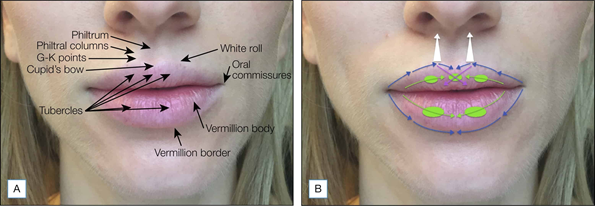
The chapter describes lip aging as a combined skeletal, muscular, soft-tissue and skin process. Maxillary and mandibular bone resorption reduce structural support. The upper lip can lengthen and lose anterior projection, the lower lip may roll inward, the Cupid’s bow and philtral columns become less defined, and the oral commissures may descend.
Photoaging adds another layer: collagen decreases, elastic tissue degrades and skin texture becomes more irregular. Repetitive orbicularis oris activity contributes to radial perioral lines. These changes explain why mature lip rejuvenation often requires attention to the entire perioral region rather than simply adding central lip volume.
What Can Lip Filler Actually Improve ?
| Concern | Potential filler goal | Important limitation |
|---|---|---|
| Naturally thin lips | Increase vermilion height, body volume and projection | Too much circumferential volume can create an unnatural “duck lip” appearance. |
| Poor Cupid’s bow definition | Restore shape and central upper-lip landmarks | Definition should be proportional to the rest of the face. |
| Weak vermilion border | Improve border definition | Border filler is different from body volumization. |
| Age-related lip deflation | Restore lost structure and subtle volume | Aging may also require perioral treatment, not lip filler alone. |
| Downturned corners | Provide structural support below the commissures | DAO activity or broader lower-face aging may also need consideration. |
| Perioral lines | Small-volume soft-tissue support in selected lines | Severe lines may respond better to multimodality treatment. |
| Asymmetry | Strategic unequal correction when baseline anatomy is asymmetric | Perfect symmetry cannot always be created because anatomy and movement differ. |
Lip Assessment : Enhancement vs Restoration
The first consultation question should be whether the patient is seeking enhancement or restoration. Younger patients commonly request additional volume or a different shape. Older patients may primarily want to recreate youthful contours, restore border definition, reduce visible aging and improve lipstick support.
The source chapter strongly emphasizes expectation setting. Treatment planning should identify what the patient likes about the existing lips, what they want changed, what is anatomically realistic and what would be disproportionate to the rest of the face.
The Three Main Lip Zones Discussed in the Chapter
- The white roll : The junction between cutaneous lip and dry vermilion, contributing to lip profile.
- The vermilion lip : The visible red lip tissue, strongly influencing projection.>
- The red roll / wet-dry transition region : An important area in volumetric augmentation.
Lip Fullness Is a Spectrum, Not One “Ideal” Size
Validated photographic scales have been developed to classify lip fullness and aging-related features. Their value is not to label one grade as “beautiful,” but to create a reproducible baseline for documentation and follow-up. The source chapter includes the validated Medicis Lip Fullness Scale and the Catherine-Knowles-Clarke Lip Evaluation Scale.
There Is No Universal Golden Lip Ratio
The chapter reviews multiple studies proposing different upper-to-lower lip ratios. Historical aesthetic references often cite approximately 1:1.6, while other surveys have favored ratios closer to 1:1 or 1:2. Studies in Asian populations have suggested different proportional preferences. The practical lesson is that lip ratio should be individualized rather than imposed as a universal formula.
Ethnic and cultural background also influence baseline anatomy and aesthetic preference. The source chapter argues against forcing every patient toward a Westernized or identical lip shape. The safer and more aesthetically coherent approach is to preserve identity and work with the patient’s existing facial proportions.
How Facial Structure Changes the “Ideal” Lip
- Chin projection affects how lip projection appears in profile.
- Dental occlusion can create apparent upper- or lower-lip prominence even before filler is used.
- Maxillary and mandibular support influence the framework beneath the lips.
- Nose projection and columellar position affect profile balance.
- Smile dynamics can reveal asymmetry or proportions that are not obvious at rest.
Why Small-Volume, Staged Treatment Can Look More Natural
The source chapter advocates conservative first-time treatment and reassessment rather than aggressive one-session overcorrection. Even a small volume can visibly change lip shape, and touch-up 1 to 2 weeks later may be preferable once swelling has settled.
One of the clearest clinical messages in the chapter is that a small amount of filler can make a major visual difference. This is particularly relevant in patients with balanced facial proportions who need refinement rather than transformation.
Why Hyaluronic Acid Is Commonly Used for Lip Filler
The chapter identifies temporary HA fillers as the preferred category for lip rejuvenation. HA products differ in particle characteristics, cross-linking technology, cohesivity, water attraction and tissue behavior, meaning that not every HA filler behaves identically in the lips.
A major practical advantage of HA is potential reversibility with hyaluronidase. That does not make the treatment risk-free, but it provides an important management option for selected problems related to HA placement or overcorrection.
Why CaHA, PLLA and Permanent Fillers Are Different in the Lips
The source chapter distinguishes direct lip augmentation from treatment of the surrounding perioral region. It states that semipermanent and permanent fillers have higher concerns for nodules, granulomas, foreign-body reactions and chronic inflammation in the lips and therefore should be avoided for direct lip augmentation.
| Material | Direct lip augmentation in source chapter | Reasoning |
|---|---|---|
| Hyaluronic acid | Commonly used / treatment of choice | Temporary, broad clinical use, product options and potential reversibility. |
| Calcium hydroxyapatite | Not recommended for the lips | Higher risk of lip nodules and not reversible with hyaluronidase. |
| Poly-L-lactic acid | Not recommended for the lips | Nodule and granuloma concerns in a highly mobile area. |
| PMMA / liquid silicone | Not recommended | Permanent-material complications can include granuloma, chronic inflammation, extrusion and permanent scarring. |
Lip Anatomy : Why Injection Location Changes the Result
The source chapter describes the superior and inferior labial arteries as branches of the facial artery with substantial anatomical variability. In most cases the arteries lie deep, between the orbicularis oris and oral mucosa, but intramuscular and more superficial courses also occur. This variability is one reason no injection plane can be assumed to be completely free of vascular risk.
From an aesthetic standpoint, the chapter makes a useful distinction: treatment of the rolled vermilion border primarily creates definition, while treatment of the lip body and wet-dry region primarily increases volume. This distinction helps explain why “one technique” cannot satisfy every aesthetic goal.
Cupid’s Bow and Philtral Columns
With aging, the Cupid’s bow may flatten and philtral columns may lose definition. The source chapter describes selective structural restoration of these landmarks using small amounts of filler. The aim is not to create exaggerated vertical ridges but to re-establish natural transition points of the upper lip.
Border Definition vs Lip Volume
Simple DistinctionBorder treatment = definition. Lip-body treatment = volume. A patient who wants sharper shape without noticeably larger lips may need a different plan from a patient seeking true volumization.
Can Lip Filler Improve Downturned Corners ?
The chapter describes structural support beneath the lateral oral commissures as one way to improve downturned corners. In some patients, botulinum toxin targeting the depressor anguli oris can be part of a multimodality strategy. The correct approach depends on whether the problem is structural, muscular, age-related or mixed.
Lip Filler and Perioral Lines
Very small-volume filler can soften selected perioral rhytides, but the source emphasizes that the orbicularis oris muscle and photoaging also contribute. For deeper or more widespread lines, botulinum toxin, chemical peels, laser resurfacing or radiofrequency microneedling may be needed rather than simply placing more filler.
Lip Flip vs Lip Filler
| Treatment | Main effect | What the source says |
|---|---|---|
| HA lip filler | Adds structure, definition and/or volume | Main focus of the chapter for lip augmentation and rejuvenation. |
| Botulinum toxin “lip flip” | Changes lip eversion and contour through muscle relaxation | Reported in the literature; off-label in the regulatory systems discussed by the chapter. |
| Combination approach | Addresses more than one cause of aging or shape imbalance | May be useful for perioral lines, downturned corners and broader rejuvenation. |
What About “Russian Lips,” Four-Point, French Kiss and Phi Techniques ?
The source chapter reviews several named techniques, including a four-point approach, the anatomy-based “No-Touch” method, the French Kiss technique and a step-by-step Phi technique. These publications show that multiple strategies can produce acceptable results, but they do not establish one branded technique as universally superior.
For a patient-facing article, the most useful takeaway is that the technique should serve the anatomy and treatment goal – not the other way around. A named trend should not override lip vascular anatomy, facial proportions or the patient’s baseline shape.
How Much Lip Filler Is “Too Much” ?
The chapter cites evidence that larger total filler volumes can be associated with more moderate-to-severe adverse events. It also repeatedly favors small-volume treatments and staged correction. The correct amount is therefore a clinical planning question rather than a universal number of syringes.
Overfilling can alter the circumferential projection of the lip and create an unnatural profile. The best endpoint is usually one in which the lips remain integrated with the nose, chin and facial width rather than becoming the dominant feature of the face.
What Is Normal After Lip Filler ?
The systematic review cited in the chapter found high overall patient satisfaction, with the most common adverse events being local injection-site reactions such as swelling, bruising, pain, redness and itching. Most reported treatment-related events were mild or moderate and the majority resolved within two weeks.
- Temporary Swelling
- Bruising
- Tenderness or pain
- Redness
- Itching
- Temporary lumpiness while swelling is settling.
Immediately after treatment, swelling can make the lips appear larger and less symmetric than the eventual result. The chapter’s case discussion specifically cautions against judging or dissolving an apparently “overcorrected” result before procedural swelling has had time to settle, unless there are concerning clinical signs.
When Swelling Is Not Just Normal Swelling
The chapter distinguishes routine post-injection edema from vascular compromise. Concerning findings include blanching and pain that is disproportionate to expected injection discomfort. These features warrant immediate clinical assessment rather than routine observation at home.
Rare but Serious Complications
Serious filler complications are uncommon but can include vascular compromise with skin necrosis and, much more rarely, visual complications. The source notes that the highest-risk areas for filler-associated blindness are the nose and glabellar complex. At the time of the chapter, it reported no HA lip-filler blindness case in the literature it reviewed, but it still emphasizes that vascular anatomy and prevention matter.
This is why lip filler should be treated as a medical procedure: product reversibility does not replace the need for anatomical knowledge, early recognition of vascular compromise and an emergency management protocol.
Needle vs Cannula : Is One Completely Safe ?
The chapter reviews evidence suggesting cannulas may provide more precise placement in some settings and may reduce the risk of vascular occlusion compared with needles. It also notes that larger blunt cannulas generally require more force for arterial penetration. However, the overall message is not that cannulas eliminate risk – only that tool selection is one component of a broader safety strategy.
Can Ultrasound Improve Filler Safety ?
The source discusses duplex ultrasound as a method for identifying clinically invisible vessels and locating filler deposits. This can support anatomical mapping and can also assist in the targeted management of selected filler complications. The chapter presents ultrasound as an additional safety tool rather than a replacement for clinical training and anatomical expertise.
Case Example From the Source Chapter
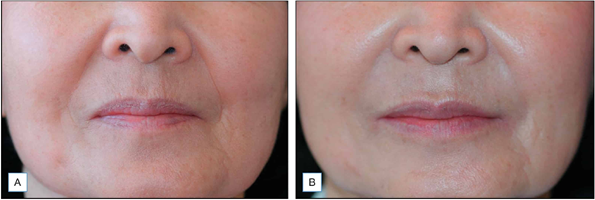
The chapter presents a patient with thin lips, loss of upper-lip structure and Cupid’s bow definition, poorly defined philtral columns and radiating perioral lines. After treatment with 1 mL of HA, the authors describe improved Cupid’s bow definition, increased lip volume and reduced appearance of perioral rhytides.
What Makes a Lip Result Look Natural ?
- Preserving the patient’s existing identity rather than imposing a template.
- Matching lip projection to the nose and chin in profile.
- Respecting baseline asymmetry instead of chasing mathematically perfect symmetry.
- Using volume only where volume is needed and definition only where definition is needed.
- Keeping border definition proportionate rather than sharply overlining the entire lip.
- Allowing swelling to settle before deciding whether additional correction is required.
- Using staged treatment when the desired change is larger than what should reasonably be attempted in one session.
Lip Filler in Abu Dhabi : What a Good Consultation Should Cover
- Do I want more volume, more definition, a different shape, or age-related restoration?
- What does my lip look like in frontal, oblique and profile views ?
- Do I have baseline asymmetry that should be documented before treatment ?
- How do my lips relate to my nose, teeth and chin?
- Would increasing the upper lip, lower lip or both create the most balanced result?
- Do I have perioral lines, downturned corners or skin changes that need a combination treatment rather than more filler?
- Which HA product family is being considered and why does its tissue behavior suit my goal?
- How conservative will the first treatment be, and when will the result be reassessed?
- What is the clinic’s plan for recognizing and managing vascular complications?
- Would ultrasound add value in my specific treatment or in managing a previous filler issue?
