
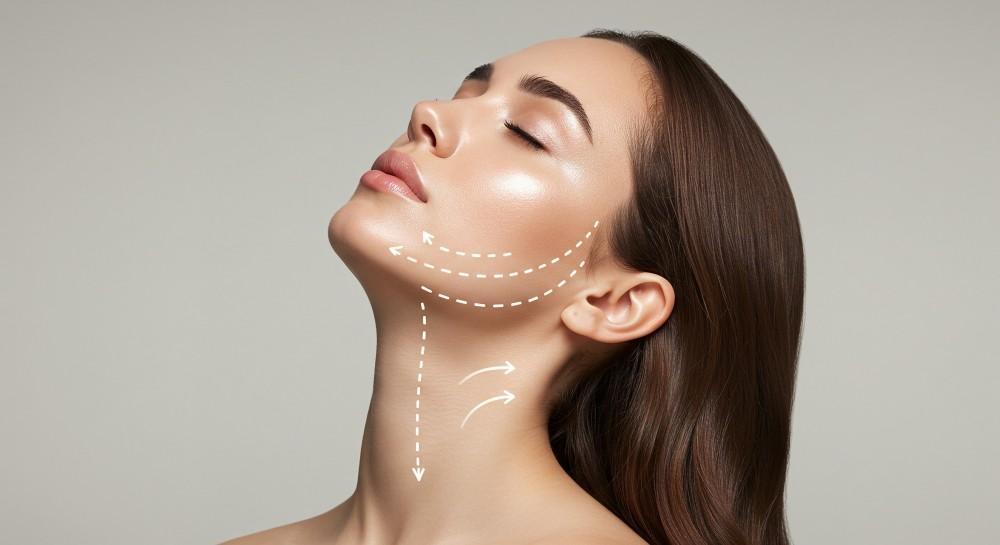
Non-Surgical Skin Tightening in Abu Dhabi : A Complete Anatomy-Based Guide
Loose skin is not a single anatomical problem. The visible change around the brow, cheeks, jawline, and neck reflects skin quality, dermal collagen, fibrous septae, subcutaneous fat, muscle activity, skeletal support, and the degree of true tissue descent. For this reason, choosing a non-surgical skin tightening treatment in Abu Dhabi should begin with anatomy rather than with a device name.
This guide reviews the major nonablative and minimally invasive tightening technologies — radiofrequency (RF), infrared light, ultrasound, RF microneedling, and subdermal RF. Across these categories, the shared goal is controlled tissue heating that triggers immediate contraction plus delayed collagen remodeling, while protecting the epidermis and limiting downtime.
A useful way to understand these treatments is to separate the patient’s visible complaint from the tissue layer actually responsible. “Loose jawline skin” may reflect true dermal laxity, descent of fat compartments, jowling, submental fat, platysmal activity, skeletal deficiency, or several factors at once. An energy device that remodels collagen can improve one component while leaving another essentially unchanged — which is why the same machine can look impressive in one patient and underwhelming in another.
What Causes Skin Laxity?
Skin laxity develops as collagen and elastic support change with age, while deeper facial and neck structures also shift. Surface looseness may coexist with volume loss, jowling, submental fat, platysmal activity, or skeletal support changes. A device that heats the dermis cannot correct every one of these contributors.
- Dermal collagen quality and organization influence firmness and recoil.
- Subcutaneous fat thickness and fibrous septae affect contour and how energy is conducted through tissue.
- Facial volume loss can mimic or accentuate laxity even when skin quality remains relatively good.
- Muscular factors such as platysmal banding may need a different treatment mechanism.
- Severe structural ptosis generally exceeds what noninvasive energy-based tightening can reliably correct.
From an anatomical perspective, “laxity” is a three-dimensional diagnosis rather than a purely surface finding. Clinicians should evaluate the face and neck both dynamically and at rest, since tissue that appears loose in a static photograph may behave differently during smiling, neck movement, or platysmal contraction. A contour deficit that looks like skin laxity may actually be driven by underlying volume or support.
For the lower face and neck, the clinically relevant question is whether the skin itself is the dominant limitation. If there is only mild-to-moderate looseness with relatively preserved structural support, a thermal remodeling treatment can be a logical choice. If the patient has substantial jowling, major soft-tissue descent, severe neck laxity, or significant skeletal deficiency, the ceiling of an energy-only treatment is lower.
Why Lower-Energy, Multi-Pass RF Became Important
A central safety lesson in modern practice is that “more energy” is not automatically better. The updated RF paradigm uses repeated, controlled passes rather than one aggressive pass, aiming for enough cumulative heat to produce a tissue response while avoiding excessive focal temperatures that can burn skin or damage fat.
The guiding philosophy is to treat toward a comfortable thermal endpoint rather than using pain as proof that a procedure is “working.” Patient heat feedback serves as a real-time safety signal. Areas over bony prominences, around the mandibular angle, and parts of the anterior neck may be more uncomfortable — fluence should be reduced and unnecessary overlap avoided as discomfort rises.
For monopolar RF, treatment grids, repeated vector passes, and zonal approaches build controlled heat without concentrating excessive energy in one spot. Additional passes may be directed along the mandibular border and submental region when the clinical goal is sharper lower-face definition.
Important safety notes:
- Direct treatment over the thyroid should be avoided with monopolar RF.
- Implantable electronic devices such as pacemakers, defibrillators, and ICDs are absolute contraindications for monopolar RF.
- Periorbital treatment requires device-specific sterile eye protection.
RF Microneedling : Delivering Energy Through Needles
RF microneedling was developed partly to bypass the epidermal barrier and deliver energy more directly into the dermis. Platforms differ in insulated versus noninsulated needles, penetration depths, needle diameters, and real-time impedance or temperature monitoring. Because platforms vary substantially, “RF microneedling” should not be treated as one identical treatment across devices.
Profound is a bipolar microneedle system designed to heat the reticular dermis while protecting more superficial structures. In one comparison, microneedle RF patients were judged to have approximately 16% improvement from baseline, versus 49% in surgical facelift patients — illustrating both a measurable nonsurgical benefit and the much larger effect of surgery. This does not mean every RF microneedling device delivers the same result; it is an illustrative magnitude comparison that reinforces surgery as a different category of correction.
Temperature-controlled RF microneedling is also linked to dermal biology outcomes. In one multicenter temperature study, a 67°C target cohort produced the strongest reported combination of neocollagenesis, neoelastogenesis, hyaluronic-acid production, and clinical laxity reduction — supporting the idea that controlled partial collagen denaturation may stimulate a more effective remodeling response than either insufficient heating or excessively destructive coagulation.
Morpheus8 and Other Modern RF Microneedling Platforms
Platforms discussed include Infini, Intensif, Genius, Legend Pro, and Morpheus8. Morpheus8 is an evolution of the Fractora handpiece, with programmable needle depths and an additional thermal zone extending beyond the physical needle depth — a good example of why device depth, needle insulation, and tissue targeting all matter.
RF microneedling platforms should not be treated as interchangeable. Needle number, needle diameter, insulation pattern, penetration depth, impedance monitoring, and thermal-spread geometry differ between devices, affecting pain, epidermal exposure, coagulation volume, and reproducibility of results.
| Platform | Key Feature |
|---|---|
| Infini | Adjustable depths from 0.5–3.5 mm; insulated needle shafts concentrating RF near the exposed tip |
| Intensif | Noninsulated gold-plated needles with digitally controlled depth increments up to 3.5 mm |
| Genius | Real-time impedance monitoring to maintain consistent energy delivery and reduce power if impedance rises too fast |
| Legend Pro (VoluDerm) | Combines controlled surface ablation with microneedle RF delivery; distinct pain profile |
| Morpheus8 | Coated insulated needles, programmable depth, and a thermal zone extending beyond physical needle depth |
Device-Comparison Caution: It would be inaccurate to claim “Morpheus8 is better than all RF microneedling.” Platforms differ technically and the literature is heterogeneous. The more accurate message: the appropriate RF microneedling platform depends on anatomy, treatment depth, pain tolerance, safety features, and the clinical endpoint.
A prospective evaluation of 247 patients treated with a combination of Morpheus8 and subdermal bipolar RF for neck laxity and jowling found the average Baker Face Neck Classification decreased from 3.1 to 1.4, with 93% of patients pleased with results and willing to repeat treatment. Because this was combination therapy, the outcome should not be attributed to Morpheus8 alone.
Subdermal Minimally Invasive RF : ThermiTight, FaceTite and AccuTite
Subdermal RF introduces a probe beneath the skin through small access points. This is more invasive than surface RF or HIFU, but allows energy delivery closer to dermal and septofascial structures, with temperature-monitoring systems intended to improve control and reduce overheating.
- ThermiTight — In a series of 35 patients with submental and jowl laxity, two blinded reviewers found clinical improvement in 74% at 30 days, with a mean change of -0.78 on a 4-point laxity scale. It uses a subdermal probe with thermistor feedback.
- BodyTite / FaceTite / AccuTite — Combine a subcutaneous RF probe with an external electrode to heat deeper and superficial structures simultaneously (bipolar RF between internal probe and external electrode). In a 42-patient FaceTite series, tightening and lifting of facial and neck regions began around 3–4 weeks and continued improving over 6 months.
Because energy is delivered from beneath the skin, these treatments interact directly with septofascial and subdermal structures and are correctly described as minimally invasive rather than noninvasive. These studies support a spectrum concept: as devices move from surface treatment to needle or subdermal delivery, invasiveness, tissue interaction, and recovery generally increase — but they do not prove subdermal RF is equivalent to surgical lifting, or that one probe-based platform outperforms another.
Infrared-Light Skin Tightening
Broadband infrared systems (roughly 800–1800 nm depending on platform) heat the dermis using water as the primary target chromophore. Titan, Icon, and SkinTyte are examples. Epidermal cooling before, during, and after energy delivery reduces surface injury while allowing deeper dermal heating. Multiple treatments are commonly required.
- In a 25-patient Ruiz-Esparza series, immediate tightening was visible in 22 of 25 patients, while 3 showed no improvement. Lower fluence combined with a high pulse count produced the best balance of effect and comfort.
- Longer follow-up studies reported improvement continuing over months, with most outcomes in the mild-to-moderate range.
- A mobile-delivery Titan technique achieved successful heating to skin-surface temperatures around 41–42°C after two monthly sessions in one cited study.
- Minor erythema was common; blisters occurred in a few over-treated areas.
- One series found better results in loose, draping skin than in sagging driven by deeper volume loss, with no improvement in the jowl region.
Histologic work showed greater collagen-fibril alteration at higher fluences and depths, but immediate histologic change does not perfectly predict the delayed clinical result — reinforcing that cumulative controlled heating matters more than simply maximizing energy.
Laser Wavelengths and Skin Tightening
1064-nm and 1320-nm lasers have historically been used for tissue tightening, generally with only modest improvement.
- 1064-nm Nd:YAG is absorbed by melanin and hemoglobin, with some water absorption. In a split-face comparison, the 1064-nm side showed somewhat better overall improvement in wrinkles and laxity than the RF side, though both were modest. Another comparison found greater improvement with 1064-nm on the lower face, with more similar results between technologies on the upper face.
- 1320-nm energy primarily targets water. In one small study using eight treatments, clinical change was subtle and only two patients reported satisfaction.
These findings reinforce that device selection should be linked to the specific clinical target rather than marketing language.
HIFU / Microfocused Ultrasound for Skin Tightening
High-intensity focused ultrasound (HIFU) creates focal heat by converting acoustic energy into thermal energy at selected depths. For aesthetic skin tightening, this uses short, lower-energy pulses in the megahertz range — distinct from traditional high-energy HIFU used for tissue ablation — creating discrete focal zones of thermal injury rather than widespread necrosis, with relative sparing of tissue between focal zones.
Ulthera / Ultherapy combines ultrasound imaging with a therapeutic module creating small (~1 mm³) zones of thermal coagulation at controlled depths in the mid-to-deep dermis and subdermis. Higher-frequency probes produce more superficial effects; lower-frequency probes reach deeper tissue.
- Early cadaver work showed focused ultrasound could target the facial SMAS while sparing adjacent structures — a key depth-specificity advantage.
- A 2010 study found more than 83% of treated patients showed significant brow elevation, averaging 1.7–1.9 mm, developing over about 90 days and remaining visible at 10 months.
- In a 2011 study of 22 Asian patients, 77% reported marked nasolabial fold improvement and 73% reported marked jawline improvement. Histology showed increased dermal collagen, dermal thickening, and straighter elastic fibers in the reticular dermis.
- A separate dual-depth study reported blinded-reviewer improvement in 93% at 6 months, 85% patient satisfaction, and maintenance at 1 year.
HIFU Evidence Positioning: These studies support focused ultrasound for selected laxity, but do not establish that HIFU is the best device for every face or neck. Published protocols vary by platform, depth, and treatment geometry, and lower-face outcomes are harder to standardize than fixed landmarks like brow height. Early Ultherapy protocols also carried real practical limitations — significant discomfort for some patients and relatively lengthy treatment times.
Sofwave : A More Superficial Ultrasound Strategy
Sofwave uses Synchronous Ultrasound Parallel Beam Technology (SUPERB), creating multiple cylindrical thermal zones in the mid-dermis with intervening untreated tissue. Reported features include:
- Consistent treatment depth of 1.5 mm
- Mid-dermal temperatures around 60–70°C
- Direct contact cooling and real-time epidermal temperature monitoring
- Treatment time of roughly 30–40 minutes
- Seven ultrasound transducers in the handpiece
Sofwave is conceptually different from Ultherapy’s deeper focal-depth approach — a mid-dermal fractional ultrasound strategy intended to avoid deeper nerves and facial fat while still generating controlled thermal remodeling. There is no head-to-head trial proving superiority over Ultherapy or RF; the difference is best explained by geometry and target depth rather than lumping both under “HIFU.”
Skin Type and Pigmentation : What Is Safer for Darker Skin?
RF, ultrasound, and infrared skin-tightening treatments are generally usable across skin types because their primary mechanism does not depend on melanin absorption the way many pigment-targeting optical systems do. The important exception is technology with an optical component absorbed by pigment, such as IPL-RF combinations.
For Fitzpatrick IV–VI, tanned skin, darkly pigmented lesions, or dense pigment irregularity, increased caution is recommended when an optical component is used — particularly relevant for an Abu Dhabi audience with diverse skin phototypes.
The reasoning is mechanistic: pure RF and ultrasound do not rely on melanin as the primary target, whereas an optical component can be absorbed by epidermal pigment. That doesn’t make RF or ultrasound risk-free, but it changes the risk profile. With optical-RF combinations, lowering optical fluence in darker or densely pigmented areas and maintaining heightened caution for burns, crusting, and pigmentary alteration is advised.
RF microneedling also bypasses part of the epidermal barrier, which can improve safety across skin types compared to treatments requiring substantial optical absorption at the surface. Still, post-inflammatory pigment change can occur after needle- or heat-based procedures, so skin phototype remains part of treatment planning — not a reason to assume “no pigment risk.”
Who Is the Best Candidate for Non-Surgical Skin Tightening?
Patient selection is one of the strongest determinants of outcome. The best results tend to occur when the treatment target is genuine mild-to-moderate laxity rather than severe structural descent. Skin quality may matter more than chronological age alone.
- Younger patients at the first signs of skin descent often show the most predictable response.
- Mild-to-moderate laxity without major underlying structural ptosis is the classic nonsurgical-treatment profile.
- Patients who understand the change will be smaller than surgery tend to be more satisfied.
- Older patients with good skin quality can still respond; age alone is not a complete exclusion criterion.
- Patients with severe sagging, deep wrinkles, or large structural deficits are generally suboptimal candidates for the degree of correction expected from noninvasive devices.
- A patient seeking maintenance rather than dramatic repositioning may be particularly well aligned with these treatments.
Case example 1: A 47-year-old woman with mild-to-moderate jowling, modest submental laxity, minimal submental fat, and realistic expectations — a reasonable candidate for nonsurgical tightening because the problem is primarily laxity without major structural deficiency.
Case example 2: An older woman with good preserved skin quality but multiple age-related changes — jawline definition loss, midface volume change, and platysmal banding. Here, one energy device won’t solve every feature; the patient may benefit from tightening combined with neurotoxin and filler, since skin, muscle, and volume contribute independently to the aged appearance.
This distinction matters for realistic counselling: a patient with jowls driven largely by volume redistribution or skeletal support loss may be disappointed if promised that tightening alone will restore the jawline. Conversely, a patient with early dermal laxity and good support may see meaningful improvement without a more invasive intervention.
Which Areas Can Be Treated?
Treatment areas include the upper face/brow, periorbital area, cheeks, jawline, submental region, neck, and selected body areas such as arms, abdomen, and knees. Suitability for each area depends on device geometry, depth, tissue thickness, pain sensitivity, and proximity to structures requiring protection.
- Brow / upper face
- Periorbital skin (with device-specific eye protection)
- Cheeks and lower face
- Jawline and jowls
- Submental contour and neck laxity
- Upper arms and selected body laxity
- Abdominal and knee crepiness in selected patients
The same device may behave differently by anatomical region — skin thickness, fat thickness, fibrous septae, underlying bone, pain sensitivity, and proximity to vulnerable structures all change the treatment environment. Settings used on the cheek cannot simply be copied to the eyelid, neck, or body.
For the jawline and submental region specifically, treatment planning should distinguish skin laxity from fat. A thermal tightening device may sharpen contour when laxity is mild, but substantial submental adiposity remains a separate problem, and prominent platysmal bands are a muscular issue that may need a different treatment category rather than more skin-tightening energy.
How Fast Do Results Appear?
There is an important distinction between an early contraction effect and delayed collagen remodeling. Some treatments look temporarily tighter immediately after energy delivery, but this acute effect may soften during the first days or weeks. The more meaningful remodeling response develops gradually.
Maximum visible change for many nonablative technologies falls in the 3–6 month window. With monopolar RF, for example, an immediate tightening effect may partially dissipate after roughly 2 weeks before slower improvement becomes more obvious later, with an accelerating remodeling response particularly between months 4 and 6.
This matters for patients comparing photographs too early — a 1-week result may reflect transient contraction or swelling, while a 3- to 6-month result better represents true collagen remodeling. Standardized photography at consistent head position is essential for fair comparison.
How Long Do Results Last?
Long-term comparative studies remain limited. Many patients can expect at least a year or more before considering repeat treatment, and some patients report that regular treatments at 1–2 year intervals help slow the visible progression of laxity — this should be framed as maintenance experience rather than proof of permanent prevention of aging.
Durability also differs between “result persistence” and “continued aging.” Even when a remodeling effect persists, the underlying aging process continues, so a patient may remain improved relative to baseline while still noticing gradual laxity over time. There is no universal maintenance schedule for all devices, and the ideal number of treatments remains uncertain for several platforms.
Why Standardized Photography Is Essential
Because tightening changes can be subtle, standardized pretreatment and posttreatment photography using identical positioning and lighting is essential. Small changes in head angle, chin position, camera distance, or illumination can exaggerate or hide a result — especially around the jawline and neck.
Before-and-after images should never use an extended chin position, stronger lighting, different focal length, or altered posture to manufacture an apparent result. Subtle but reproducible improvement is more credible — and more trustworthy — than dramatic photographs created by inconsistent technique.
Side Effects and Safety
Most contemporary skin-tightening devices have favorable safety profiles when used appropriately, but energy delivery can cause harm if treatment is overly aggressive or tissue contact is poor.
- Transient erythema, edema, tenderness, or heat sensitivity may occur depending on modality.
- Overheating can produce burns or blisters.
- Excessive thermal injury can cause fat necrosis, contour indentation, or atrophic scarring.
- Optical/RF hybrid systems can cause tissue arcing and burns if the handpiece doesn’t maintain complete contact.
- Pigmentary alteration is a greater concern when an optical component interacts with melanin.
- Implanted electronic devices (pacemakers, defibrillators, ICDs) are absolute contraindications to monopolar RF.
- Periorbital treatment requires device-appropriate ocular protection.
| Risk / Limitation | Most Relevant Technology | Prevention Principle |
|---|---|---|
| Burn / blister | Surface RF, infrared, optical-RF combos | Avoid focal overtreatment; maintain proper contact/cooling; conservative cumulative heating |
| Indentation / fat injury | Aggressive or excessive deep RF heating | Avoid over-aggressive energy; respect tissue thickness and target |
| Pigment change | Optical components in darker/tanned skin | Reduce optical fluence; extra caution where melanin can absorb energy |
| Pain limiting treatment | HIFU, deeper RF microneedling/RF approaches | Use patient feedback and comfort strategies rather than escalating through pain |
| Implant interaction | Monopolar RF | Screen for pacemaker, defibrillator, ICD, or other implantable electronic devices |
| Eye injury | Periorbital energy procedures | Platform-specific ocular protection; respect orbital treatment limits |
A major evolution in the field has been the movement away from high-energy, painful treatment toward lower-energy, multipass protocols with feedback and monitoring — improving tolerability and reducing adverse events across the monopolar RF literature. Modern device safety depends not only on the platform but also on how it is used.
Can Skin Tightening Be Combined with Fillers or Botox?
Yes. Global rejuvenation using complementary modalities is well supported when different components of aging are present:
- Skin-tightening devices address laxity
- Fillers restore structural support and volume
- Neurotoxins address selected muscular contributors such as brow depressors or platysmal activity
- Other light/laser treatments address pigmentation or texture
Clinical experience suggests monopolar RF can be used over certain soft-tissue fillers and may have synergistic collagen effects, though exact sequencing and product/device compatibility should be individualized.
The strongest reason for combination treatment isn’t simply to “stack” procedures — it’s to match each treatment to a different component of aging. A jawline with dermal laxity, midface deflation, and platysmal banding is a three-problem anatomy. Tightening energy addresses laxity, filler restores selected structural support, and neurotoxin modifies a muscular vector. Increasing the energy of one device does not replace those other mechanisms. Skin tightening alone does not correct deep wrinkles, pigmentary changes, or facial volume loss.
Key takeaway: The best treatment is determined by the cause of the laxity, not by the name of the machine.
Non-Surgical Skin Tightening vs Facelift
| Approach | Strength | Recovery | Best Fit |
|---|---|---|---|
| Noninvasive RF / ultrasound / infrared | Modest tightening and maintenance | Usually low downtime | Mild-to-moderate laxity; realistic expectations |
| RF microneedling | Fractional dermal/deeper remodeling | More redness/swelling than surface devices | Laxity with texture or deeper dermal targets, depending on platform |
| Subdermal RF | Stronger minimally invasive tissue interaction | More recovery than noninvasive devices | Selected face/neck laxity needing deeper heating |
| Surgical facelift / neck lift | Greatest tissue repositioning | Surgical recovery | Advanced laxity or structural ptosis requiring larger correction |
Rhytidectomy (surgical redraping) remains the benchmark for laxity correction. Non-surgical technologies should be compared on invasiveness, tissue target, recovery, and expected degree of improvement — not marketed as equal replacements for surgery.
Surgical lifting physically repositions and redrapes tissue. Energy-based treatments instead create controlled thermal remodeling, with or without deeper probe- or needle-based tissue contraction — fundamentally different in magnitude, predictability, and immediacy of correction. In patients with advanced jowling, marked neck laxity, or substantial structural ptosis, nonsurgical tightening is unlikely to reproduce a surgical result.
The trade-off: the nonsurgical patient accepts a smaller degree of change for less invasiveness and generally less recovery — not a weakness when expectations are aligned, especially for patients seeking maintenance or modest improvement.
RF vs Morpheus8 vs HIFU vs Sofwave : How Are They Different?
The most useful comparison is based on delivery method and target depth, not brand recognition:
- Surface RF produces resistive heating without skin penetration.
- RF microneedling introduces needle electrodes to deliver fractional heat within the dermis or deeper tissue.
- HIFU creates discrete focal thermal zones using acoustic energy.
- Sofwave uses a more superficial parallel-beam ultrasound geometry centered in the mid-dermis.
- Subdermal RF moves further along the invasiveness spectrum by placing a probe beneath the skin.
Because these modalities act differently, the “best” option depends on the clinical problem. Fine dermal laxity may not require a deep intervention; a thick lower face with deeper laxity may not respond optimally to a purely superficial strategy. Texture, acne scarring, submental fat, skeletal support, and muscular pull can all alter the treatment plan. There is no definitive ranking of these technologies — more comparative research is needed to establish distinct advantages between devices.
| Technology | Delivery | Depth Concept | Main Strength | Main Limitation |
|---|---|---|---|---|
| Monopolar RF | Surface electrode + grounding pad | Volumetric resistive heating | Noninvasive broad-area tightening | Results often modest and gradual |
| Morpheus8 / RF microneedling | Needles + RF | Programmable needle depths + thermal zone | Depth customization; dermal/deeper remodeling | More invasive than surface RF; platform parameters matter |
| HIFU / Ultherapy | Focused ultrasound | Discrete focal depths | Depth-specific noninvasive treatment | Can be painful and time-consuming in some protocols |
| Sofwave | Parallel-beam ultrasound | Mid-dermal fixed-depth concept | Shorter treatment; mid-dermal fractional heating | Not a substitute for deeper structural correction |
| Subdermal RF | Percutaneous probe + external/return electrode | Direct subdermal heating | Stronger minimally invasive tissue interaction | More invasive with greater recovery considerations |
Non-Surgical Skin Tightening in Abu Dhabi : What a Consultation Should Clarify
For a patient searching for non-surgical skin tightening in Abu Dhabi, the most useful consultation is a problem-based assessment rather than a device-shopping conversation. The same jawline can look “loose” for very different anatomical reasons.
A thorough consultation should clarify:
- Is the dominant issue dermal laxity, jowling, submental fat, platysma, volume loss, or skeletal support?
- How much correction is expected, and is a nonsurgical result realistically capable of meeting that goal?
- What is the patient’s skin quality, thickness, and phototype?
- Is the priority the face, jawline, neck, brow, or a body area?
- Does the patient prefer a completely noninvasive treatment or accept microneedling / minimally invasive probe treatment?
- How much downtime and discomfort is acceptable?
- Would combination treatment better match the anatomy than increasing energy from a single device?
- Are there device-specific contraindications, such as implanted electronic devices?
For an Abu Dhabi service page, skin phototype deserves explicit discussion given the ethnically diverse patient population. RF and ultrasound avoid melanin-dependent targeting, but optical combination devices require more pigment-aware planning. Recent tanning, dense pigment, and Fitzpatrick skin type should be part of the pre-treatment assessment, not an afterthought.
Downtime tolerance should also be clarified: patients wanting a completely noninvasive option may prefer surface RF or ultrasound, while those willing to accept needle-based or minimally invasive treatment may be eligible for RF microneedling or subdermal RF. These represent different treatment experiences, not just brand choices.
What the Evidence Supports — and What It Does Not
What the evidence supports
- Energy-based tightening works through controlled heat, immediate collagen contraction, and delayed remodeling/neocollagenesis.
- RF, infrared, ultrasound, RF microneedling, and subdermal RF can improve laxity and contour in selected patients.
- Patient selection and expectation management are central determinants of satisfaction.
- Lower-energy multipass protocols and better monitoring have improved comfort and safety for several RF systems.
- Results usually evolve over months rather than appearing final immediately.
- Mild-to-moderate laxity is generally a better nonsurgical target than severe structural ptosis.
- Combination treatment with fillers, neurotoxins, or other energy modalities may improve global rejuvenation when different aging mechanisms coexist.
What the evidence does not establish
- That any one device is universally the “best” skin-tightening technology.
- That non-surgical devices reproduce the magnitude of a facelift.
- A single universal energy, depth, or pass protocol that should be copied across platforms and patients.
- Guaranteed response — some patients show little or no visible improvement.
- Permanent prevention of aging or permanent tightening from one session.
- Direct equivalence between different RF microneedling or ultrasound devices.
- That a device treatment can correct volume loss, platysmal activity, deep wrinkles, pigment, or severe structural ptosis by itself.
Higher power, greater pain, more passes, or deeper treatment do not automatically produce a better result. Improved safety and tolerability followed protocols becoming less aggressive — supporting conservative, anatomy-led treatment rather than “maximum energy” marketing.
Frequently Asked Questions About Non-Surgical Skin Tightening
Does non-surgical skin tightening really work? Yes — multiple technologies and studies show improvement in selected patients, but the typical result is modest rather than surgical. Patient selection strongly affects outcome.
What is the best treatment for loose skin on the face? There is no single best device for every face. RF, RF microneedling, and ultrasound differ in tissue delivery and depth. The best choice depends on where the laxity sits, skin quality, volume, fat, muscle, and the degree of structural descent.
How does radiofrequency tighten skin? RF converts electrical energy into heat through tissue resistance. Controlled heating contracts collagen and triggers delayed wound-healing remodeling and new collagen production.
Is Morpheus8 the same as radiofrequency skin tightening? Morpheus8 is a specific RF microneedling platform. It delivers RF through needles at programmable depths rather than through a surface-only electrode.
Is HIFU better than RF? Not universally. HIFU creates focused thermal zones at selected depths; RF creates resistive heating using electrical current. Anatomy and treatment target matter more than a simple “better” label.
Is Sofwave the same as HIFU? Both use ultrasound, but the treatment geometries and depths differ. Sofwave is a mid-dermal parallel-beam ultrasound platform, while Ultherapy uses focused, depth-specific thermal coagulation.
Can non-surgical skin tightening replace a facelift? No. These technologies are not a replacement for surgical lifting and generally produce smaller improvements.
Who gets the best results? Patients with mild-to-moderate laxity, relatively good skin quality, no major structural ptosis, and realistic expectations are generally the best candidates.
How long does it take to see results? Maximum change is gradual and often evolves over approximately 3–6 months, since collagen remodeling continues after treatment.
How long do results last? Long-term comparative data are limited. Many patients may go a year or more before considering repeat treatment, with some choosing maintenance every 1–2 years.
Is skin tightening safe for darker skin? RF, ultrasound, and infrared are generally usable across skin types. Extra caution is needed when a device includes an optical component that can be absorbed by pigment.
Can Botox and filler be combined with skin tightening? Yes. Combination rejuvenation is well supported when laxity coexists with muscular or volume-related changes. Sequencing should be individualized.
What are the main risks? Depending on modality: pain, redness, swelling, burns, blisters, pigment change, indentations, fat injury, and scarring. Modern protocols and proper technique reduce these risks.
Does stronger treatment mean better results? No. Aggressive energy can increase pain and complications. Controlled cumulative heating and patient feedback are more important than maximum intensity.
Which treatment is best for jawline and neck tightening in Abu Dhabi? It depends on whether the jawline problem is skin laxity, jowling, submental fat, platysma, or volume/structural loss. A clinical assessment should determine the dominant cause before choosing RF, HIFU, RF microneedling, or another modality.
Additional Patient Questions
Is RF microneedling more powerful than surface RF? It is more invasive and can deliver energy directly through needles at selected depths, but “more powerful” is not the same as “better.” The right choice depends on the target tissue, desired recovery, and device-specific evidence.
Why can two patients respond differently to the same treatment? Tissue thickness, fat thickness, fibrous septae, skin hydration, impedance, age-related collagen changes, structural support, and the degree of laxity can all influence energy delivery and the visible response.
Can non-surgical tightening improve jowls? It can improve mild-to-moderate lower-face laxity in selected patients, but jowls caused by major tissue descent or structural deficiency may require combination treatment or surgery for a larger correction.
Does RF melt facial fat? Some deeper RF systems can interact with fat, but surface tightening and fat reduction are not the same treatment goal. Excessive deep thermal injury can cause unwanted fat necrosis or contour change.
Is severe pain necessary for a good result? No. The evolution toward lower-energy, multipass RF protocols emphasizes patient feedback. Severe pain is not a desired endpoint and can signal excessive treatment.
How should I compare Morpheus8 and Sofwave? Morpheus8 is RF microneedling with needle-based energy delivery and programmable depth. Sofwave is a mid-dermal parallel-beam ultrasound technology. They differ in invasiveness, geometry, and tissue target, so the decision should be anatomy-led.
Can skin tightening improve pigmentation or deep wrinkles? Not reliably by itself. Nonablative tightening alone is not an effective treatment for all textural aspects of photoaging, deep wrinkles, or pigmentary change. Combination treatment may be needed.
How many treatments are required? There is no universal number. Some platforms are used as single-session treatments, while others are delivered in a series. The ideal number of sessions remains uncertain for many devices.
Why are before-and-after photos so important? Because tightening changes can be subtle and gradual. Small differences in chin position, lighting, camera distance, or facial expression can distort the apparent result, so standardized photography is essential.
When should surgery be discussed instead? When the patient has severe skin sagging, substantial structural ptosis, advanced jowling, or expectations that exceed the typical mild-to-moderate improvement of noninvasive treatments.