
Hyaluronic Acid Filler vs Polynucleotides for Under-Eye Rejuvenation in Abu Dhabi
Under-eye rejuvenation is one of the most technically demanding areas in aesthetic medicine because the visible problem is rarely caused by one tissue alone. A patient may describe “dark circles,” “eye bags,” “hollowness,” “fine lines,” “crepey skin” or “tired eyes,” yet each description can reflect a different combination of thin skin, tear trough anatomy, ligamentous tethering, orbital fat changes, cheek volume loss, microcirculation and lymphatic drainage. The correct treatment therefore depends on identifying whether the dominant problem is structural, dermal, fluid-related or mixed.
Two injectable strategies are now frequently discussed for this region: hyaluronic acid (HA) fillers and polynucleotides (PN), including polydeoxyribonucleotide-based preparations. They are often marketed as alternatives, but the 2026 review used for this article reaches a more useful conclusion: they solve different problems. HA remains more effective for structural correction and volume restoration, whereas PN is better positioned as a regenerative, skin-quality treatment for thin, crepey or early ageing changes. In many patients, the two modalities are complementary rather than interchangeable.
This distinction is particularly important around the eyes. HA can produce an immediate visible correction when a true tear trough hollow is present, but its water-attracting behaviour can be problematic in patients who are already prone to puffiness or malar oedema. PN has much less volumetric effect and therefore cannot fill a moderate or severe hollow, but current evidence suggests gradual improvements in hydration, elasticity, fine rhytids and overall dermal quality with a generally favourable safety profile.
Why the Under-Eye Area Is So Difficult to Treat
The periorbital region has an unusually narrow margin for error. The review notes that infraorbital skin is exceptionally thin, approximately 0.5 mm, and lies over a dense vascular and dynamic musculoskeletal framework. Ageing affects this region through several simultaneous processes: dermal atrophy, reduction in collagen and elastin, ligamentous laxity, redistribution of fat compartments, altered microcirculation and changes in lymphatic drainage.
The tear trough itself is not simply an empty groove waiting to be filled. It may reflect volume loss, tethering by the tear trough ligament, weakening of supporting structures, deep medial cheek fat loss and pseudo-herniation of orbital fat. The skin can also become increasingly translucent as it thins, making underlying vessels and pigmentation more visible. This is why treating every under-eye concern with volume can be ineffective or, in the wrong patient, make the appearance worse.
The lower eyelid is also highly susceptible to oedema. The review emphasises that the lymphatic network of the lower eyelid and midface is clinically important because disruption or compression of superficial lymphatic channels can predispose a patient to persistent swelling. A treatment that looks ideal on a static photograph may therefore behave very differently in a patient with poor lymphatic drainage or pre-existing malar puffiness.
Under-Eye Anatomy Relevant to HA and PN Treatments
The key anatomical structures described in the review include the thin lower-eyelid skin, orbicularis oculi muscle, orbital fat pads, orbital rim, tear trough ligament, orbicularis retaining ligament, deep medial cheek fat and sub-orbicularis oculi fat (SOOF). Together, these layers determine whether the visible concern is a true hollow, a fat bulge, a shadow, thin skin, a contour step-off or a combination.
For HA filler, anatomy determines where volume is actually missing and whether adding product can smooth the lid-cheek junction without creating excess bulk. For PN, anatomy matters because the treatment is intended to improve dermal quality rather than to replace missing deep structural support. If the main problem sits deep at the level of the cheek or orbital rim, a low-volume regenerative injectable cannot be expected to create the same contour correction as a true volumising filler.

Hyaluronic Acid Fillers : What They Do Best
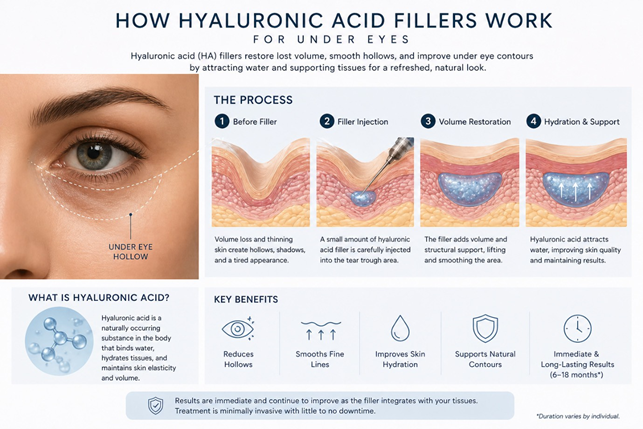
Hyaluronic acid fillers remain the cornerstone of minimally invasive correction when the dominant problem is a true tear trough or infraorbital volume deficit. Their primary action is structural. By occupying space and attracting water, HA can restore volume along the lid-cheek junction, reduce the apparent depth of a hollow and decrease shadowing. The effect is typically visible immediately after treatment, although swelling and settling can influence the early appearance.
The advantages of HA described in the review are practical and well established: predictable rheological behaviour, biocompatibility, immediate contour correction and the availability of hyaluronidase for enzymatic degradation if product needs to be dissolved. In a well-selected patient with a genuine volume deficit, these features can make HA the most direct and effective minimally invasive option.
However, the same mechanism creates its limitations. HA is not a true dermal-regeneration treatment. It may improve hydration and the appearance of the overlying skin indirectly, but it does not primarily target the biological processes responsible for dermal thinning, fine crepiness or loss of elasticity. If a patient has little or no volume deficit, adding filler may be unnecessary and can increase the risk of visible irregularity or puffiness.
The Main Limitations of HA Under the Eyes
- Tyndall effect: superficially placed HA may create a bluish or grey discolouration because the lower-eyelid dermis is extremely thin.
- Malar or lower-eyelid oedema: water attraction and lymphatic compression can lead to prolonged swelling, especially in patients who are already oedema-prone.
- Contour irregularity or overfilling: a small amount of excess product can remain visible in this unforgiving anatomical region.
- Filler migration or late persistence: delayed or chronic contour changes are described in the periorbital filler literature cited by the review.
- Vascular occlusion and visual loss: rare but potentially catastrophic complications can occur because facial arterial pathways communicate with the ophthalmic circulation.
- Limited effect on true skin degeneration: filler can correct a hollow but is not primarily designed to rebuild thin, crepey dermis.
The review stresses an important safety point: the availability of hyaluronidase should not be interpreted as a reason to treat the region casually. Reversibility is a management tool after a complication or unsatisfactory result; it does not eliminate the need for strict patient selection, anatomical knowledge and procedural caution.
Polynucleotides : A Different Treatment Philosophy
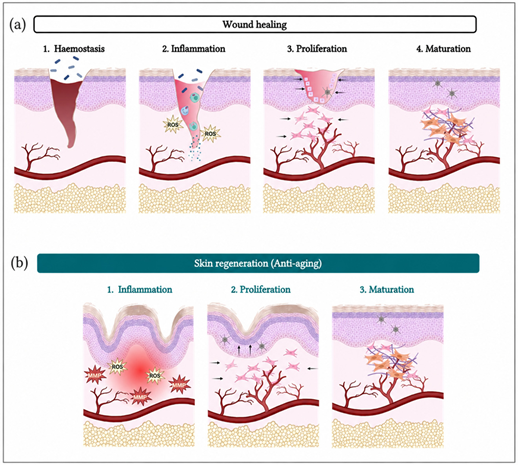
Polynucleotides represent a regenerative rather than primarily volumetric approach. The review describes PN, commonly including PDRN-based preparations, as biologically active molecules intended to modulate tissue repair and dermal quality. Their proposed actions include activation of adenosine A2A receptor pathways, fibroblast stimulation, increased collagen synthesis, elastin production, angiogenesis, anti-inflammatory effects and support of nucleotide salvage pathways.
The clinical goal is therefore different from that of a filler. PN is used to improve the quality of the tissue itself: hydration, elasticity, fine rhytids, crepiness and texture. Changes appear gradually rather than immediately, and the aesthetic effect is generally subtle rather than strongly volumising. In the under-eye region, this may be an advantage when adding volume would be undesirable.
The review is also careful not to overstate the science. Many of the proposed regenerative pathways are strongly supported by laboratory and preclinical research, but the direct link between each molecular mechanism and the magnitude of visible clinical improvement is not yet fully established. Current clinical evidence supports real but generally moderate improvements in skin-quality parameters rather than dramatic structural transformation.
What Polynucleotides Can and Cannot Do
PN appears most relevant when the dominant problem is dermal rather than structural: thin skin, fine lines, crepiness, reduced elasticity, reduced hydration, textural deterioration or early ageing changes. The review also notes that the low volumetric impact of PN can be attractive in patients who are prone to oedema or who want a subtle result without obvious filling.
What PN cannot do is equally important. It does not provide the same structural support as cross-linked HA filler and therefore should not be expected to correct a moderate or severe tear trough caused by genuine volume deficiency. A patient with a deep hollow may notice better skin quality after PN while the hollow itself remains. This is not treatment failure; it reflects a mismatch between the mechanism and the problem.
PN also requires time and usually a course of treatment rather than a single instant correction. The review discusses protocols commonly involving multiple sessions and later maintenance, while also noting that optimal long-term intervals are not yet standardised. Patients choosing PN should therefore understand that the goal is progressive tissue improvement rather than same-day contour replacement.

HA Filler vs Polynucleotides: Side-by-Side Comparison
| Feature | Hyaluronic Acid Filler | Polynucleotides (PN/PDRN) |
|---|---|---|
| Primary role | Structural correction / volume restoration | Dermal quality / regenerative support |
| Best suited to | Clear tear trough hollowing or contour deficiency | Thin, crepey, early-ageing or texture-dominant skin |
| Onset | Immediate visible contour change | Gradual improvement over weeks |
| Volume effect | Meaningful; product occupies space and attracts water | Low; not intended for major volumisation |
| Skin quality | Indirect or limited primary effect | More consistent improvements in hydration, elasticity and fine rhytids |
| Oedema concern | Higher concern in oedema-prone anatomy because of hydrophilicity and lymphatic compression | Generally lower volumetric burden; still causes temporary injection-site swelling |
| Tyndall effect | Recognised risk if HA is superficial | Not a typical Tyndall-type filler complication in the reviewed PN literature |
| Reversibility | HA can be degraded with hyaluronidase | No equivalent enzyme-based reversal described in the source review |
| Serious vascular risk | Rare but potentially vision-threatening vascular occlusion is documented for facial HA injections | No serious PN-attributed events reported in the reviewed data, although long-term periorbital evidence is still limited |
| Typical strategy | Use conservatively for a real structural deficit | Use for skin-quality improvement; may complement HA in mixed presentations |
What Does the Direct Comparative Evidence Show?
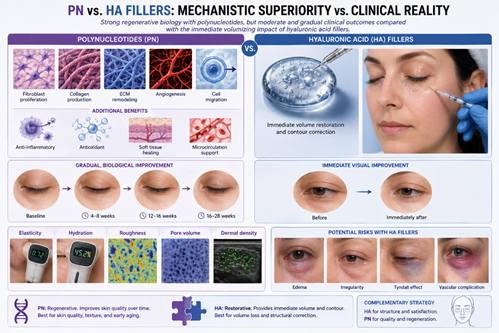
A key study discussed in the review is a randomised, double-blind, split-face trial comparing polynucleotide filler with non-crosslinked hyaluronic acid for periocular rejuvenation. The review reports that the two treatments produced similar improvements in overall visual analogue and global aesthetic scores, while objective measurements tended to favour PN for elasticity, hydration, surface roughness and pore volume over time.
This finding is valuable because it challenges two simplistic claims. First, PN is not proven to be globally superior to HA just because its regenerative biology is attractive. Second, HA is not automatically superior simply because its effect is more visible immediately. In the direct periocular comparison, overall aesthetic improvement was similar, while the pattern of improvement differed: HA emphasised contour and volume, whereas PN showed stronger skin-quality metrics.
The review also cites a periocular PN study showing approximately 37–39% improvement in lateral canthal lines at 16–28 weeks with maintained hydration gains and no major adverse events. By contrast, large HA infraorbital trials report high GAIS response rates, often in the 80–90%+ range during the first months, with results sustained in many patients for 6–12 months or longer. These datasets are not directly interchangeable because the products, indications, outcomes and study designs differ, but they illustrate the characteristic response trajectories of each treatment.
Mechanistic Superiority Does Not Automatically Mean Better Clinical Results
Regenerative medicine is attractive because it targets biological pathways rather than simply filling space. PN demonstrates fibroblast stimulation, collagen production, extracellular-matrix remodelling, angiogenesis and anti-inflammatory activity in experimental systems. Yet the source review warns against assuming that a stronger mechanistic story automatically produces a superior cosmetic result.
Clinical improvement with PN is usually moderate and gradual. HA, although biologically simpler as a structural filler, can create a much more obvious same-day change when the problem is a true hollow. The question is therefore not which product has the more sophisticated mechanism, but which mechanism matches the patient’s anatomy and treatment goal.
Safety: PN vs HA in the Periorbital Area
Both treatments can cause short-term injection-site reactions such as redness, swelling, bruising or discomfort. The difference is that HA has an additional group of product- and anatomy-related complications associated with volume, hydrophilicity and vascular injection risk, whereas the PN evidence reviewed to date is dominated by transient local reactions.
| Safety issue | HA filler | PN |
|---|---|---|
| Transient swelling / redness / bruising | Common injection-related effects | Common injection-related effects |
| Persistent malar / lower-eyelid oedema | Well documented; can be delayed and difficult to manage | Not reported as a characteristic persistent PN complication in the reviewed studies |
| Tyndall / blue-grey discoloration | Recognised HA complication, especially with superficial placement | Not described as a typical PN complication in the review |
| Contour irregularity / migration | Documented, including delayed presentations | Not a major pattern in the reviewed PN data |
| Vascular occlusion / visual loss | Rare but potentially catastrophic; documented after facial HA injection | No serious PN-attributed vascular event reported in the review, but evidence base is smaller |
| Long-term evidence | Substantial clinical experience and larger datasets, including delayed-complication literature | Growing evidence, but long-term periorbital safety data remain relatively sparse |
One long-term HA study cited in the review reported malar oedema in 11%, blue-grey dyschromia in 31.3% and contour irregularities in 30.5% of 147 patients, with most events classified as mild. These numbers should not be interpreted as universal complication rates for every modern filler, technique or patient; they come from a specific cohort and are included here because they demonstrate that delayed under-eye filler issues are clinically real and can emerge long after the injection.
The PN evidence is reassuring but smaller. A systematic review of 219 PN-treated patients found adverse effects to be generally mild and transient with no serious complications reported. Real-world datasets and periorbital case series cited by the review similarly describe temporary swelling, bruising, burning or discomfort without the same pattern of persistent oedema, Tyndall-like discolouration or nodules. The limitation is that smaller datasets can miss rare events, so “no serious events reported so far” is not the same as “serious events are impossible.”
Who Is More Suitable for HA Filler?
- A patient with a clear tear trough or infraorbital hollow caused predominantly by structural volume loss.
- A patient in whom the lid-cheek transition can be improved by carefully restoring volume rather than by treating skin quality alone.
- A patient without a strong tendency to chronic lower-eyelid or malar oedema.
- A patient whose skin and anatomy allow a conservative, well-placed filler correction without obvious risk of superficial visibility.
- A patient who understands that HA provides rapid contour change but can also persist longer than expected and may require hyaluronidase if an unsatisfactory or delayed complication occurs.
The review also references treatment algorithms that emphasise strict selection, attention to skin quality and vector, assessment of oedema tendency, conservative product volumes and consideration of midface support before directly filling the tear trough. The exact injection plan is a clinical decision and should not be reduced to a universal volume or one fixed technique.
Who Is More Suitable for Polynucleotides?
- A patient whose main complaint is thin, crepey or early-ageing under-eye skin rather than a deep structural hollow.
- A patient seeking gradual, subtle improvement in texture, hydration and fine lines without obvious volumisation.
- A patient with delicate or oedema-prone tissue in whom additional HA volume may be undesirable.
- A patient who accepts a course of treatment and delayed improvement rather than expecting an immediate filler-like change.
- A patient with mild mixed ageing changes who may benefit from PN as a priming or refining treatment within a staged multimodal plan.
PN is not a substitute for surgery in patients with significant lower-eyelid fat prolapse, major skin excess or a structural problem beyond the capacity of an injectable skin-quality treatment. The source review is focused on injectable periorbital rejuvenation and does not claim that either PN or HA can solve every anatomical cause of under-eye ageing.
When a Combination Approach Makes More Sense
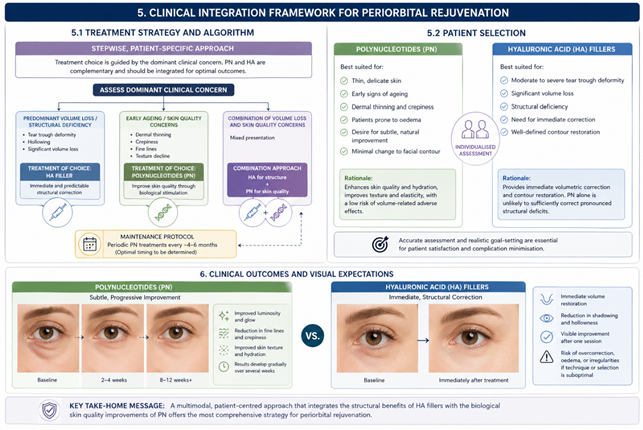
The most common real-world presentation is mixed: some degree of structural hollowing coexists with thin skin, fine rhytids or textural decline. In this situation, the review supports a multimodal strategy rather than forcing one injectable to do two different jobs. HA can restore the missing contour, while PN can address the quality of the overlying tissue.
The sequence should be individualised. The review discusses PN “priming” paradigms in which regenerative sessions are performed before filler, as well as staged combination approaches in which structural support and skin-quality refinement are planned separately. It also cites expert guidance suggesting multiple PN sessions at short intervals followed by maintenance, while acknowledging that the ideal long-term protocol remains undefined.
The safest message is that combination therapy should not mean “more product.” It means matching each modality to the component it is best equipped to treat and using the minimum intervention needed to reach the patient’s goal.
A Patient-Centred Treatment Algorithm
- Identify the dominant concern: true hollow/volume loss, thin crepey skin, oedema/puffiness, or a mixed pattern.
- Assess whether the problem is genuinely injectable. Significant orbital fat prolapse, skin excess or festooning may require a different treatment pathway.
- If structural deficiency dominates and the anatomy is suitable, consider conservative HA-based contour correction.
- If dermal quality dominates with little volume loss, consider PN-focused skin rejuvenation.
- If both structure and dermal quality are relevant, consider a staged combination rather than overfilling with HA or expecting PN to create volume
- Reassess after tissue settling before adding more treatment. In the under-eye region, restraint is often more important than aggressive correction.
Common Treatment Mismatches to Avoid
1. Using filler when the main problem is skin quality
If the under-eye looks crepey, thin or finely wrinkled but is not actually hollow, adding volume can create puffiness without solving the primary complaint. PN may be more aligned with the treatment goal in this presentation.
2. Using PN when the main problem is a deep tear trough
PN may improve skin quality over the hollow but cannot provide the same structural correction as HA. Patients should not be promised filler-like volume from a regenerative injectable.
3. Ignoring pre-existing oedema
The source review repeatedly highlights the importance of lymphatic drainage and fluid dynamics. Patients with puffiness or malar oedema require particular caution with hydrophilic HA because a technically correct injection can still produce an aesthetically poor result in an unfavourable fluid environment.
4. Treating every dark circle as a volume problem
“Dark circles” can be influenced by shadowing from a hollow, skin translucency, visible vasculature, pigmentation and fluid-related changes. HA may improve shadowing when a contour deficit is present, but neither HA nor PN should be presented as a universal treatment for all causes of pigmentation or discoloration.
5. Chasing perfection with repeated under-eye filling
The periorbital region tolerates very little unnecessary volume. More product does not necessarily produce a smoother result. Delayed oedema, visible filler and contour irregularity are all reasons to favour conservative correction and reassessment over repeated filling.
How Fast Do Results Appear ?
HA filler typically produces an immediate contour change because the mechanism is physical volume restoration. The early appearance can still be influenced by swelling, hydration and product settling. The review summarises studies in which aesthetic responses remained evident for several months, with many HA datasets reporting durability through 6–12 months and some reports extending longer depending on product and patient factors.
PN follows a different timeline. Its visible effects develop progressively as dermal quality improves. Studies discussed in the review evaluate changes over weeks to months, including later follow-up points around 16–28 weeks for wrinkle outcomes. Maintenance is commonly discussed because the regenerative effect is not a one-time permanent structural correction.
This timeline difference is important for expectation management: a patient choosing PN should not judge the treatment by the mirror immediately after injection, while a patient choosing HA should understand that an immediate contour improvement does not automatically predict the long-term fluid behaviour of the product.
How Long Do Results Last ?
The review does not support one universal duration for either modality. HA longevity varies with product characteristics, treatment plane, volume, tissue movement and patient factors; the literature cited in the review includes results sustained for 6–18 months in many studies. PN durability is less clearly standardised because products, concentrations and protocols vary, and long-term comparative data beyond 12 months remain limited.
For PN, the more clinically honest concept is “treatment course plus maintenance” rather than a guaranteed fixed duration. The review explicitly identifies the lack of long-term standardisation as one of the main research gaps. For HA, the similarly honest message is that persistence can sometimes be longer than the patient expects, which is relevant when discussing both benefits and delayed complications.
What About Fine Lines and Crepey Skin ?
Fine rhytids, crepiness and loss of elasticity are the areas where PN is most differentiated from a purely volumetric filler. The review reports consistent improvements in skin-quality parameters such as hydration, elasticity, surface roughness and wrinkle severity across several PN studies. These changes are generally progressive and modest rather than dramatic.
HA can sometimes make the skin look smoother by supporting the tissue from beneath and attracting water, but this is not the same mechanism as regenerative dermal remodelling. If the patient has good volume but poor skin quality, the review’s framework favours a treatment that targets the tissue rather than adding unnecessary volume.
What About Puffiness and Malar Oedema ?
Puffiness is one of the most important reasons not to treat the under-eye area based on a photograph alone. The review explains that superficial lymphatic channels can be compressed by filler material and that HA’s hydrophilic behaviour can worsen fluid retention. Persistent or late lower-eyelid and malar oedema is well documented in the HA literature and may occur weeks, months or even years after treatment.
PN does not carry the same volumetric water-attraction profile, and current PN studies mainly report temporary injection-related swelling. For an oedema-prone patient whose primary concern is skin quality, PN may therefore be more logical than HA. If the patient has both oedema tendency and a deep hollow, the problem becomes more complex and may not have a simple injectable answer.
What About Tyndall Effect?
The Tyndall effect is a bluish or grey appearance caused by light scattering when HA is too superficial or visible through thin skin. Because the lower eyelid dermis is particularly thin, this region is especially vulnerable. The review treats Tyndall effect as a well-recognised limitation of HA and one of the reasons product selection and injection depth are critical.
PN does not function as a cross-linked volumising gel and the reviewed PN literature does not show the same characteristic Tyndall pattern. This does not mean PN injections cannot bruise or temporarily swell; it means the mechanism and complication profile are different.
Which Treatment Gives a More Natural Result?
“Natural” depends on the problem being treated. A precisely corrected tear trough with a conservative amount of HA can look extremely natural because it restores a missing contour. PN can look natural for a different reason: the change develops gradually and does not rely on obvious volume. Neither modality is inherently natural or unnatural; poor patient selection and overtreatment are the greater risks.
The source review aligns PN with the contemporary preference for subtle, biologically harmonious skin-quality improvement, but it does not claim that PN should replace HA when structural volume loss is the main problem. Natural-looking rejuvenation is more likely when the treatment mechanism matches the anatomy.
Decision Matrix : Which Direction Fits the Main Concern?
| Dominant concern | Most evidence-aligned injectable direction | Clinical note |
|---|---|---|
| Deep tear trough / true hollow | HA usually has the clearer role | PN alone is unlikely to provide enough structural correction |
| Thin crepey skin with little hollowing | PN may be aligned with the problem | Avoid adding volume simply to treat skin texture |
| Fine lines and reduced elasticity | PN may offer more targeted skin-quality improvement | HA may improve appearance indirectly but is not a primary regenerative treatment |
| Oedema-prone lower eyelid | PN may be preferable when treatment is otherwise appropriate | HA requires particular caution because of hydrophilicity and lymphatic compression |
| Mixed hollow + poor skin quality | Staged HA + PN can be considered | Use each treatment for its strongest indication |
| Significant orbital fat prolapse or festoons | Neither injectable should automatically be considered the answer | Requires a broader anatomical assessment and potentially a different treatment category |
