
Quick Answer
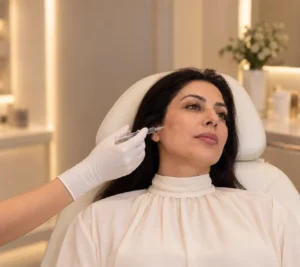
RF microneedling (radiofrequency microneedling) combines mechanical microneedling with radiofrequency energy. Each needle creates a controlled dermal injury while RF energy forms small thermal treatment zones beneath the skin, stimulating wound healing and collagen remodeling.
A 2020 clinical review supports RF microneedling as a useful treatment for acne scars, active acne, skin laxity and facial rejuvenation, with additional reported uses including hyperhidrosis, large pores, rosacea (in combination protocols), cellulite and stretch marks.
Most acne-scar patients need more than one session, and full results are often best seen months after the final treatment.
The key clinical advantage of RF microneedling is depth control. The epidermis does not have to receive the same thermal dose as the dermis, especially when coated (insulated) needles are used. This makes the treatment particularly useful when the goal is dermal remodeling with less surface downtime than fully ablative scar treatments.
What Is Radiofrequency Microneedling?
Microneedling has been used as a collagen-induction technique for decades. Sterile microneedles puncture the skin and trigger a wound-healing cascade involving growth factors such as TGF-alpha, TGF-beta and platelet-derived growth factor.
Radiofrequency microneedling adds controlled electrical energy to this process. Each needle delivers RF current into the tissue, creating small thermal treatment zones in addition to the mechanical channels. The result is a combination of collagen-induction injury and thermal remodeling.
Why Add Radiofrequency to Microneedling?
Preclinical evidence described in the review shows that adding radiofrequency to microneedling can increase collagen type I, collagen type III and elastic fibers compared with microneedling alone. Clinically, the purpose is to create a stronger and more depth-specific remodeling response.
| Treatment Component | Biological Role |
|---|---|
| Microneedle penetration | Creates controlled dermal injury and initiates wound healing |
| RF current | Creates localized thermal zones around the needle path |
| Growth-factor signaling | Supports the healing cascade and neocollagenesis |
| Collagen / elastin remodeling | Supports improvement in scars, texture and laxity over time |
| Adjustable depth | Allows treatment to be adapted to scar depth, anatomy and indication |
Who Is a Good Candidate for RF Microneedling?
The review describes ideal patients broadly as adults around 30 to 60 years old with mild-to-moderate skin laxity, rhytides, acne scars or other appropriate indications. Age alone is not the deciding factor. The more important variables are the condition being treated, skin type, scar pattern, laxity and realistic expectations.
- Atrophic acne scars
- Active acne, when RF microneedling is selected as part of an acne treatment plan
- Mild-to-moderate facial skin laxity
- Fine lines, rhytides and photoaging
- Patients seeking dermal remodeling with less downtime than fully ablative resurfacing
- Selected darker skin types when needle coating, depth and energy are planned appropriately
When Expectations Need to Be Adjusted
RF microneedling can achieve considerable rejuvenation without surgical downtime, but it does not replace the structural effect of a facelift in moderate facial aging. Patients should understand whether the goal is scar remodeling, texture improvement, skin tightening or a combination.
Coated vs. Uncoated Microneedles
RF microneedling tips may use coated (insulated) or uncoated (non-insulated) needles. With coated tips, the thermal zone is concentrated deeper in the tissue and does not directly heat the epidermis along the full needle shaft.
The review considers coated tips safer in darker skin types because energy remains below the epidermis and away from the basal layer containing melanocytes. That does not eliminate pigment risk completely. Post-inflammatory dyspigmentation can still occur, so treatment selection remains important.
| Feature | Coated / Insulated Needle | Uncoated / Non-insulated Needle |
|---|---|---|
| RF delivery | Concentrated at exposed needle segment / tip | Energy can be delivered along more of the needle surface |
| Epidermal thermal exposure | Reduced | Potentially greater |
| Common rationale | Depth-focused thermal treatment | Broader tissue interaction depending on device |
| Darker skin | Often preferred in the review | Can still be used in selected protocols, but pigment risk requires attention |
Preparation Before RF Microneedling
Patient selection, photography, skin preparation and post-procedure follow-up are not administrative extras. They affect safety and your ability to judge whether treatment is actually working.
- Standardized pre-procedure photographs from the front and both angled side views
- Removal of all makeup before photography and treatment
- Thorough skin cleansing with an appropriate antiseptic such as 70% alcohol or chlorhexidine in the reviewed protocol
- Individualized topical skin-care planning before and after treatment when appropriate
- Consideration of antiviral medication in patients with a relevant clinical history
- Consideration of oral antibiotics in selected patients with active acne lesions
- A comfort plan using topical anesthesia, nerve blocks or local anesthetic when clinically appropriate
Adjunctive Skin-Care and PRP Strategies
The review discusses several adjuncts. A topical tri- and hexapeptide serum used before and after RF microneedling was associated with enhanced results in one cited study. Another pre- and post-treatment moisturizer regimen improved radiance, texture, tone, smoothness, redness and overall appearance after one full-face treatment.
RF Microneedling for Active Acne and Acne Scars
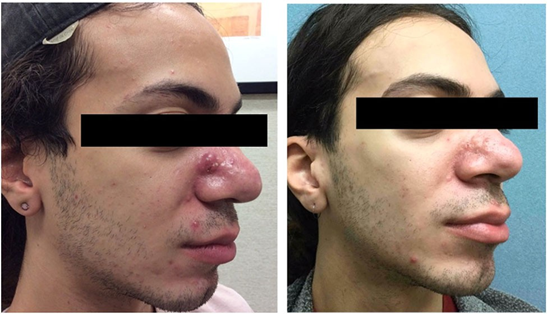
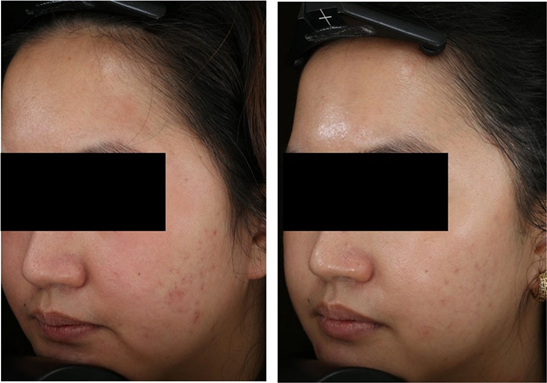
Acne and acne scars are among the strongest indications discussed in the review. RF microneedling was described as safe and effective across skin types, with substantially less downtime than fully ablative acne-scar treatments. Two or more sessions are typically necessary for full results.
Clinical studies summarized in the review reported improvement in inflammatory acne, acne scars and sebum production. That means RF microneedling may address both active disease and residual textural scarring in selected treatment plans, although acne control should still be individualized.
How Strong Is the Acne-Scar Evidence?
The review summarizes multiple studies rather than relying on a single before-and-after series. A meta-analysis of six studies in Asian patients found fractional RF microneedling superior to fractionated lasers for acne scars. However, another 40-patient comparison found no statistically significant difference between three sessions of RF microneedling and a 1550 nm Er:Glass fractional laser.
This avoids a false “one device always wins” conclusion. RF microneedling is a strong scar-remodeling option, but the best modality depends on scar type, skin type, downtime tolerance and treatment depth.
| Study Signal Summarized in the Review | Outcome |
|---|---|
| 18 Korean patients | Improvement in acne scars / inflammatory acne with RF microneedling |
| Meta-analysis of 6 Asian studies | RF microneedling favored over fractionated lasers for acne scars |
| 40-patient RF microneedling vs 1550 nm Er:Glass study | No statistically significant difference after 3 sessions |
| 19 patients, Fitzpatrick III-V, 3 uncoated-needle sessions | All patients’ acne scars improved at 3 months; no reported post-inflammatory dyspigmentation |
| 20 Indian patients, Fitzpatrick IV-V, 1-3 shallow treatments | Acne scars improved |
| 31 patients, Fitzpatrick III-V, 4 treatments | Significant acne-scar improvement |
RF Microneedling in Darker Skin Types
One major advantage of RF microneedling is the ability to place the primary thermal effect below the epidermis. The review specifically discusses successful acne-scar treatment in Fitzpatrick III-V skin and describes coated needles as a way to reduce epidermal energy exposure.
At the same time, darker skin still has a higher risk of post-inflammatory dyspigmentation after inflammatory or energy-based procedures. Depth, coating, energy, number of passes and post-treatment inflammation all remain important.
RF Microneedling for Facial Rejuvenation and Skin Laxity
Beyond acne scarring, the review describes RF microneedling as a minimal-downtime approach to facial rejuvenation. Reported goals include improvement in rhytides, texture, skin laxity and overall appearance.
Combination protocols were also discussed, including RF microneedling with a 1927 nm thulium fractional laser, and RF microneedling followed by a topical growth-factor/cytokine medium. The aim of these combinations is to address more than one component of photoaging rather than relying on a single device.
Skin Tightening and Jowls
Skin laxity is one of the core indications described in the review. The authors note that jowls are a common and difficult concern and discuss adjustable-depth fractional RF in combination treatment approaches.
The review also summarizes improvement in thigh laxity after weight loss, and improvement in wrinkles, texture and laxity of the upper chest after three 2-mm RF microneedling sessions.

Other Applications of RF Microneedling
The review goes well beyond acne scars. Some of these indications are supported by small clinical studies or combination protocols rather than large definitive trials, so they should be read with appropriate context.
| Indication | Evidence Signal Summarized in the Review |
|---|---|
| Axillary hyperhidrosis | 20-patient study with 2 sessions showed reduced sweat severity; another 45-patient multicenter experience reported 75-80% improvement after 3 treatments |
| Large facial pores | 30-patient study: pore size decreased in 70% after one session |
| Papulopustular rosacea | 25-patient combination protocol using RF microneedling + PDL + low-dose isotretinoin improved papules/pustules and redness |
| Nevus comedonicus | Case report: 4 sessions produced significant improvement |
| Cellulite / buttock laxity | Small studies reported improvement after deep bipolar RF microneedling |
| Posterolateral thigh cellulite | 50-subject study: 93% improved at 6 months; 75% satisfied |
| Striae (stretch marks) | Clinical images and case experience show improvement in stretch marks and laxity |
Important: How to Read Combination Studies
When RF microneedling is combined with pulsed-dye laser, isotretinoin, thulium laser, growth factors or another RF platform, the final result cannot be attributed to RF microneedling alone. Combination studies are useful for treatment planning, but they are not proof that RF microneedling by itself produced the entire outcome.
How Many RF Microneedling Sessions Are Needed?
There is no single session number for every indication. For acne and acne scars, two or more sessions are typically needed for full results. Studies in the review range from one treatment to four or more, depending on the condition.
The full result is often not appreciated until months after the final treatment. This is consistent with the biology of collagen remodeling: the treatment happens on the day of the procedure, while tissue reorganization continues afterward.
| Timeline | What to Expect |
|---|---|
| Immediately after treatment | Redness, swelling and itching may occur |
| First several hours | Expected inflammatory effects usually begin to settle |
| Following days | Visible surface recovery progresses while deeper remodeling continues |
| After a series of sessions | Texture and scar changes become easier to assess |
| Following months | Final improvement may not be fully appreciated until months after the last treatment |
RF Microneedling Side Effects and Complications
The expected short-term side effects are temporary erythema (redness), edema (swelling) and itching, which typically last a few hours after treatment.
The review also mentions uncommon reported events: one case of temporary greater auricular nerve paresthesia and one case of a rosacea flare after three facial-rejuvenation sessions. Post-inflammatory dyspigmentation is another consideration, particularly in darker skin tones.
| Effect / Complication | How the Review Describes It |
|---|---|
| Erythema | Expected, temporary |
| Edema | Expected, temporary |
| Itching | Expected, temporary |
| Post-inflammatory dyspigmentation | Risk is higher in darker skin; treatment strategy matters |
| Temporary greater auricular nerve paresthesia | Single case report mentioned |
| Rosacea flare | Case report after three RF microneedling rejuvenation sessions |
Does Coated-Needle RF Microneedling Eliminate Pigmentation Risk?
No. Coated tips reduce direct epidermal RF exposure and were favored for darker Fitzpatrick types in the review, but darker skin can still develop post-inflammatory dyspigmentation. Needle type is only one part of safe treatment planning.
RF Microneedling vs. Other Treatments
RF Microneedling vs. Standard Microneedling
Both techniques create controlled micro-injury and stimulate a wound-healing cascade. RF microneedling adds thermal energy around the needles, creating additional dermal treatment zones and a more energy-based remodeling effect.
RF Microneedling vs. Fractional Laser for Acne Scars
The evidence does not support a simplistic winner. A meta-analysis favored RF microneedling over fractionated lasers in Asian acne-scar patients, while a direct study against 1550 nm Er:Glass found no statistically significant difference after three treatments. The practical choice should consider skin type, scar morphology, pigment risk, downtime, and whether the treatment also needs to address active acne or laxity.
RF Microneedling vs. Facelift for Laxity
The review explicitly states that the gold standard for moderate facial aging remains a facelift. RF microneedling can produce meaningful rejuvenation with less surgical risk and downtime, but it should not be presented as a replacement for surgery when major tissue repositioning is required.
Where Does Secret RF Fit?
Secret RF is one of the platforms specifically listed in the device section of the 2020 review. The comparison described adjustable depths from 0.5 to 3.5 mm, coated and uncoated needle options, and 25- or 64-needle tips, with the 64-needle option described as coated.
For patients, the more important question is not whether the treatment is called Secret RF, Genius, Fractora or another brand. Outcome and safety depend on needle depth, coating, energy, pulse duration, pass pattern, indication, skin type and operator technique.
RF Microneedling in Abu Dhabi: What to Ask Before Treatment
If you are considering RF microneedling in Abu Dhabi, ask for a treatment plan built around your diagnosis rather than a fixed device package. Questions worth asking at your consultation:
- Is my main concern active acne, acne scars, pores, texture, laxity or a combination?
- What acne-scar types do I have, and will all of them respond to RF microneedling alone?
- Will coated or uncoated needles be used, and why is that choice right for my skin type?
- What needle depth is planned for each region?
- How many sessions are realistic for my indication?
- What downtime and pigment risk should I expect with my Fitzpatrick skin type?
- Will the treatment be combined with another modality, and what is each treatment meant to address?
- When will standardized follow-up photographs be taken to assess the true response?
A strong consultation should be especially careful with patients who have active inflammatory acne, darker skin types, a history of pigmentation problems, or expectations of surgical-level lifting.
Frequently Asked Questions About RF Microneedling
What is radiofrequency microneedling?
It is microneedling combined with RF energy. The needles create controlled dermal channels while radiofrequency creates thermal treatment zones around the needle path.
How is RF microneedling different from regular microneedling?
Regular microneedling relies on mechanical injury. RF microneedling adds controlled thermal energy for a deeper, energy-based remodeling response.
Does RF microneedling help acne scars?
Yes. Acne scars are one of the main indications supported in the review, with multiple clinical studies showing improvement.
How many sessions are needed for acne scars?
Two or more sessions are typically needed for full results, although the exact number depends on scar type and treatment settings.
Can RF microneedling treat active acne?
The review summarizes studies showing improvement in active acne lesions and decreased sebum production.
Is RF microneedling safe for darker skin?
It can be used successfully in darker skin types, but pigment risk remains important. Coated tips are often favored because they reduce direct epidermal RF exposure.
What are coated needles?
They are insulated along part of the needle so RF energy is concentrated deeper rather than heating the epidermis along the full shaft.
What are uncoated needles?
They can deliver RF energy along more of the needle surface. They may be appropriate in selected protocols but create a different tissue interaction.
How deep can RF microneedling go?
Depth depends on the platform. Devices in the 2020 review ranged from approximately 0.5 mm to more than 5 mm in specialized subcutaneous systems.
Does Secret RF treat acne scars?
Secret RF is one of the adjustable-depth RF microneedling platforms listed in the review. The paper supports RF microneedling as a treatment category for acne scars rather than providing a separate Secret RF acne-scar trial.
Does RF microneedling tighten skin?
Yes. Skin laxity and rejuvenation are among the main indications described in the review.
Can RF microneedling improve jowls?
The review discusses jowls as a difficult laxity concern and includes adjustable-depth RF approaches, but RF microneedling does not reproduce the structural repositioning of a facelift.
Does RF microneedling improve pores?
A 30-patient study summarized in the review reported decreased pore size in 70% of patients after one treatment.
Can RF microneedling treat hyperhidrosis?
The review summarizes axillary hyperhidrosis studies showing reduced sweat severity after RF microneedling protocols.
Can RF microneedling treat rosacea?
A combination protocol using RF microneedling with pulsed-dye laser and low-dose isotretinoin improved papulopustular rosacea. That result cannot be attributed to RF microneedling alone.
Can RF microneedling treat cellulite?
Deep bipolar RF microneedling has been studied for cellulite and skin laxity in small clinical studies summarized in the review.
What are the common side effects?
Temporary redness, swelling and itching are the expected short-term effects described in the review.
How long does redness last?
Expected erythema, edema and itching generally last for a few hours, although individual recovery can vary.
Can RF microneedling cause pigmentation?
Post-inflammatory dyspigmentation is a recognized risk, especially in darker skin types.
Can RF microneedling cause nerve symptoms?
The review cites one case report of temporary greater auricular nerve paresthesia.
Can RF microneedling trigger rosacea?
The review cites one reported rosacea flare after three RF microneedling rejuvenation sessions.
When will I see the final result?
Full results are often not appreciated until months after the final treatment.
Is one session enough?
It depends on the indication. Acne-scar treatment usually requires multiple sessions; some other indications have been studied after a single session.
Should photographs be taken before treatment?
Yes. The review strongly recommends standardized baseline and follow-up photography to evaluate improvement accurately.
Can PRP be used after RF microneedling?
The authors describe using PRP after RF microneedling in their practice and report that patients find it soothing. Topical treatment channels have also been studied.
Can RF microneedling replace a facelift?
No. The facelift remains the gold standard for moderate facial aging, although RF microneedling can provide rejuvenation with less downtime and surgical risk.