
Non-insulated RF microneedling was tested in a multicenter clinical study using smooth-motion radiofrequency for facial wrinkles, skin tightening and lifting. Forty-nine patients completed three monthly treatments and were followed for three months after the last session.
Key Takeaways
- Wrinkle severity improved significantly (P < 0.001).
- All patients were rated as improved on the Global Aesthetic Improvement Scale (GAIS).
- 65% reached the study’s “significant improvement” categories (GAIS 3–5).
- Mild-to-moderate redness and swelling lasted up to about 12 hours.
- Average treatment pain was 4/10.
- The investigators reported no post-inflammatory hyperpigmentation, epidermal burns or scarring.
Why RF Microneedling Was Studied for Facial Aging
Facial aging is driven by both intrinsic aging and external factors such as cumulative sun exposure. Traditional resurfacing methods can improve wrinkles and texture, but deeper or more aggressive resurfacing may require longer recovery and can increase the risk of pigmentary change in susceptible skin types.
The rationale for fractional RF is different from chromophore-dependent laser treatment. Radiofrequency is not dependent on a specific pigment target and can deliver heat into the dermis and hypodermis. The study describes microneedle RF as an evolution of fractional RF that places the electrodes directly into the skin, allowing treatment at depths up to 3.5 mm.
Fractional CO₂ vs. RF: Why Skin Type Matters
The source notes that fractional CO₂ resurfacing can be effective but has been associated with post-inflammatory hyperpigmentation or hypopigmentation, particularly in Fitzpatrick III and IV skin. The study authors highlight RF as a chromophore-independent alternative with a lower epidermal thermal burden.
How Can Non-Insulated Needles Heat the Dermis Without Coagulating the Epidermis?
This is the key technical idea in the study. The authors describe a difference in electrical impedance between the relatively dry epidermis and the wetter dermis. RF current follows the lower-impedance pathway, which helps direct energy into deeper dermal tissue after insertion.
The non-insulated needles emit RF along most of their length, except for the upper portion in contact with the epidermis. The authors proposed two practical advantages: deeper volumetric coagulation without separate superficial and deep passes, and minimal treatment bleeding because the thermal effect produces coagulation around the needle paths.
| Non-Insulated Needle Feature | Proposed Clinical Effect |
|---|---|
| RF delivered along most of the inserted needle length | Broad dermal thermal treatment rather than tip-only heating |
| Epidermis has higher impedance than dermis | Helps direct RF current toward deeper tissue |
| No separate deep/superficial passes required | Simplifies multi-depth treatment in the tested system |
| Coagulation around needle channels | Minimal or no treatment bleeding in the study description |
| Minimal epidermal thermal injury | Potentially lower risk of PIH compared with more epidermally destructive treatments |
Who Was Included in the Multicenter Trial?
Fifty-three subjects were enrolled across four centers – three in the United States and one in Japan. Four participants dropped out for reasons unrelated to treatment. Forty-nine patients completed the full treatment and follow-up protocol.
| Study Characteristic | Value |
|---|---|
| Completed study | 49 patients |
| Sex | 46 female, 3 male |
| Age range | 39–63 years |
| Average age | 53.0 ± 5.6 years |
| Fitzpatrick skin types | II–IV |
| Treatment centers | 4 total: 3 USA, 1 Japan |
| Treatments | 3 sessions |
| Interval | 1 month between sessions |
| Formal follow-up | 1 month and 3 months after the third treatment |
Key Exclusion Criteria
- Heart disorders.
- Medical or hormonal medications affecting the skin.
- Pregnancy or breastfeeding.
- History of keloids.
- Skin lesions in the treatment area.
- Clotting disorders.
- Aesthetic treatment within three months before the study.
- Plans for another invasive or non-invasive skin treatment in the study area during the trial.
What Areas Were Treated?
Every patient had both cheeks, the area under the jaw and the neck treated. This makes the study particularly relevant to patients concerned with lower-face laxity, jawline definition and neck aging rather than only superficial wrinkles.
Anesthesia and Aftercare in the Trial
Topical anesthetic was used. Intravenous anesthesia and contact cooling were not required. Post-treatment care consisted of a soothing cream, and participants were encouraged to use high-SPF sunscreen throughout the study together with their normal skin-care routine.
Recovery: What Did the Skin Look Like Immediately After Treatment?
The study documented mild-to-moderate erythema and edema immediately after treatment. These effects resolved within approximately 12 hours in the reported cohort.
How Painful Was the Treatment?
Average treatment pain was 4/10 across the treatment sessions, which the investigators categorized as mild to moderate.
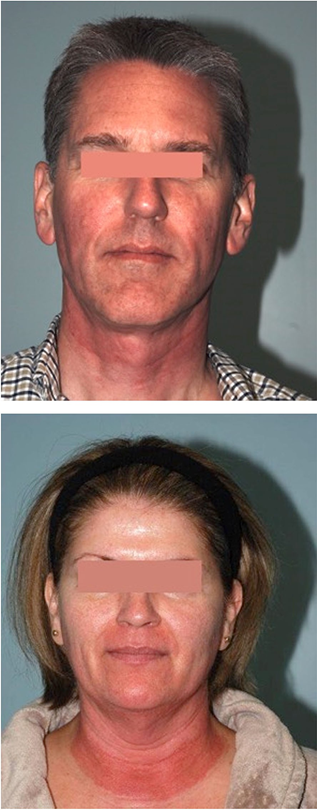
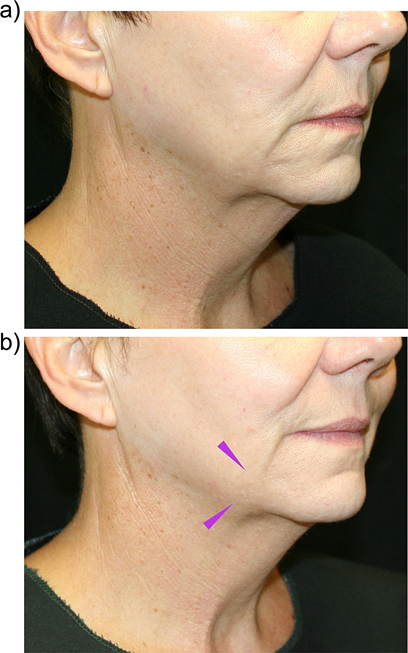
Clinical Lifting and Contour Examples
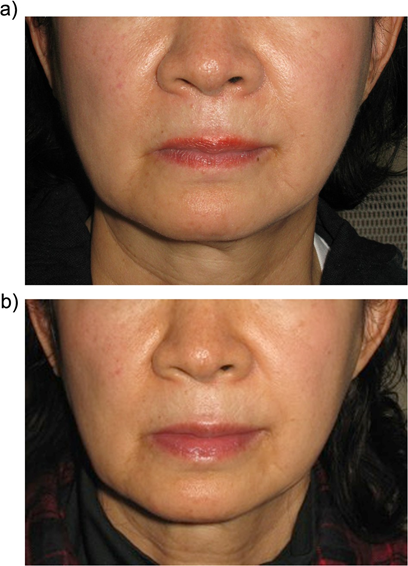
The study includes several standardized before-and-after examples from the four participating centers. They illustrate lower-face and jawline changes after one, two or three treatments, depending on the patient.


Wrinkle Reduction: The Main Objective Result
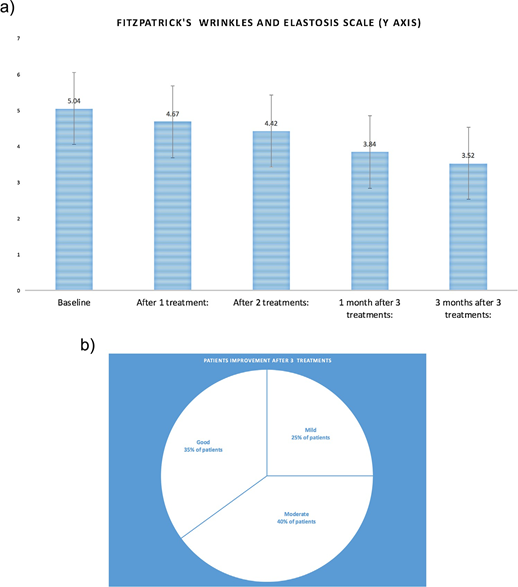
Wrinkle severity was assessed using the Fitzpatrick Wrinkle and Elastosis Scale by blinded dermatologists. Treatment success was defined as a reduction of at least one grade at the final follow-up.
| Time Point | Mean Fitzpatrick Wrinkle Score |
|---|---|
| Baseline | 5.04 ± 1.22 |
| 1 month after 3 treatments | 3.829 ± 1.69 |
| 3 months after 3 treatments | 3.50 ± 1.66 |
The reduction was highly statistically significant (P < 0.001). The average decrease at three months was approximately 1.5 grades, and the score continued to improve between the one-month and three-month visits.
That delayed improvement supports the study’s remodeling hypothesis: RF creates an immediate controlled thermal injury, but the final aesthetic response develops as collagen and elastin remodeling continue over time.
GAIS: How Many Patients Improved?
Improvement was reported in 100% of treated patients on the five-grade Global Aesthetic Improvement Scale. Sixty-five percent of patients were classified in the study’s significant-improvement categories (GAIS 3–5).
Safety Findings
The trial reported no unusual adverse events. Importantly, post-inflammatory hyperpigmentation, epidermal burns and scar formation were not observed during the study.
| Safety / Recovery Endpoint | Study Finding |
|---|---|
| Erythema | Mild to moderate; up to approximately 12 hours |
| Edema | Mild to moderate; up to approximately 12 hours |
| Average pain | 4/10 |
| Post-inflammatory hyperpigmentation | Not observed |
| Epidermal burns | Not observed |
| Scar formation | Not observed |
| Unusual adverse events | None reported |
Why Was PIH Risk Considered Lower?
The discussion explains that histology from previous non-insulated RF studies showed mechanical epidermal disruption from needle penetration but very little thermal damage to the epidermis. The mechanical channels closed rapidly, with no disruption seen at four days in the referenced histology.
The authors proposed that avoiding significant epidermal thermal coagulation reduces injury at the epidermal-dermal junction and may lower the risk of post-inflammatory hyperpigmentation.
Non-Insulated vs. Insulated RF Microneedles
The discussion argues that non-insulated needles may offer an advantage because RF is emitted along most of the needle length rather than only from the needle tip. That allows treatment of a larger dermal column during each insertion.
| Feature | Non-Insulated System in This Study | Typical Insulated Concept |
|---|---|---|
| Energy release | Along most of inserted needle length | Focused at exposed tip / selected segment |
| Depth coverage per insertion | Broader dermal column | More focal depth-specific thermal zone |
| Epidermal protection strategy | Impedance selectivity + untreated upper needle segment | Insulation limits energy delivery along shaft |
| Study conclusion | Effective for wrinkles and lifting | Not directly compared in this trial |
Why Results Can Continue to Improve After the Last Session
The average Fitzpatrick score was better at three months than at one month after the final treatment. The authors linked this to continuing collagen remodeling triggered by the fractional thermal injury.
The discussion also cites previous work showing new collagen, elastin and hyaluronic acid after deep dermal fractional RF injury. This supports the idea that the treatment response is biological and progressive rather than limited to immediate post-treatment contraction.
What Kind of Result Should a Patient Expect?
The study supports measurable wrinkle reduction and visible tightening of the mid and lower face after a three-session series. It does not show surgical-level repositioning, and it does not establish that every patient will achieve the same lifting effect.
- Expect a treatment series rather than a one-time procedure in the protocol studied.
- Expect the final result to continue developing after the last session.
- Expect temporary redness and swelling on the treatment day.
- Understand that the strongest evidence in this paper relates to wrinkles, lower-face tightening and lifting.
- Do not interpret selected before-and-after photographs as a guaranteed result.
How Strong Is the Evidence?
This is stronger than a single-center case series because it was prospective, multicenter, IRB-approved and included 49 completed patients across four international sites. It also used blinded wrinkle scoring and standardized photography. However, it was not a randomized controlled comparison against another tightening device or a sham treatment.
Study Limitations
- No untreated or sham control group.
- No randomized comparison with insulated RF microneedling, laser resurfacing or surgery.
- Follow-up was limited to three months after the final session.
- The cohort was predominantly female.
- Fitzpatrick skin types were II–IV; the results cannot automatically be generalized to every skin type.
- The study evaluated one specific platform and treatment protocol.
What the Study Does Support
The study supports that the tested non-insulated smooth-motion RF microneedling protocol produced statistically significant wrinkle reduction, measurable clinical lifting/tightening, short recovery and a favorable short-term safety profile in Fitzpatrick II–IV patients.
RF Microneedling for Face Lifting in Abu Dhabi: What Patients Should Ask
Patients considering RF microneedling in Abu Dhabi should ask for a plan based on anatomy and treatment objective rather than choosing only by device brand.
- Is my main concern wrinkles, skin laxity, jowls, under-chin tissue or texture?
- Will insulated or non-insulated needles be used, and why?
- What needle depth is planned for the cheeks, jawline and neck?
- How many sessions are realistic for my degree of laxity?
- How will pain be managed during treatment?
- What downtime should I expect after each session?
- Is my Fitzpatrick skin type associated with a higher pigment risk?
- When will standardized photographs be taken to judge the final result?
The study protocol treated cheeks, under-jaw tissue and neck with different depth ranges, reinforcing an important practical point: the same depth should not automatically be used across every facial region.
Frequently Asked Questions About Non-Insulated RF Microneedling
How many patients completed the non-insulated RF microneedling study?
Forty-nine patients completed all three treatments and follow-up visits.
How many RF microneedling treatments were performed?
Three sessions were performed, one month apart.
How long were patients followed?
Formal follow-up was performed one month and three months after the third treatment.
Which areas were treated?
Both cheeks, the area under the jaw and the neck were treated in every participant.
What device was used?
The EndyMed Pro platform with the Intensif applicator.
How many needles were in the applicator?
Twenty-five non-insulated gold-plated microneedle electrodes.
How deep could the needles penetrate?
The applicator had a maximum penetration depth of 3.5 mm.
How deep were the cheeks treated?
The cheek protocol used approximately 1.8 to 2.8 mm depth.
How deep was the neck treated?
The neck protocol used approximately 1.3 to 2.5 mm depth.
How painful was RF microneedling treatment?
Average pain was 4/10 across treatment sessions.
Was anesthesia used?
Topical anesthesia was used. Intravenous anesthesia and contact cooling were not required.
What was the downtime?
Mild-to-moderate redness and swelling lasted up to approximately 12 hours in the study.
Did wrinkles improve?
Yes. Mean Fitzpatrick wrinkle scores decreased significantly from 5.04 at baseline to 3.50 at three months after the treatment series.
Did the result improve between one and three months?
Yes. Mean wrinkle scores continued to improve between the one-month and three-month follow-ups.
How many patients improved?
All patients were rated as improved on GAIS, and 65% were in the study’s significant-improvement categories.
Did patients develop post-inflammatory hyperpigmentation (PIH)?
Post-inflammatory hyperpigmentation was not observed in this trial.
Were burns or scarring reported?
Epidermal burns and scar formation were not observed.
Why use non-insulated needles?
The authors proposed that energy along most of the needle length creates broader dermal coagulation and allows multi-depth treatment without separate passes.
Are non-insulated needles proven better than insulated needles?
No. The study did not randomize patients against an insulated-needle system, so superiority was not established.
Can RF microneedling replace a facelift?
No. It can improve wrinkles and mild-to-moderate laxity, but it does not reproduce surgical tissue repositioning.
Can RF microneedling help the jawline?
The study documented lower-face and under-jaw tightening and included visible contour examples.
Can RF microneedling help the neck?
Yes. The neck was treated in every patient using a shallower depth range than the cheeks.
Why can the result take months?
The authors attributed continued improvement to ongoing collagen remodeling after the fractional thermal injury.