
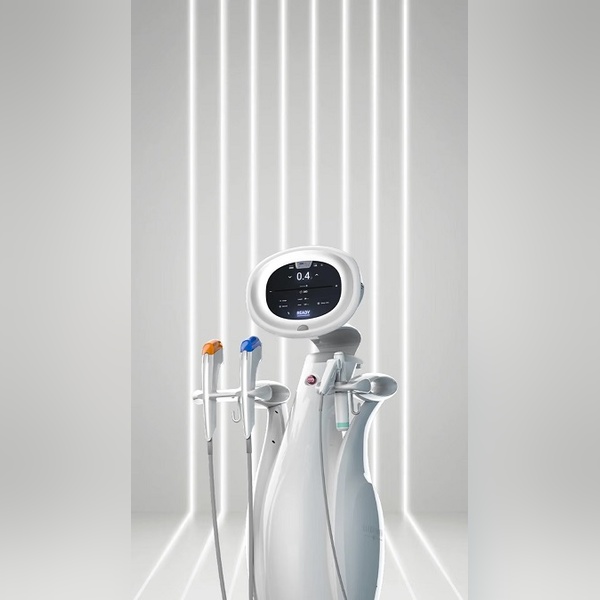
Ultraformer MPT is not a one-depth treatment. Different cartridges focus ultrasound energy at different tissue levels, allowing treatment to be adapted to skin thickness, facial anatomy and the main goal of treatment. More superficial depths are used when the priority is skin quality and dermal remodeling, while deeper depths can interact with deeper connective tissue and selected fat compartments. The most important part of treatment planning is not choosing the deepest cartridge – it is choosing the correct depth for each anatomical zone.
What Is Ultraformer MPT ?
Ultraformer MPT is a focused-ultrasound platform designed for non-surgical facial and body treatment. It delivers high-intensity focused ultrasound into selected tissue planes without making an incision or placing a needle into the skin.
Instead of heating the entire tissue column uniformly, focused ultrasound creates small thermal coagulation points at a chosen depth. These focal points trigger a controlled healing response that can influence collagen organization, elastin behavior, tissue contraction and – at selected deeper settings – subcutaneous fat.
Why Treatment Depth Matters More Than the Device Name
Two patients can both receive ‘Ultraformer MPT’ and still receive completely different treatments. A patient with thin skin and early laxity may need a strategy focused on superficial support and collagen remodeling, while a patient with heavier jowls or submental fullness may need deeper targeting in carefully selected zones.
This is why simply asking how many shots will be used is less useful than asking which tissue layers are being targeted, why those depths were selected, and which parts of the face are intentionally being protected from unnecessary deeper treatment.
How HIFU Creates Tightening
Focused ultrasound concentrates acoustic energy at a defined depth. At the focal point, the tissue experiences a controlled thermal and mechanical effect. The immediate response includes contraction and denaturation of existing collagen structures, followed by a remodeling phase in which new collagen and elastin organization can develop.
The visible result is therefore not only an immediate ‘shrink-wrap’ effect. Some of the more important changes evolve gradually as the tissue remodels.
Collagen : Why It Matters for Firmness
Collagen is a major structural protein in the dermis and connective tissue. With aging, collagen quantity, organization and mechanical quality change. A well-planned HIFU treatment aims to create enough controlled thermal stimulation to trigger remodeling without unnecessarily damaging surrounding tissue.
Different depths place that thermal stimulus in different layers, which is why the same cartridge should not automatically be used across the entire face.
Elastin : Why Tight Skin Still Needs Flexibility
Elastin contributes to the skin’s ability to return toward its original position after movement or stretch. Facial rejuvenation is not simply about making tissue ‘tighter’; healthy-looking skin also needs flexibility. Ultraformer MPT treatment can be planned to support both firmness and elastic behavior by selecting appropriate depths and avoiding excessive treatment.
Fat : When HIFU Can Help – and When It Can Hurt the Result
Focused ultrasound can also affect adipose tissue when energy is delivered at depths that reach the subcutaneous fat layer. This can be useful in a patient with unwanted fullness in the jowl, lower face or submental area.
The same biological effect can be undesirable in a naturally thin face. If a patient already has hollow cheeks or limited facial fat, an aggressive deep-fat strategy can work against the goal of a youthful appearance. Treatment planning should therefore distinguish between ‘tightening’ and ‘fat reduction’ rather than treating them as the same objective.
Ultraformer MPT Depths Explained
| Depth | Primary tissue concept | Typical treatment objective | Planning caution |
|---|---|---|---|
| 2.0 mm | Superficial dermal / subdermal treatment level | Skin quality, fine tightening, superficial remodeling | Avoid assuming superficial means risk-free; anatomy and tissue thickness still matter. |
| 3.0 mm | Deeper dermis / superficial soft tissue and selected fat compartments | Tightening plus contour refinement | Can interact with facial fat depending on location and tissue thickness. |
| 4.5 mm | Deeper support layer / fascia-level target in suitable zones | Structural tightening, lower-face support, deeper lifting strategy | Not appropriate for every area; thin or central facial regions need caution. |
| 6.0 mm | Deeper subcutaneous target | Selected contouring or deeper fat-focused treatment | Should be reserved for tissue thick enough to justify this depth. |
2.0 mm Ultraformer MPT : A More Superficial Strategy
The 2.0 mm depth sits closer to the skin surface than the deeper HIFU cartridges. It is therefore more relevant when the goal is to stimulate the superficial support environment rather than aggressively change deeper fat.
This type of depth can be useful when a patient has fine skin laxity, early textural change or wants additional tightening without a major contour-reduction objective. It may also be integrated into a multi-depth treatment when the clinician wants to address both superficial and deeper components of aging.
Who Might Benefit From a More Superficial Depth?
- Patients with early laxity rather than heavy tissue descent.
- Patients with thin facial tissue where aggressive deep-fat treatment would be undesirable.
- Patients whose priority is skin quality and firmness rather than slimming,
- Areas where a superficial supportive effect is preferred.
- Multi-layer plans where superficial remodeling complements deeper tightening.
3.0 mm Ultraformer MPT : The Bridge Between Skin Tightening and Contouring
The 3.0 mm depth occupies an important middle ground. Depending on the patient’s anatomy, it can interact with deeper dermal structures, fibrous septae and superficial subcutaneous tissue.
That makes it potentially useful for patients who need more than surface-level tightening but do not necessarily need a deeply fat-focused plan. It is also one of the depths where treatment technique and facial zone matter greatly because the thickness of the soft tissue changes dramatically between the cheek, jowl, temple, forehead and periorbital region.
3.0 mm and Facial Fat Preservation
A 3.0 mm cartridge does not produce the same biological interaction in every patient. In a fuller lower face, it may reach tissue that contributes to heaviness. In a thin face, the same nominal depth may sit relatively deeper within the patient’s available soft tissue.
This is why experienced treatment planning considers tissue thickness rather than using a fixed cartridge map for every face.
4.5 mm Ultraformer MPT : Deeper Structural Support
The 4.5 mm depth is used when treatment needs to reach deeper support tissue. In suitable facial zones, this depth is conceptually closer to the fascial support layer that contributes to lower-face and jawline structure.
It is not a cartridge that should simply be applied everywhere. Some regions do not have enough soft-tissue thickness, and central facial areas contain nerves and other structures that require conservative planning.
Where Deeper Treatment Can Be Useful
- Lower-face laxity where deeper support is part of the problem
- Jawline and jowl-related treatment plans
- Areas with adequate tissue thickness for safe focal treatment
- Patients whose main concern is structural looseness rather than only fine surface lines
6.0 mm Ultraformer MPT : Deeper Contouring and Fat-Related Goals
The 6.0 mm depth is a deeper setting and should be understood primarily in the context of thicker soft tissue and selected subcutaneous targets. Its role is fundamentally different from a superficial skin-quality cartridge.
This type of depth is most relevant when the treatment objective includes localized fullness or deeper contouring. It is not automatically appropriate for a thin face or for regions where desirable facial fat should be preserved.
Why Deeper Does Not Mean Better
The ‘best’ Ultraformer depth is not the deepest one. A depth is useful only when it matches the tissue being treated. Using a deeper cartridge in a thin area may add discomfort or affect tissue that the patient would prefer to preserve, while using only superficial treatment in a heavy lower face may not address the main anatomical problem.
Normal Mode vs MP Mode
Ultraformer MPT includes a micro-pulsed treatment concept. MP mode places multiple focused energy points with very small spacing between thermal coagulation points, allowing energy to be distributed efficiently along the treatment path.
The practical goal is not simply to create ‘more heat.’ The goal is controlled, repeatable energy delivery that can stimulate remodeling across the selected tissue layer while maintaining an acceptable treatment experience.
What MP Mode Changes Conceptually
- Closer spacing of thermal coagulation points.
- Broader treatment coverage along a pass.
- Efficient distribution of focused energy
- Potentially different tissue remodeling pattern compared with conventional dot-style delivery.
- Greater importance of choosing the correct depth and treatment zone because energy is distributed more densely.
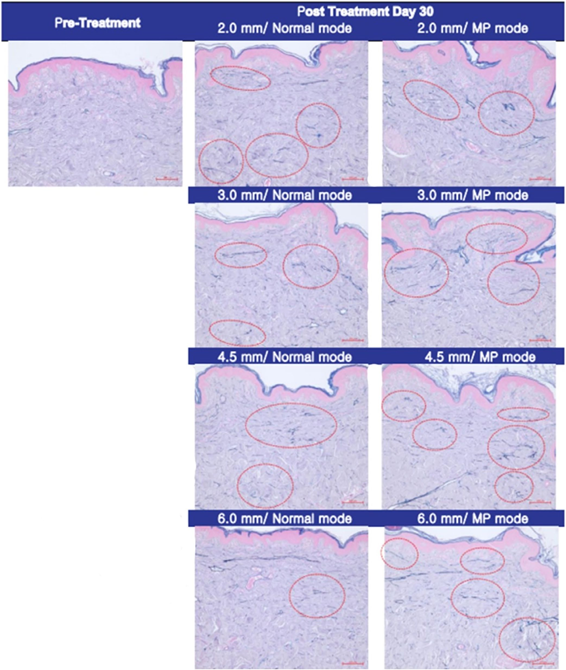
What Happens to Elastin After Focused Ultrasound ?
Thermal stimulation initiates a healing response in the treated tissue. Elastin fibers can reorganize and regenerate as part of that remodeling process, helping improve the quality and elastic behavior of the treated skin.
The effect should be understood as tissue remodeling, not as an instant mechanical pull. The skin’s appearance may continue to evolve after the initial treatment period.
What Happens to Collagen ?
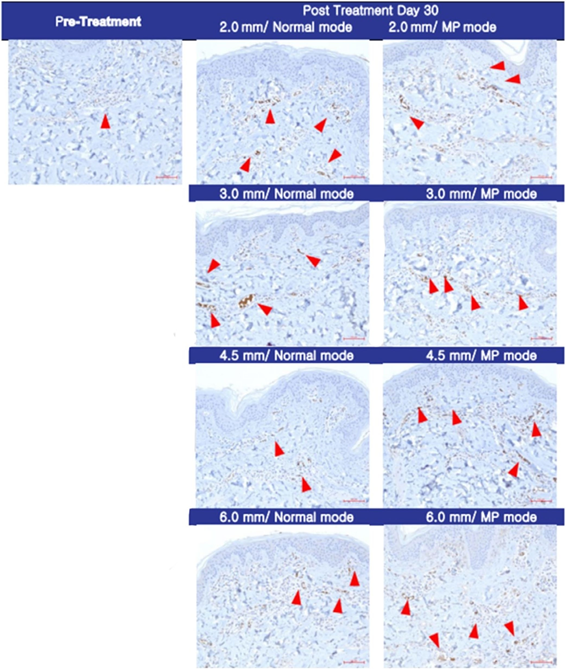
Collagen remodeling is one of the central reasons HIFU is used for non-surgical tightening. Controlled thermal stimulation can activate a repair response that promotes new collagen formation and reorganization of existing collagen structure.
Both type I and type III collagen contribute to the structural environment of skin and connective tissue. The treatment objective is not simply ‘more collagen,’ but better support, organization and firmness in the tissue layer being targeted.
What Happens to Fat ?
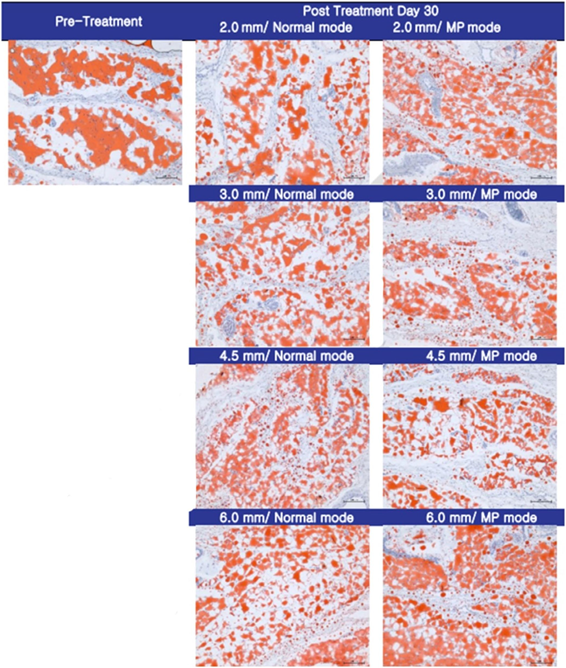
At deeper treatment levels, focused ultrasound can affect adipose tissue. This can contribute to facial contouring when the patient has unwanted fullness, particularly in selected lower-face or submental areas.
Because facial fat is also an important component of youthfulness, fat reduction should never be treated as automatically desirable. The goal is selective contour improvement – not indiscriminate volume loss.
Ultraformer MPT for Facial Slimming
Facial slimming is not the same as facial lifting. A patient can have laxity without excess fat, excess fat without major laxity, or both at the same time.
When slimming is a goal, deeper treatment can be directed toward carefully selected fat compartments. When volume preservation is a priority, the treatment plan should avoid unnecessary deep energy in naturally hollow or thin areas.
Ultraformer MPT for Jowls
Jowls are produced by a combination of soft-tissue descent, ligamentous change, skeletal support, fat distribution and skin laxity. HIFU can improve the appearance of the jowl area when tightening and selected contouring are appropriate.
It does not physically remove loose skin in the way surgery does, and it cannot correct every anatomical cause of jowling. Treatment works best when the jowl is assessed as part of the entire lower face rather than as an isolated bulge.
Ultraformer MPT for Jawline Definition
A cleaner jawline can come from several different changes: tightening loose tissue, reducing selected fullness, improving the transition between the jowl and mandibular border, or improving the relationship between the lower face and neck.
That is why a good jawline protocol may use more than one treatment depth rather than relying on a single cartridge across the entire mandibular border.
Ultraformer MPT for the Submental Area
The submental area is one of the zones where both laxity and fat can contribute to an undefined profile. A patient with mainly loose skin needs a different strategy from a patient with thicker submental fat.
Deeper treatment may be useful when there is enough tissue to justify it, while thinner patients may need a more conservative depth strategy focused on tightening rather than fat reduction.
Ultraformer MPT for the Midface
The midface is a volume-sensitive area. In many patients, cheek fullness is desirable and contributes to a youthful facial shape. Aggressive deep-fat reduction in the wrong midface compartment can therefore be counterproductive.
Midface treatment should focus on whether the problem is skin laxity, soft-tissue descent, superficial texture change or true excess fullness. The answer determines whether superficial, intermediate or deeper treatment is appropriate.
Ultraformer MPT Around the Eyes
The periorbital region contains thin skin and delicate anatomy. Conservative depth selection is essential. The goal may be improvement in fine laxity and tissue quality rather than aggressive deep heating.
Patients with true upper-eyelid skin excess, significant brow ptosis or structural under-eye volume loss may require a different or combined treatment strategy.
Why Ultrasound Anatomy Matters
Facial tissue thickness is not uniform. The forehead, temple, cheek, jawline and neck have different relationships between skin, fat, fascia, muscle, bone and nerves.
This is the reason anatomy-led treatment is more important than a generic ‘full face’ map. The same cartridge depth can interact with completely different tissues in two different anatomical regions – or in two different patients.
Thin Faces vs Full Faces
| Feature | Thin / volume-deficient face | Full / heavier lower face |
|---|---|---|
| Primary concern | Preserve desirable facial volume while tightening | Tighten and selectively reduce unwanted fullness |
| Depth strategy | More conservative deeper treatment | Deeper treatment may have a larger role in selected areas |
| Midface | Avoid unnecessary fat-targeted treatment | Assess whether fullness is fat, descent, or both |
| Lower face | Focus on support and laxity | May combine support-focused and contour-focused depths |
| Main risk of poor planning | Over-slimming / hollowing | Under-treating the true volume component |
Can Ultraformer MPT Make the Face Look Hollow ?
It can contribute to unwanted volume reduction if deeper fat-targeting treatment is used in a patient or region where the existing facial fat is already limited. This is not an inevitable effect of Ultraformer; it is a treatment-planning issue.
A volume-preservation strategy should identify the fat compartments that support a youthful contour and avoid unnecessarily aggressive treatment in those areas.
Can Ultraformer MPT Replace Filler ?
No. HIFU is a tightening and contouring technology. Filler is used to replace or reshape volume. A patient with true cheek, temple or chin volume deficiency may still need filler or another volume-restoration strategy.
In some faces, tightening without adding volume is exactly the goal. In others, reducing or tightening tissue without restoring lost structure can make the face look more tired. The treatment plan should match the anatomy.
Can Ultraformer MPT Replace a Facelift ?
Ultraformer MPT can improve mild to moderate laxity and facial contour without surgery, but it does not surgically remove or reposition large amounts of excess tissue.
If the result a patient wants can only be demonstrated by manually pulling the face strongly upward or backward, expectations should be discussed carefully because a non-surgical device may not reproduce that degree of change.
How Results Develop Over Time
Some tightening may be noticeable early because thermal exposure can create immediate tissue contraction. The remodeling phase is slower. Collagen and elastin reorganization develops gradually, so the final appearance should not be judged only in the first few days.
This is especially important for patients comparing before-and-after photographs. Early changes can be influenced by temporary redness, swelling or tissue contraction, while longer-term change reflects remodeling.
Pain and Treatment Comfort
Focused ultrasound can produce heat, tingling, tenderness or brief sharp sensations, especially where energy is delivered close to bone or superficial nerves.
Comfort varies by anatomical zone, cartridge depth, energy, tissue thickness and individual sensitivity. A responsible treatment plan should adjust energy and depth rather than treating severe pain as something that must simply be tolerated.
Why Central Facial Areas Need More Caution
In the central face, important sensory and motor nerves can lie relatively close to the treatment field. Repetitive or overly aggressive deep treatment can increase discomfort and the risk of nerve irritation.
For this reason, deeper cartridges are not automatically used with the same intensity in the central face as in thicker lateral or lower-face tissues.
Who May Be a Good Candidate ?
- Mild to moderate facial laxity
- Early jowling or loss of jawline definition
- Selected lower-face or submental fullness
- Patients who want non-surgical tightening with limited downtime
- Patients who understand that device-based tightening is subtler than surgery
- Patients whose anatomy allows a clear depth-based treatment plan
Who May Need a Different Strategy ?
- Severe skin redundancy requiring surgical tissue removal
- Marked facial volume deficiency where tightening alone may accentuate hollowness
- A primary pigmentation problem rather than laxity
- Major structural skeletal concerns requiring a different approach
- Patients expecting an immediate surgical-level lift
- Patients with contraindications to focused ultrasound treatment
What a Good Ultraformer MPT Consultation Should Clarify
- Is my main problem laxity, fat, volume loss, texture or a combination?
- Which areas should be tightened but not slimmed?
- Which areas can safely tolerate deeper treatment?
- Which cartridge depths will be used in each zone and why?
- Is MP mode being used for superficial remodeling, deeper contouring, or both?
- How will desirable cheek and temple volume be protected?
- Do I need one treatment modality, or would a combination plan be more anatomically appropriate?
- How will results be documented so that subtle changes can be evaluated fairly?
- When should I judge the final result?
- What degree of improvement is realistic without surgery?
