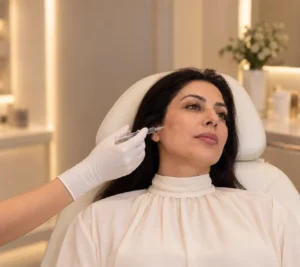

A rejuvenated face can still look mismatched when the neck, décolletage or hands show advanced aging. Here’s how modern evidence-based treatments target each area differently.
Why the Neck, Chest and Hands Need Their Own Rejuvenation Strategy
Non-facial aging reflects a mix of intrinsic tissue change and external exposure, but the visible pattern differs considerably by area. A treatment plan built purely on facial protocols often misses what these three regions actually need.
Neck Aging
The platysma muscle extends across much of the neck and changes with age — thinning and transitioning from a more uniform muscle into visible fibrous bands. This is accompanied by horizontal rhytids, sagging, and changes in the superficial fat layer. In other words, “neck aging” can mean several different problems at once: skin texture, horizontal lines, laxity, volume change, or visible platysmal activity.
Chest / Décolletage Aging
The chest has thinner epidermal and dermal layers than the face and fewer pilosebaceous glands, making it especially vulnerable to intrinsic aging and environmental damage. In more photodamaged skin, combination treatment is often required rather than relying on a single modality.
Hand Aging
The dorsal hands experience both surface aging and deeper volume loss. Over time, veins, tendons and bones become more visible, while wrinkles, pigmentation and textural changes develop. This is why hand rejuvenation often combines volume restoration with skin-quality or pigment-directed treatments.
Which Treatment Targets Which Problem?
| Main Concern | Evidence-Supported Options | Practical Goal |
|---|---|---|
| Dehydration / crepey skin | HA skin boosters; Profhilo for the neck | Skin quality and hydration rather than major volume replacement |
| Horizontal neck lines | HA filler / skin booster; other modalities depending on depth | Direct line softening when anatomy is suitable |
| Skin laxity / collagen loss | PLLA; diluted or hyperdiluted CaHA; RF microneedling; Profhilo for selected neck concerns | Gradual improvement through tissue remodeling |
| Platysmal bands / dynamic neck pull | Botulinum toxin | Targets muscle activity; does not replace lost volume |
| Dorsal hand volume loss | HA filler or CaHA; PLLA in selected use | Reduce skeletal/tendon prominence and restore soft-tissue appearance |
| Photodamage / pigmentation | Chemical peels and device-based approaches | Depth and skin type influence risk, especially on neck and hands |
| Mixed aging | Combination plan | Common when volume, laxity, texture and pigmentation coexist |
Fillers vs Skin Boosters: The Difference Matters
Traditional dermal fillers are usually placed in deeper tissue planes when the goal is volume restoration or structural correction. Skin boosters, by contrast, are generally placed more superficially to hydrate and revitalize the skin. The exact behavior of either still depends on product composition, particle characteristics, cross-linking, and the specific treatment area.
PLLA / Sculptra for the Neck, Chest and Hands
Poly-L-lactic acid (PLLA) is a biodegradable biostimulatory injectable. Collagen formation and fibroplasia are central to its effect, improving both volume and skin quality over time. It has been used off-label in the neck, chest and hands.
PLLA for the Neck
Published experience reports visible improvement developing over the following weeks, with long durability in some studies. The key safety issue is nodule or beading formation, making patient selection, dilution, placement and post-procedure care especially important. Superficial deposition and excessive product can increase problems.
PLLA for the Chest / Décolletage
For chest rejuvenation, PLLA addresses wrinkling, laxity and collagen loss through treatment courses rather than a single universal session, with correction reported lasting up to two years or longer in cited literature. Post-treatment massage is emphasized because of the risk of nodules.
PLLA for the Hands
PLLA has also been studied for the aging hand, where both soft-tissue loss and skin quality may need attention. Multiple treatment sessions are used in some protocols, with bruising, swelling, itching and nodules among potential adverse effects.
Studies report durability of up to about two years or longer for selected PLLA treatments of the neck, chest and hands. This should not be interpreted as a guaranteed duration for every patient or product protocol.
Calcium Hydroxyapatite / Radiesse
Calcium hydroxyapatite (CaHA) is a biodegradable, resorbable injectable containing hydroxyapatite microspheres in a carrier gel. It produces two distinct effects: immediate correction from the carrier gel, and longer-term biostimulatory change involving collagen, elastin-related remodeling, angiogenesis and dermal cell activity.
CaHA for the Neck
Diluted and hyperdiluted CaHA has been used for neck rejuvenation, especially when the objective is tissue quality and tightening rather than focal volumization. Consensus-based injection approaches report typical durability around 15–18 months. Early nodules, persistent inflammation, swelling or erythema, and delayed granulomatous reactions are among the complications discussed.
CaHA for the Chest
Data for CaHA in the décolletage are more limited than for other areas, though published approaches use diluted product and distributed injection patterns. The evidence here is best described as promising but less extensive.
CaHA / Radiesse for Hand Rejuvenation
The hands are one of the better-established non-facial indications. CaHA has U.S. FDA approval for dorsal hand rejuvenation, with studies describing improvement in age-related volume loss lasting approximately 12–15 months. Pain, bruising, erythema, edema and itching are among the expected short-term effects.
Hyaluronic Acid: Neck Lines, Skin Boosting and Hand Volume
Hyaluronic acid (HA) can be manufactured in different forms, including cross-linked fillers and smaller-particle skin-boosting products. Cross-linking generally increases density and durability. HA can also be enzymatically degraded with hyaluronidase, which is clinically relevant for correction or complication management.
HA for Horizontal Neck Lines
HA can be used in selected patients to soften horizontal neck lines and improve neck skin quality, with effects in the range of roughly 6–8 months in some neck studies. Redness, swelling, pain and temporary blue discoloration are reported adverse effects, along with rare inflammatory nodules and infections.
HA Skin Boosters for the Neck
Smaller-particle HA products can be used as skin boosters when the goal is hydration and revitalization rather than major shape change, typically via intradermal micropuncture along horizontal lines.
HA for the Chest / Décolletage
Both stabilized HA fillers and skin-boosting approaches have been used for décolletage wrinkles and skin quality. Some studies observed wrinkle improvement for several months, with mild bruising and redness reported, and durability commonly around 6–8 months depending on product and technique.
HA for the Hands
HA may be used either for dorsal hand volume restoration or as a skin booster, with results commonly lasting around 6–12 months. When the goal is hydration and texture rather than volume, repeated skin-booster sessions are often used.
PLLA vs CaHA vs HA: Practical Comparison
| Injectable | Main Role | Areas in Review | Reported Durability | Key Safety Considerations |
|---|---|---|---|---|
| PLLA | Biostimulation + gradual volume/texture improvement | Neck, chest, hands (off-label use) | Up to ~2 years or longer | Nodules, bruising, edema, inflammation; response varies |
| CaHA | Immediate correction + collagen/skin-quality biostimulation | Neck, chest, hands | Neck/chest ~15–18 months; hands ~12–15 months | Nodules, inflammation, swelling, erythema; delayed reactions possible |
| HA | Hydration, line softening, or volume restoration | Neck, chest, hands | Often ~6–12 months | Bruising, edema, redness, pain; rare nodules/infection |
Mesotherapy for Neck, Chest and Hands
Mesotherapy places small amounts of selected ingredients into the superficial dermis, using formulations containing HA, amino acids, nucleotides, antioxidants and vitamins. In one 64-patient study covering facial and body areas, improvement was reported in hydration, brightness and age-related skin changes; a small hand study also reported improvement in glow and elasticity.
Many mesotherapy protocols involve little or no downtime, though short-term redness, bruising and swelling can occur. Importantly, inadequate aseptic technique has been associated with delayed atypical mycobacterial infection, making infection prevention a central safety issue.
Microneedling and Radiofrequency Microneedling
Microneedling creates controlled micro-injury to trigger a wound-healing and remodeling response — fibroblast activity, collagen deposition and neovascularization. Improvement continues over weeks to months rather than appearing only on the day of treatment.
Microneedling for the Neck
Several published studies exist, though many are small. In one eight-participant study, seven patients improved after two microneedling sessions, with ultrasound showing increased dermal thickness at 32 weeks. RF microneedling studies also reported improvement in laxity and smoothness, including a 49-participant study where patients rated improvement at 74% after two sessions.
RF Microneedling for the Chest
In a 12-subject décolletage study, three fractional RF microneedling sessions produced overall improvement in 67% of participants using GAIS. Seventy percent reported improvement in laxity and rhytides, and 60% were satisfied with skin texture. Evidence for microneedling alone (without RF) on the chest was not identified.
Microneedling for the Hands
Evidence is much thinner here. A three-patient report showed improvement in texture and tightening, but larger trials are still needed — a good example of a treatment that’s biologically plausible and clinically used, yet has limited area-specific evidence.
Microneedling commonly produces 2–3 days of erythema, swelling or flaking. Sunscreen and sun avoidance during recovery are emphasized.
Chemical Peels for Non-Facial Rejuvenation
Chemical peels can target pigment, texture and photodamage, but depth matters greatly outside the face. Peels are classified as superficial, medium and deep according to how far they penetrate the epidermis and dermis. More aggressive treatment increases the risk of prolonged erythema, scarring, infection and post-inflammatory hyperpigmentation.
Neck Peels
The neck carries a higher scarring risk than the face, so a lighter approach is recommended. This is not an area where “stronger” automatically means “better.”
Chest Peels
Deep chemical agents should generally be avoided on the chest; superficial or light-to-medium approaches are more appropriate, guided by skin type and photodamage pattern.
Hand Peels
Deep peels also warrant caution on the hands because the skin is thin with limited adnexal structures. Published protocols have used glycolic acid, TCA, and focal salicylic acid, but risks include prolonged redness, pigmentary change, scarring and demarcation between treated and untreated skin.
Post-inflammatory hyperpigmentation is a significant risk with chemical peels, especially medium and deep peels. Test spots are valuable in darker Fitzpatrick skin types.
Botox for Neck and Chest Rejuvenation
Botulinum toxin differs from fillers and skin boosters because it primarily targets muscle activity. In the neck, it’s most relevant when platysmal bands and downward muscle pull contribute to the appearance. In the chest, published use has focused on dynamic vertical and horizontal furrows associated with muscle activity.
Nefertiti Lift and Platysmal Band Treatment
The Nefertiti lift is a non-surgical approach treating the lower face and neck by targeting platysmal activity, alongside microdroplet or “microbotox” techniques. Deeper or excessive treatment can increase the risk of neck weakness, dysphagia or dysphonia, so anatomy and dose selection are critical.
Botox for Décolletage Lines
Botulinum toxin has also been described for dynamic chest lines, though the evidence is narrower than for common facial indications — best presented as a selected treatment for muscle-related rhytides rather than a universal chest solution.
Only when muscle activity is a major part of the problem. Botox can help platysmal bands and selected dynamic lines, but it does not replace volume, correct pigmentation, or directly restore dermal hydration. Many patients need a different treatment or a combination plan.
Profhilo for Neck Rejuvenation
A 25-participant study of hybrid high- and low-molecular-weight hyaluronan injections examined neck roughness and laxity. Participants received two treatments one month apart, with statistically significant improvement in laxity, wrinkles and hydration, and high tolerability.
Typical Profhilo durability falls in the range of 6–12 months, with both early injection-site reactions and less common delayed local swelling or nodules noted. Crucially, no published Profhilo studies for chest or hand use were identified in the reviewed literature — neck data should not be extrapolated to every body area.
Evidence Snapshot by Area
| Area | Treatments Discussed | Evidence-Based Interpretation |
|---|---|---|
| Neck | PLLA, CaHA, HA/skin boosters, mesotherapy, microneedling/RF, light peels, Botox, Profhilo | Broadest range of modalities; treatment must distinguish laxity, lines, hydration and platysmal activity |
| Chest / décolletage | PLLA, CaHA, HA/skin boosters, mesotherapy, RF microneedling, peels, Botox | Combination treatment often relevant in photodamage; evidence varies by modality |
| Hands | PLLA, CaHA, HA, HA skin boosters, mesotherapy, limited microneedling evidence, peels | Often requires both volume restoration and surface-quality treatment |
How to Think About Treatment Selection Clinically
A useful way to plan non-facial rejuvenation is to identify the dominant tissue problem first, rather than starting from a specific product.
- Volume loss: consider a structural filler strategy, especially for dorsal hands.
- Dehydration or crepey skin: consider HA skin-quality treatments or neck Profhilo where appropriate.
- Laxity and collagen decline: biostimulatory injectables or RF microneedling may be more relevant.
- Platysmal banding: botulinum toxin may be more logical than filler.
- Pigmentation or photodamage: a peel or device-based strategy may be necessary.
- Multiple coexisting problems: combination treatment may be more rational than forcing one product to solve every layer.
Safety: Why Non-Facial Areas Require Careful Technique
The neck, chest and hands are not simply extensions of facial injection technique. Tissue thickness, vascular anatomy, muscle function and healing characteristics differ by region.
| Treatment | Potential Adverse Effects | Safety Emphasis |
|---|---|---|
| PLLA | Bruising, edema, pain, inflammation, nodules; rare granuloma | Avoid overly superficial deposition and excessive product; follow product-specific post-care |
| CaHA | Pain, bruising, edema, erythema; nodules; delayed inflammatory or granulomatous reactions | Dilution, depth and distribution matter |
| HA | Swelling, redness, pain, bruising; rare nodules/infection | Product selection and anatomy matter; enzymatically reversible with hyaluronidase |
| Mesotherapy | Erythema, bruising, edema; delayed atypical mycobacterial infection if asepsis fails | Strict aseptic technique is essential |
| Microneedling / RF | Erythema, edema, flaking; usually short downtime | Avoid in poor wound healing, keloidal tendency, or selected inflammatory skin conditions |
| Chemical peels | Burning, erythema, pigment change, scarring, infection | Extra caution on neck/hands and in darker skin; depth selection is critical |
| Botulinum toxin | Bruising, edema, discomfort, headache; rare weakness, dysphagia/dysphonia with problematic neck treatment | Anatomy, dose and depth are central to safety |
| Profhilo | Injection-site swelling, erythema/ecchymosis; delayed local swelling/nodules reported | Patient selection and sterile injection technique remain important |
A Note on “FDA Approved” vs Local Practice in Abu Dhabi
U.S. FDA approval status is often used to describe individual indications, which is useful scientific context. But it should not be presented as a substitute for UAE product registration, local labeling, facility policy, or clinician scope of practice. A use may be well described in international literature while remaining off-label in a specific jurisdiction or for a specific anatomical area.
What Should Be Assessed at a Consultation?
- Is the main concern volume loss, laxity, wrinkles, dehydration, pigmentation, muscle activity, or several of these together?
- Is there significant photodamage that needs a skin-surface treatment rather than an injectable alone?
- Does the neck show platysmal banding, horizontal lines, skin laxity, or a combination?
- For the hands, is the problem mainly visible veins/tendons from volume loss, or primarily skin texture and pigmentation?
- Which products are approved or appropriate for the intended area in the local clinical setting?
- What is the expected number of sessions, and when should improvement become visible?
- What downtime and aftercare are realistic for the chosen modality?
- What complications are possible, and how would they be recognized and managed?
Frequently Asked Questions
What is the best treatment for neck rejuvenation in Abu Dhabi?
There is no single best treatment. HA can target selected horizontal lines or hydration, PLLA and CaHA can target collagen loss and laxity, botulinum toxin can target platysmal activity, RF microneedling can address texture and laxity, and Profhilo has published neck data for hydration, wrinkles and laxity. The correct choice depends on the dominant problem.
What is the best treatment for aging hands?
When the main problem is dorsal volume loss, HA or CaHA are among the best-studied injectable options. When pigmentation and texture are major issues, a combined plan may be more appropriate.
Can Sculptra be used on the neck?
Yes, PLLA has published off-label use for neck rejuvenation. It is a biostimulatory treatment rather than a simple hydration injection and carries a nodule risk if technique or product handling is suboptimal.
Can Radiesse improve neck skin?
Diluted or hyperdiluted CaHA has been used for neck skin quality and tightening, with collagen-related biostimulatory effects and reported durability around 15–18 months.
Can Radiesse be used in the hands?
Yes. CaHA has U.S. FDA approval for dorsal hand rejuvenation and is one of the more established options for hand volume loss.
Can hyaluronic acid treat neck lines?
Yes, selected horizontal neck lines may be treated with HA, and HA skin boosters can also be used for hydration and skin quality. Product type and depth should match the indication.
How long do HA treatments last in the neck or chest?
Approximately 6–8 months is commonly reported for neck and chest HA treatments, although duration varies by product, technique and patient.
Is Profhilo good for neck laxity?
A 25-participant study found significant improvement in neck laxity, wrinkles and hydration after two sessions one month apart, with high tolerability.
Is Profhilo proven for hand rejuvenation?
No published Profhilo studies for the hands were identified in the reviewed literature. Evidence from the neck should not automatically be generalized to the hands.
Can Botox tighten the neck?
Botulinum toxin can improve the appearance of platysmal bands and selected dynamic neck lines by reducing muscle activity. It does not directly replace lost volume or correct skin pigmentation.
What is a Nefertiti lift?
It is a botulinum-toxin technique for lower-face and neck rejuvenation, targeting platysmal activity along the jawline and neck. Results depend on anatomy and appropriate dosing.
Does RF microneedling work on the neck?
Several neck studies show improvement in laxity and smoothness. One 49-participant study reported patient-rated improvement of 74% after two sessions.
Can RF microneedling be used on the chest?
Yes. A small 12-subject study reported overall improvement after three fractional RF microneedling sessions, including improvement in laxity, rhytides and texture.
Are chemical peels safe for the neck?
A lighter approach is advised because the neck has a higher scarring risk than the face. Deeper treatment is not automatically better and should be selected very carefully.
Why are combination treatments common for the chest?
Chest aging often combines wrinkles, laxity, pigmentation and photodamage. Severe photodamage frequently requires combination therapy rather than a single modality.
How many sessions will I need?
It depends on the treatment. Some hand fillers may be performed in one session, while PLLA, skin boosters, Profhilo, mesotherapy and microneedling are often performed as treatment courses. There is no single universal schedule.
Which treatment has the longest duration?
Among the injectables discussed, PLLA has some of the longest durations reported, with selected studies describing results around two years or longer. CaHA commonly lasts over a year in several non-facial uses, while HA often lasts months rather than years.
Are these treatments the same as surgery?
No. These are clinic-based non-surgical or minimally invasive rejuvenation options. Significant structural laxity or advanced neck aging may still require surgical assessment in selected patients.