
Evidence-Based Non-Surgical Eyebrow Elevation & Periocular Rejuvenation
| Quick answer
Fotona Fox Eyes Lift is a non-surgical laser approach studied for subtle eyebrow-tail elevation and periocular rejuvenation. In a 21-patient split-face study, the dual-wavelength Fox Eyes Lift protocol produced a mean eyebrow-tail elevation of 1.75 mm after three monthly sessions, compared with 0.78 mm using standard SmoothEye. Results were measurable but deliberately subtle—not a surgical “cat-eye” transformation. |
Fotona Fox Eyes Lift in Abu Dhabi: An Evidence-Based Guide
The “fox eye” look is often associated with a slightly higher lateral eyebrow, a more open periocular appearance, and a smoother transition between the upper eyelid, brow, and temple. Surgery and thread-based lifting can create more dramatic changes, but many patients now look for a subtler option with minimal downtime.
A 2024 paper in the Journal of Cosmetic Dermatology evaluated a laser protocol designed specifically for eyebrow elevation using the Fotona SP Spectro platform. The authors called the technique Fox Eyes Lift (FEL) and compared it directly, side by side, with the established SmoothEye protocol.
For patients searching for Fotona Fox Eyes Lift in Abu Dhabi, the most useful way to understand this treatment is not as a replacement for surgical brow lifting, but as a collagen-remodeling laser strategy intended to create a measurable yet natural change in brow position and periocular skin quality.
What Is the Fotona Fox Eyes Lift?
Fotona Fox Eyes Lift is a non-surgical eyebrow-elevation protocol that combines two laser wavelengths: 2940 nm Er:YAG and 1064 nm Nd:YAG. In the published study, the protocol treated the eyelid/periocular area together with the lateral frontal region, extending the treatment field beyond the standard SmoothEye approach.
The key concept is multi-layer tissue remodeling. The Er:YAG SMOOTH mode produces controlled non-ablative thermal stimulation associated with collagen contraction and remodeling, while the Nd:YAG FRAC3 mode reaches deeper tissue levels with a fractional thermal effect. The paper proposes that combining wavelengths and expanding the treatment area may generate a stronger lifting vector at the eyebrow tail than treating the periocular area alone.

Why the Eyebrow and Eyelid Area Ages Early
The eyelid region is one of the first facial areas to show age-related change. The source article notes that eyelid epidermis is extremely thin—approximately 0.04 mm—helping explain why skin laxity, fine lines, and changes in brow position become noticeable early.
Periocular aging is not only a surface-skin issue. Aesthetic appearance is influenced by skin quality, collagen support, brow position, and the relationship between the eyelid, lateral canthus, brow tail, and forehead. This is why a treatment designed for eyebrow elevation may need to address more than the eyelid itself.
How Does the Dual-Wavelength Fotona Approach Work?
Er:YAG 2940 nm in SMOOTH mode
In the paper, Er:YAG SMOOTH mode is described as a non-ablative thermal treatment that delivers controlled optical energy without direct epithelial ablation. The intended biological effect is tissue heating, collagen contraction, cell activation, extracellular-matrix production, and remodeling.
Nd:YAG 1064 nm in FRAC3 mode
Nd:YAG 1064 nm penetrates more deeply because of relatively low absorption by common skin chromophores. FRAC3 produces a self-induced fractional thermal effect in deeper layers, creating microscopic high-temperature zones that can stimulate collagen and elastic-fiber remodeling.
Why combine the two?
The Fox Eyes Lift protocol combines the superficial-to-mid-depth remodeling effect of Er:YAG SMOOTH with the deeper thermal action of Nd:YAG FRAC3. The authors suggest that treating multiple tissue layers—and including the lateral frontal region—may explain the greater brow-elevation effect observed compared with SmoothEye alone.
What Did the Clinical Study Actually Find?
The most important strength of the study is its split-face design: each participant acted as his or her own control. One side received standard SmoothEye and the other side received Fox Eyes Lift, with allocation determined randomly. Twenty-one subjects (19 women) with a mean age of 50.1 years completed three treatment sessions at one-month intervals.
| Study metric | Fox Eyes Lift (FEL) | SmoothEye (SE) | |
| Participants | 21 split-face subjects | Same subjects, opposite side | |
| Sessions | 3 sessions | 3 sessions | |
| Interval | 4 weeks | 4 weeks | |
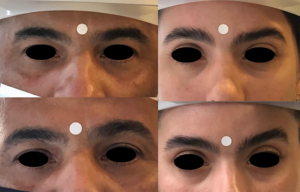
| Mean eyebrow-tail elevation | 1.75 mm | 0.78 mm | |
| Within-protocol significance | p < 0.0001 | p = 0.0002 | |
| Between-protocol difference | Greater post–pre change; p = 0.0003; d = 0.95 | Smaller mean lift | |
| The number to remember: 1.75 mm
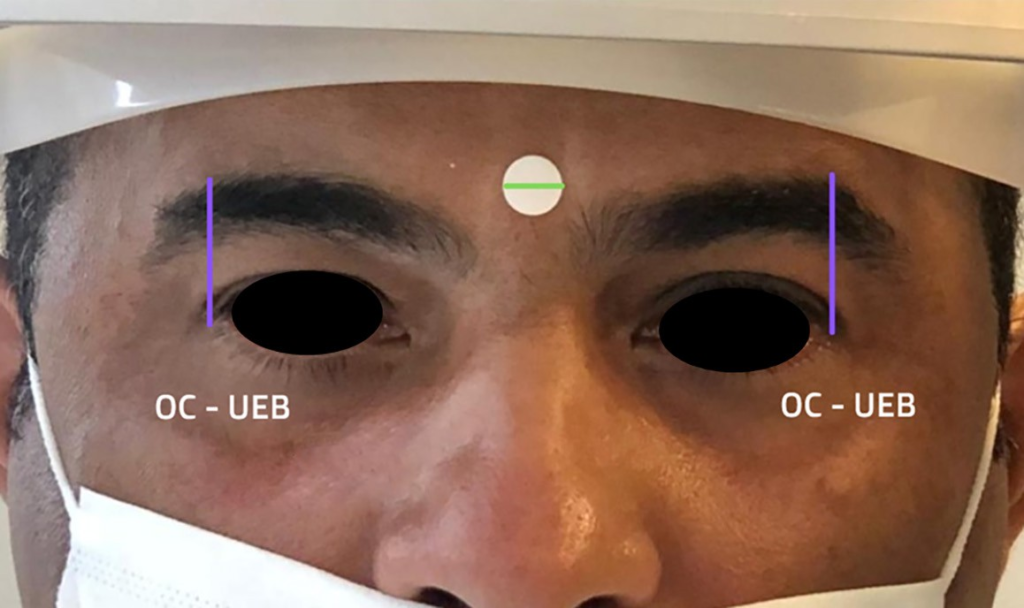
The FEL side showed a mean eyebrow-tail elevation of 1.75 mm (95% CI 1.37–2.14 mm), compared with 0.78 mm (95% CI 0.48–1.07 mm) for SmoothEye. The difference in treatment response was statistically significant and the reported effect size was large (d = 0.95). |
|||
What Does a 1–2 mm Brow Lift Look Like in Real Life?
A millimeter-scale change may sound small, but around the eye it can noticeably alter the relationship between the lateral brow and the upper eyelid. The expected effect is subtle: a slightly more elevated brow tail, a more open eye area, smoother periocular skin, and a less tired appearance.
This distinction matters for expectation-setting. A laser brow lift should not be marketed as equivalent to an endoscopic brow lift, temporal lift, or surgical “cat-eye.” The published protocol demonstrated a discreet elevation, not a dramatic surgical repositioning.

Who May Be a Good Candidate for Fotona Fox Eyes Lift?
Based on the treatment concept and study population, the procedure is most relevant to patients seeking a modest, non-surgical improvement rather than a dramatic anatomical repositioning.
- Mild lateral brow descent or a “tired” periocular appearance
- Fine lines and early skin laxity around the upper or lower eyelid
- Preference for a non-surgical treatment with limited downtime
- Realistic expectations about a subtle millimeter-scale lift
- Interest in collagen remodeling and skin-quality improvement in addition to brow position
- Willingness to complete a treatment series rather than expect a one-session surgical result
Final candidacy should always be determined after in-person assessment of eyelid anatomy, brow position, skin laxity, facial symmetry, ocular history, and the degree of change the patient actually wants.
How Many Sessions Were Used in the Study?
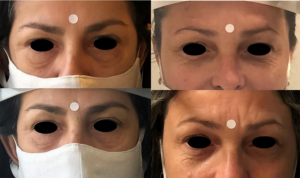
The published Fox Eyes Lift protocol used three sessions at approximately one-month intervals. Standardized photographs were taken before treatment and one month after the final session. This means the evidence in this paper reflects a treatment series, not a single-session result.
Downtime and Safety: What the Study Reported
The authors described the treatment as comfortable with minimal downtime, and no lasting adverse effects were reported in the study. However, “minimal downtime” does not mean “zero reaction.” Temporary swelling, redness, and peeling can occur.
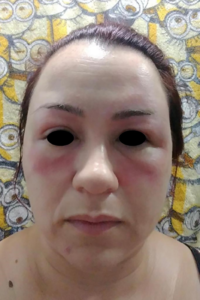
One participant developed eyelid swelling and redness with slight skin peeling on both sides, more pronounced on the FEL-treated side. Two participants developed marked eyebrow asymmetry because the FEL side lifted more than the SmoothEye side; the study team treated the opposite side after the study and reported resolution of the asymmetry.
These findings reinforce an important clinical point: a treatment that is intentionally designed to lift can create visible asymmetry if baseline anatomy, treatment response, or side-to-side dosing effects are not carefully considered.
What the Study Can—and Cannot—Tell Us
The study provides useful early clinical evidence because it used a prospective split-face design, standardized photography, objective ImageJ measurements, and statistical comparison between two protocols. The result was not based only on patient opinion: eyebrow position was measured.
At the same time, the sample was small (21 subjects), the follow-up assessment was performed one month after the final session, and the study primarily evaluated eyebrow position rather than long-term durability. Therefore, the paper supports short-term efficacy and tolerability of the protocol, but it does not establish how long the lift lasts in every patient or whether the same magnitude of response will occur across all ages, skin types, and degrees of laxity.
Fotona Fox Eyes Lift vs SmoothEye
| Feature | Fox Eyes Lift | SmoothEye |
| Primary goal | Periocular rejuvenation + stronger eyebrow-tail elevation | Periocular rejuvenation + mild brow lift |
| Wavelengths in study | Er:YAG 2940 nm + Nd:YAG 1064 nm | Er:YAG 2940 nm |
| Treatment field | Periocular + lateral frontal region | Primarily periocular |
| Mean brow-tail lift in study | 1.75 mm | 0.78 mm |
| Downtime | Minimal in study; temporary reactions possible | Minimal in study |
| Best fit | Patients prioritizing a subtle lifting vector plus skin rejuvenation | Patients prioritizing eyelid/periocular tightening |
How Does It Compare With Other Non-Surgical Brow-Lift Options?
The source paper discusses other minimally invasive technologies used around the eyelid and brow, including microfocused ultrasound and microneedle radiofrequency. These technologies also create controlled thermal injury or heating to stimulate collagen contraction and neocollagenesis, but they deliver energy differently and target different tissue depths.
| Option | Main mechanism | Typical advantage | Important limitation |
| Fotona FEL | Dual-wavelength thermal collagen remodeling | Treats periocular and lateral frontal region with minimal downtime | Published evidence is still limited and lift is subtle |
| SmoothEye | Er:YAG SMOOTH periocular remodeling | Focused eyelid/periocular rejuvenation | Smaller brow-lift effect in the comparative study |
| Microfocused ultrasound | Focused ultrasound thermal coagulation at defined depths | Can create a non-surgical brow-lifting vector | Requires precise anatomical knowledge and device-specific training |
| Microneedle RF | RF energy delivered through microneedles into dermis | Collagen remodeling with controlled depth | Needle-based; treatment experience and downtime differ |
| Surgery | Direct tissue repositioning | Most powerful and predictable structural lift | Invasive; recovery and surgical risks |
Is This the Same as Fotona4D?
No. Fotona4D is a broader facial rejuvenation concept combining four distinct treatment steps—SmoothLifting, FRAC3, PIANO, and SupErficial—using Er:YAG and Nd:YAG wavelengths. The Fox Eyes Lift protocol is a targeted eyebrow/periocular protocol evaluated specifically for brow elevation. The technologies overlap, but the treatment objectives and application patterns are not identical.
Fotona Fox Eyes Lift in Abu Dhabi: What Should Be Assessed Before Treatment?
For a patient considering a non-surgical eyebrow lift in Abu Dhabi, treatment selection should begin with anatomy rather than a device name. The same “heavy eye” complaint can arise from different causes, including brow descent, upper-eyelid skin excess, orbital volume changes, muscle balance, or baseline asymmetry.
- Baseline eyebrow height and natural right–left asymmetry
- Upper-eyelid skin laxity and degree of hooding
- Lower-eyelid texture, fine lines, and laxity
- Lateral canthal and temporal anatomy
- Skin type and previous laser history
- History of ocular or eyelid procedures
- Desired result: subtle rejuvenation versus structural lifting
- Whether combination treatment is more appropriate than laser alone
This anatomy-first approach is especially important because the study itself observed two cases in which the stronger FEL response created visually important asymmetry.
What Results Can Patients Realistically Expect?
The most defensible expectation from the current evidence is a gradual, subtle improvement. In the study, most participants noticed improvement in eyelid opening, brow lift, wrinkle reduction, and skin quality. Fifteen participants perceived the FEL side as having the higher brow position, while five felt that both sides improved similarly.
A good clinical endpoint is not simply “higher is better.” The goal is a balanced eyebrow position that looks natural in relation to the eyelid, temple, and opposite side of the face.
Aftercare in the Published Protocol
The study authors recommended topical moisturizer three times daily for one week together with sunscreen. They described the procedure as allowing a prompt return to normal daily activities after a brief clinic visit. Individual aftercare may vary according to skin response, treatment intensity, and clinician instructions.
Frequently Asked Questions — Fotona Fox Eyes Lift Abu Dhabi
What is Fotona Fox Eyes Lift?
It is a non-surgical laser protocol studied for eyebrow-tail elevation and periocular rejuvenation. The published protocol combined 2940 nm Er:YAG and 1064 nm Nd:YAG treatment and extended beyond the eyelids into the lateral frontal region.
Does Fotona really lift the eyebrow?
In a 21-patient split-face study, both Fotona protocols significantly elevated the eyebrow. The Fox Eyes Lift side achieved a mean 1.75 mm lift at the eyebrow tail, compared with 0.78 mm with SmoothEye.
Is Fotona Fox Eyes Lift surgery?
No. It is a non-surgical laser treatment designed to stimulate tissue remodeling and collagen-related tightening. Its expected lift is subtle and should not be compared with the magnitude of surgical brow repositioning.
How many sessions are needed?
The clinical study used three treatment sessions at four-week intervals. That three-session series is the evidence base for the reported eyebrow-elevation results.
When are results assessed?
In the study, standardized photographs and measurements were obtained one month after the final treatment session. Collagen remodeling may evolve over time, but this paper did not establish long-term durability.
Is there downtime?
The study described minimal downtime. Temporary redness, swelling, and slight peeling occurred in one participant, and two participants developed noticeable asymmetry because the FEL side lifted more strongly.
Can Fotona Fox Eyes Lift improve eyelid wrinkles?
The study participants commonly reported improvement in wrinkle appearance, eyelid opening, brow position, and skin quality. The protocol is designed around collagen remodeling in the periocular and lateral frontal regions.
Is Fotona Fox Eyes Lift the same as SmoothEye?
No. SmoothEye used Er:YAG alone in the periocular area. The FEL protocol added Nd:YAG FRAC3, more comprehensive Er:YAG treatment, and application to the lateral forehead; it produced the larger brow-lift effect in this study.
Is it suitable for every “hooded eye”?
No. Hooding can result from brow position, eyelid skin excess, anatomy, or other factors. Laser may be appropriate for selected patients with mild laxity, but an in-person assessment is needed to determine the correct treatment.
How do I choose a Fotona provider in Abu Dhabi?
Look for a licensed medical practitioner with experience in periocular laser anatomy, appropriate eye protection protocols, conservative patient selection, and the ability to explain realistic outcomes, alternatives, and potential asymmetry.
Can it be combined with other treatments?
Combination treatment may be considered when different anatomical problems coexist, but the published FEL study evaluated the laser protocol itself. Any combination should be individualized rather than automatically added.
Is the result permanent?
The source study did not establish permanent results or long-term durability. It documented measurable improvement one month after completion of a three-session series.
Clinical Bottom Line
Fotona Fox Eyes Lift is a promising non-surgical option for selected patients who want a modest elevation of the eyebrow tail together with periocular skin rejuvenation. The best available evidence in the supplied source is a small prospective split-face study showing that the dual-wavelength FEL protocol produced a significantly greater short-term brow lift than standard SmoothEye after three monthly sessions.
The key is expectation management: this is a subtle collagen-remodeling lift, not a surgical fox-eye transformation. Careful assessment of brow anatomy and baseline asymmetry is essential, and the long-term durability of the effect remains less well defined by this study.