

Double Chin Liposuction in Abu Dhabi
A double chin is not always just "extra fat." The contour beneath the chin is influenced by the volume and depth of fat, skin tone, the platysma, jowls, the mandibular border, submandibular-gland position and the cervicomental angle. That is why the same amount of submental fullness can look very different from one person to another — and why a careful anatomical assessment is essential before choosing a treatment.
What Is Double Chin Liposuction?
Chin or submental liposuction removes localized fat from beneath the chin and along the jawline to improve lower-face and neck contour. In the supplied study, the authors used ultrasound-assisted liposuction, specifically VASER (vibration amplification of sound energy at resonance), to emulsify fat before aspiration. The treatment was performed under local anesthesia in a hospital setting.
The aim was not simply to "make the face smaller." The authors evaluated improvement in fat removal, skin tightening, mandibular definition and overall facial slimming, while also documenting when residual skin laxity limited the result.
Why the Double Chin and Jawline Change Facial Shape
The study notes that fat deposition in the chin, neck and jawline can occur even in younger individuals. With aging, additional changes such as wrinkles, skin laxity, submental and subplatysmal fat accumulation can increase the cervicomental angle and blur the mandibular border.
- Submental / supraplatysmal fat can create fullness directly beneath the chin.
- Skin laxity can remain even after fat is removed.
- Jowls can soften the mandibular border and may not be corrected by chin liposuction alone.
- Platysmal bands and subplatysmal fat represent deeper anatomical contributors.
- Submandibular-gland laxity can contribute to neck fullness that should not be mistaken for simple superficial fat.
What Is Ultrasound-Assisted / VASER Chin Liposuction?
Ultrasound-assisted liposuction uses an ultrasound probe to emulsify fat before suction. In the published protocol, VASER was used at a 20–40% setting for 2–3 minutes before fat was aspirated. These are the authors' study parameters, not a universal recommendation for every device or patient.
The paper also acknowledges that the exact reason for postoperative tightening is not completely established. Possible contributors discussed include the effect of ultrasound energy on skin, the amount of fat removed, the creation of tunnels or a single space, contractile healing, redraping of skin after fat removal and the patient's baseline skin elasticity.
Candidate Selection: Who Is Best Suited to Chin Liposuction?
The clearest candidate statement in the source paper is that a patient with minimal-to-no skin laxity, good skin tone and lipodystrophy in the chin and jawline is ideally suited to ultrasound-assisted liposuction. The authors also evaluated patients outside this ideal profile, which helps illustrate the limitations of liposuction alone.
- 35 patients were reported in the methods as having minimal or no skin laxity.
- 5 patients had moderate skin laxity.
- The methods section states that 10 patients were overweight/obese with BMI >28 and wanted overall facial slimming.
- The discussion later states that 15 patients were in the high-BMI category (>28). This discrepancy is present in the source and should not be silently reconciled.
When Liposuction Alone May Not Be Enough
The authors stress that patient evaluation should also consider jowls, platysmal bands, subplatysmal fat and submandibular-gland laxity. These findings can reduce the likelihood that stand-alone liposuction will create the desired neck contour.
Five patients in the series had residual skin laxity despite overall facial slimming. Two were post-massive-weight-loss patients and three already had some laxity before the procedure. The authors state that these patients had been counselled about the possible need for a neck lift.
Treatment Mapping and Pre-Procedure Marking
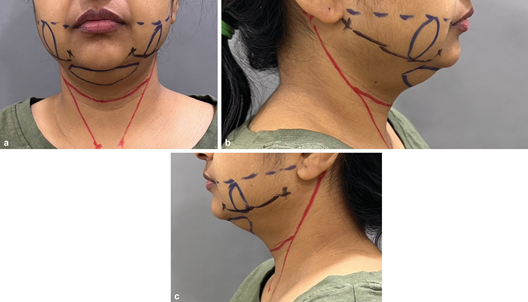
On the day of treatment, the study protocol included clinical marking and standardized photographs in front, oblique and side views. The markings identified the mandibular border, angle of the mandible, anterior border of the sternocleidomastoid and the superior and inferior extent of the treatment area.
Local Anesthesia and Access Points in the Study
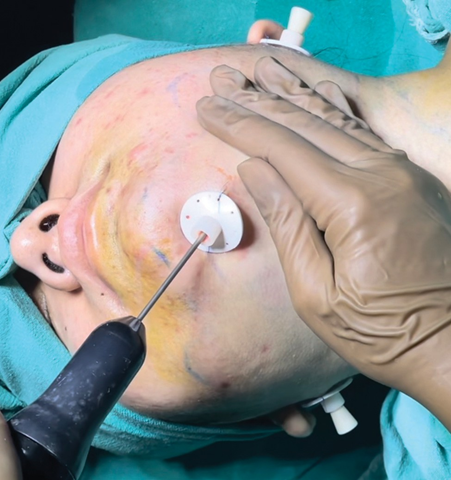
All procedures in the case series were performed under local anesthesia. The study describes a tumescent solution containing plain 2% lignocaine, adrenaline and Ringer's lactate. It was introduced through three points: one behind the chin and one behind each ear. Three approximately 2-mm incisions were then used for infiltration and access.
The required infiltration volume was reported as 150–250 mL depending on the amount of fat in the supraplatysmal plane. The patients remained awake and conversant throughout treatment, with continuous pulse oximetry and intermittent blood-pressure monitoring.
VASER Emulsification and Fat Aspiration
After infiltration, the source protocol used VASER at a 20–40% setting for 2–3 minutes to emulsify the target fat. Fat was then aspirated from all three access sites in multiple directions. The reported aspirated volume ranged from 25 to 150 mL.
Post-Procedure Compression and Follow-Up in the Study
The first follow-up was scheduled at 5 days for recovery assessment and stitch removal. The paper instructed patients to wear the chin strap continuously for 5 days and then at night for another 2 weeks. Results were assessed at 1, 3 and 6 months and finally at 1 year.
These timings describe the study protocol. Real-world aftercare should follow the treating clinician's instructions because compression duration, wound care and follow-up can vary by technique and patient factors.
Results: What Did the Surgeons Observe?
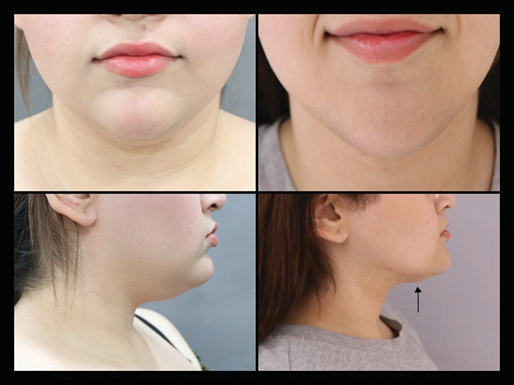
Thirty-five of the 50 patients were rated by the surgeons as having satisfactory results based on two criteria: fat removal and skin tightening. The paper also reports that 5 patients had residual laxity despite overall facial slimming. Patients in the overweight/obese group showed visible change, but the authors advised further neck contouring or weight loss to improve the final result.
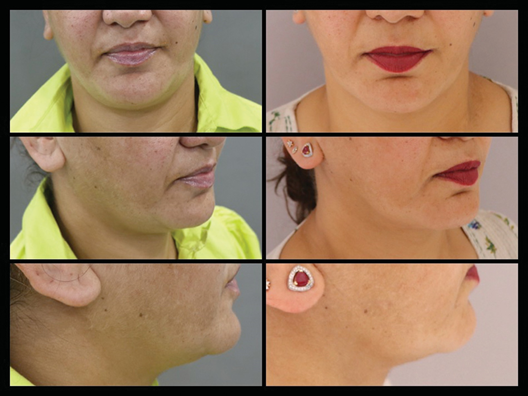
This does not mean the surgeons rated every outcome as technically ideal. The paper reports 35 surgeon-rated satisfactory results, while patient satisfaction placed all 50 patients in the two favorable response categories. These are different endpoints and should not be merged into one percentage.
High BMI and Facial Slimming
The study includes patients with higher BMI who were seeking facial slimming. The authors report that these patients could still achieve a visible difference, but they also advised additional neck contouring or weight reduction for better overall results. The paper specifically shows a patient with BMI 35 at 3 months.

The source therefore supports a nuanced message: liposuction can change local contour in selected higher-BMI patients, but it is not a substitute for broader weight management and may not correct every component of neck fullness.
Does Chin Liposuction Tighten the Skin?
The paper reports skin tightening as one of the surgeon-assessed outcomes, but it also emphasizes that the mechanism is not fully established. The authors discuss ultrasound energy, skin redraping after fat removal, contractile healing and baseline elasticity as possible contributors.
Importantly, patients with pre-existing laxity were more likely to have residual looseness. For a patient-facing page, it is therefore more accurate to say that ultrasound-assisted liposuction may be associated with some tightening in selected patients, rather than promising that it reliably treats moderate or advanced skin laxity.
Why the Supraplatysmal Plane Matters
The source repeatedly distinguishes supraplatysmal fat from deeper structures. The amount of supraplatysmal fat was used to determine infiltration volume, and the authors warn against overly superficial subdermal suction. They state that subdermal suction can damage the subdermal vascular plexus and may contribute to surface irregularities, pigmentation and excessive induration.
The study also identifies subplatysmal fat and submandibular-gland laxity as anatomical findings that affect suitability for stand-alone liposuction. In other words, not all fullness below the jaw should be approached as superficial fat.
Potential Complications Reported or Discussed
The paper lists potential complications of chin and neck liposuction including bleeding, hematoma, seroma, hyperpigmentation, infection, paresis of the marginal mandibular nerve, fibrosis, over-resection and, rarely, globus pharyngeus.
In this 50-patient series, two patients developed temporary neuropraxia of the marginal mandibular nerve. The authors report that the weakness resolved within 4–5 hours and attributed it to probable seepage of tumescent solution into the subplatysmal plane, resolving as the anesthetic effect wore off.
Local Anesthesia: What the Source Actually Shows
Every procedure in the source series was performed under local anesthesia. The authors highlight avoidance of general-anesthesia-related postoperative nausea and vomiting and describe the approach as a "lunchtime liposuction" procedure. That phrase reflects the authors' framing; it should not be interpreted as meaning that the procedure is trivial or requires no recovery planning.
The paper also notes that patients needing general anesthesia for additional procedures such as brow lift, rhinoplasty or body liposuction were excluded from this study. Therefore, the evidence specifically reflects isolated chin/jawline liposuction under local anesthesia rather than complex combined surgery.
How Long Do Results Last?
The authors describe ultrasound-assisted liposuction as a one-time solution with long-lasting results as long as the patient maintains his or her weight. The clinical series included assessments through 1 year, which is useful follow-up for a case series but does not establish lifetime durability.
A careful website statement would therefore be: removed fat can produce durable local contour change, but weight change, aging, skin laxity and deeper neck anatomy can alter the appearance over time.
What the 1-Year Follow-Up Adds
The source study is useful because outcomes were not limited to an immediate postoperative photograph. The authors assessed results at 1, 3 and 6 months and finally at 1 year. Figure 4 specifically documents a postbariatric patient with residual mild skin laxity at 1 year while still being described as having an overall satisfactory result.
This again reinforces the difference between fat reduction and complete skin correction: a patient may be satisfied with facial slimming even when some laxity remains.
Ultrasound-Assisted vs Conventional Liposuction: What the Authors Claim
In their discussion, the authors state that ultrasound-assisted liposuction offers faster recovery, fewer chances of complications, less swelling and bruising and less patient discomfort compared with conventional liposuction. However, this 50-patient article was not designed as a randomized head-to-head comparison against conventional liposuction. Those comparative statements therefore reflect the authors' interpretation and cited literature rather than a direct comparison within this study.
Liposuction vs Non-Surgical Double-Chin Treatments
The source contrasts liposuction generally with nonsurgical options by describing liposuction as a one-time, long-lasting solution when weight is maintained. It does not directly compare ultrasound-assisted liposuction with HIFU, Endolift, radiofrequency, injectables or other specific technologies in a randomized trial.
Can Liposuction Be Combined With Other Facial-Slimming Procedures?
The source states that ultrasound-assisted liposuction can be combined with buccal fat pad removal under local anesthesia to improve overall facial slimming. The study does not provide a separate comparative outcome analysis for this combination, so the point should be presented as the authors' procedural suggestion rather than proven added benefit.
Double Chin Liposuction in Abu Dhabi: What a Consultation Should Clarify
For a patient searching for double chin liposuction in Abu Dhabi, the most important question is whether the visible fullness is actually suitable for liposuction. The source paper provides a useful assessment framework that can be translated directly into consultation questions.
- How much of the fullness is superficial / supraplatysmal fat?
- Is skin tone good enough to redrape after fat removal?
- Is there pre-existing moderate or advanced laxity?
- Are jowls contributing to the lower-face contour?
- Are platysmal bands visible?
- Could deeper subplatysmal fat or submandibular-gland laxity be contributing?
- Is the patient expecting facial slimming, skin tightening, a sharper jawline, or all three?
- Would a different or combined neck-rejuvenation strategy better match the anatomy?
What This Study Supports — and What It Does Not
What the source supports
- Ultrasound-assisted chin and jawline liposuction under local anesthesia was feasible in the authors' 50-patient series.
- The study documented improvements in facial slimming, fat removal and selected skin-tightening outcomes.
- Patient satisfaction was high using the study's four-response index.
- Pre-existing skin laxity can remain after fat removal and may limit the result.
- Assessment of supraplatysmal fat, skin laxity, jowls, platysma, deeper fat and submandibular-gland laxity is relevant to candidate selection.
- Two temporary marginal mandibular neuropraxia events were reported and resolved within hours in this series.
- Follow-up included assessments through 1 year.
What the source does not establish
- Superiority over HIFU, Endolift, radiofrequency, deoxycholic-acid injections or other specific non-surgical treatments.
- Superiority over conventional liposuction within a randomized head-to-head trial.
- A universal VASER setting, tumescent formula, aspiration volume or compression protocol for every patient.
- Guaranteed skin tightening in patients with moderate or severe laxity.
- Long-term outcomes beyond the study's 1-year follow-up.
- An exact definitive number of high-BMI patients because the source reports 10 in one section and 15 in another.
Frequently Asked Questions About Double Chin Liposuction
The supplied 50-patient series reported satisfactory contour improvement in many patients, especially when the main problem was chin/jawline fat with good skin tone. Results were less ideal when significant laxity was already present.
Yes. All 50 patients in the supplied series were treated under local anesthesia and remained awake and conversant during the procedure.
The source describes the ideal candidate as having minimal-to-no skin laxity, good skin tone and localized chin/jawline lipodystrophy.
Some skin-tightening improvement was reported, but the source also documented residual laxity in patients who already had looser skin. Liposuction should not be presented as a reliable substitute for a neck lift in advanced laxity.
VASER is ultrasound-assisted liposuction. In the source protocol, ultrasound energy was used to emulsify fat before aspiration.
The reported aspirated fat volume ranged from 25 to 150 mL. This is study-specific and should not be used as a target volume for an individual patient.
The published protocol used three approximately 2-mm access incisions: one behind the chin and one behind each ear.
In the study, patients were instructed to wear it continuously for 5 days and then at night for 2 weeks. Individual aftercare may differ.
Patients were assessed at 1, 3 and 6 months and finally at 1 year.
The source discusses bleeding, hematoma, seroma, pigmentation, infection, marginal mandibular nerve paresis, fibrosis, over-resection and rare globus pharyngeus, among other considerations.
Two of 50 patients had temporary marginal mandibular neuropraxia, reported to resolve within 4–5 hours.
The source includes higher-BMI patients who achieved facial slimming, but the authors also recommended weight loss or additional contouring in some cases. The paper contains inconsistent high-BMI patient counts, so this subgroup should be interpreted cautiously.
The authors describe it as long-lasting when body weight is maintained. The study itself followed patients for up to 1 year, not for life.
This paper does not compare those treatments directly. The best option depends on whether the dominant issue is superficial fat, skin laxity, deeper anatomy or a combination.
By reducing selected chin and jawline fat, liposuction can improve lower-face contour and mandibular definition in appropriate candidates. It does not correct every cause of a poorly defined jawline.