
Botox for Chronic Migraine in Abu Dhabi: Evidence, Treatment Process & What to Expect
A clinical, evidence-based guide to onabotulinumtoxinA (Botox) as a preventive therapy for chronic migraine — based on the PREEMPT trial program and long-term follow-up data.
What Is Chronic Migraine?
Chronic migraine (CM) is a disabling neurological disorder characterized by frequent headache and migraine symptoms that can affect work, sleep, family life, concentration, and day-to-day function. Medical terminology around this condition evolved over decades — from concepts such as “chronic daily headache” and “transformed migraine” toward the current, formally defined chronic migraine diagnosis.
Under the ICHD-3 classification, chronic migraine means headache occurring on at least 15 days per month for more than 3 months, with migraine headache features present on at least 8 days per month. This distinction matters because the clinical evidence for Botox (onabotulinumtoxinA) is specifically built around chronic migraine — not occasional or low-frequency migraine.
Chronic Migraine vs Episodic Migraine
| Feature | Chronic Migraine | Why the Distinction Matters |
|---|---|---|
| Headache burden | At least 15 headache days per month for >3 months | The pivotal development program targeted patients with high-frequency, disabling disease. |
| Migraine-feature days | At least 8 days per month with migraine features | Helps distinguish chronic migraine from other chronic headache disorders. |
| Clinical impact | Often substantial effects on daily activity and quality of life | Prevention aims to reduce headache frequency and burden — not simply treat one attack. |
| Evidence base | Extensive onabotulinumtoxinA clinical and observational data | Efficacy and safety findings specifically apply to chronic migraine. |
Why Chronic Migraine Can Be So Disabling
People with chronic migraine may experience symptoms on or around many days of the month. Beyond head pain, patients often report dizziness, cognitive difficulty (“brain fog”), light sensitivity, nausea, and other migraine-associated symptoms. This cumulative burden can interfere with employment, education, social plans, and family responsibilities — which is why preventive treatment is judged by headache-day frequency, disability, and quality of life, not simply whether every attack disappears.
How Was Botox Discovered as a Migraine Treatment?
One of the most interesting facts about Botox for migraine is that the benefit was discovered by accident. In the early 1990s, clinicians treating patients with onabotulinumtoxinA for other head and facial conditions noticed that some of these patients also reported improvement in their migraine symptoms. These observations led to chart reviews, open-label studies, and eventually a formal clinical development program.
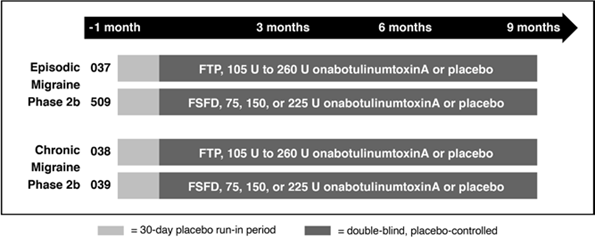
Early development explored multiple doses, cranial injection sites, and strategies such as fixed-site/fixed-dose (FSFD) and “follow-the-pain” (FTP) approaches, which were later standardized into a protocol suitable for Phase 3 testing.
The PREEMPT Program: The Pivotal Evidence
The Phase 3 REsearch Evaluating Migraine Prophylaxis Therapy (PREEMPT) program consisted of two Phase 3 studies. Each included a 24-week double-blind, placebo-controlled phase followed by a 32-week open-label phase. Together, PREEMPT I and PREEMPT II enrolled 1,384 adults with chronic migraine.
A key lesson from the program was that headache-day frequency proved to be a more meaningful efficacy measure for chronic migraine than headache-episode frequency. In PREEMPT I, the original primary endpoint (headache-episode frequency) did not separate significantly from placebo — while headache-day frequency did. PREEMPT II therefore used headache-day frequency as its primary endpoint, and the combined program supported regulatory approval.
What Did PREEMPT Show?
Across the PREEMPT program, onabotulinumtoxinA produced sustained, significant reductions from baseline in headache-day frequency, with incremental benefit across successive treatment cycles. Pooled analyses found a greater proportion of treated patients achieved at least a 50% reduction in headache-day frequency compared with placebo.

Why One Treatment Cycle May Not Tell the Whole Story
An important point for patient counseling: a weak response after the first treatment cycle does not necessarily predict failure of later cycles. Some patients who did not respond to the first cycle experienced clinically meaningful improvement after the second or third cycle.
Longer-term evidence comes from the COMPEL study, in which patients received onabotulinumtoxinA every 12 weeks over 108 weeks — equivalent to nine treatment cycles — adding valuable data on consistency of efficacy, tolerability, and long-term safety.
How Is Botox for Chronic Migraine Given?
Migraine Botox is not the same procedure as cosmetic Botox. It follows a standardized head-and-neck treatment paradigm that requires specialized clinical training, with administration into 31 to 39 injection sites across 7 muscles of the head and neck.
The exact treatment plan, dose, and injection sites should always follow the relevant approved product labeling and be individualized only within appropriate clinical guidance. Botulinum toxin units are not interchangeable between different brands or products.
| Migraine Botox | Cosmetic Botox | Why Patients Should Not Confuse Them |
|---|---|---|
| Neurological preventive indication | Aesthetic reduction of selected expression lines | The treatment goals and clinical endpoints are entirely different. |
| Standardized multi-site head-and-neck paradigm | Injection map depends on the cosmetic area and anatomy | A cosmetic forehead treatment is not a substitute for the migraine protocol. |
| Assessed by headache days, disability, and quality of life | Assessed by movement and wrinkle appearance | Aesthetic improvement does not prove migraine prevention. |
| Requires a confirmed chronic migraine diagnosis and medical evaluation | Requires aesthetic assessment | Correct diagnosis is essential before considering preventive treatment. |
How Does OnabotulinumtoxinA Work in Chronic Migraine?
The mechanism behind Botox for migraine is more complex than simple muscle relaxation. Early clinical observations showed that pain relief could be dissociated from the degree or duration of muscle relaxation — pointing to a sensory and pain-signaling mechanism instead.
After injection into head and neck muscles innervated by sensory nerve terminals, onabotulinumtoxinA is internalized into nerve terminals and cleaves SNAP-25, a protein required for synaptic vesicle fusion. This reduces the release of pain-associated neurotransmitters and neuropeptides — including CGRP and glutamate — and affects membrane insertion of receptors involved in pain (nociceptive) signaling.
Does Botox for migraine work simply by relaxing muscles?
Not only. The evidence points to a pain-modulating mechanism involving sensory nerve terminals and reduced release of pain-related neuropeptides and neurotransmitters. Muscle relaxation alone does not fully explain the clinical migraine effect.
What Results Can Patients Realistically Expect?
The goal of preventive therapy is to reduce migraine burden — a successful outcome does not necessarily mean zero headaches. PREEMPT evidence focused strongly on change in headache-day frequency, while longer-term studies also assessed disability, headache impact, and quality of life.
Long-term studies reported improvements beyond headache frequency alone, including measures of migraine-related disability, quality of life, sleep disturbance, fatigue, depression, and anxiety. These are study-level outcomes and should not be read as a guarantee that every individual patient will experience every benefit.
What About Medication Overuse?
The development program intentionally included many patients with medication overuse, reflecting real-world clinical practice. Evidence shows benefit in chronic migraine populations both with and without medication overuse, and effective prevention may reduce reliance on acute medication in some patients. Patients should never stop or change acute or preventive medicines based on an online article — treatment decisions should always be made with the clinician managing the headache disorder.
Safety and Possible Side Effects
Across clinical trials and real-world studies, onabotulinumtoxinA was generally well tolerated, and adverse events were usually mild to moderate. The frequency of several common adverse events tended to decline over repeated treatment cycles.
- Neck pain
- Muscular weakness
- Eyelid ptosis (drooping)
- Muscle tightness
- Injection-site pain
- Headache
- Myalgia
- Musculoskeletal stiffness or pain
Safety information can vary by jurisdiction and product label. A qualified clinician should review medical history, current medications, prior botulinum toxin exposure, and the locally approved prescribing information before treatment.
When Should a Patient Seek Urgent Medical Assessment?
This guide is not a complete emergency or contraindication reference. Any unexpected neurological symptoms, severe systemic symptoms, or concerning reaction after treatment should prompt appropriate medical evaluation. Patients should follow the emergency and safety instructions given by their treating clinician and the local product labeling.
Botox for Chronic Migraine in Abu Dhabi : What a Good Consultation Should Clarify
For a patient in Abu Dhabi considering preventive treatment with onabotulinumtoxinA, the first step should always be confirming that the headache pattern actually meets chronic migraine criteria — and that other causes or headache diagnoses have been appropriately ruled out.
- How many headache days do I have in a typical month?
- How many of those days have migraine features?
- Has the pattern persisted for more than three months?
- What acute and preventive treatments have I already used?
- Am I overusing acute headache medication?
- What is the planned follow-up strategy after the first treatment cycle?
- How will response be measured — headache days, disability, acute medication use, or a combination?
- Which local product label and dosing paradigm will be followed?
- Who will manage the broader migraine plan if additional preventive or acute therapies are needed?
Should Botox Be Used for Every Migraine?
No. The evidence base is specifically about prevention of chronic migraine and should not be generalized to every type of headache or every patient with episodic migraine. Correct diagnosis is central to appropriate treatment selection.
Is Botox an Acute Migraine Treatment?
No. The approved role for onabotulinumtoxinA is prevention of chronic migraine — it is not a rescue injection to stop an individual migraine attack once it has already started.
Botox and CGRP-Targeted Preventive Therapies
Modern preventive options also include monoclonal antibodies targeting the calcitonin gene-related peptide (CGRP) pathway. However, the core clinical evidence for Botox is primarily historical and development-focused, and does not provide a head-to-head comparison against CGRP-targeted therapies. Treatment selection therefore requires a separate, individualized clinical assessment.
Frequently Asked Questions About Botox for Chronic Migraine
What qualifies as chronic migraine?
The ICHD-3 definition: headache on at least 15 days per month for more than 3 months, with migraine features on at least 8 days per month.
Is Botox approved for chronic migraine?
Yes. OnabotulinumtoxinA became the first medication and first biologic approved specifically to prevent headaches in chronic migraine, in 2010.
Was the approval based on randomized trials?
Yes — the pivotal evidence came from two similarly designed Phase 3, double-blind, randomized, placebo-controlled, multicenter PREEMPT studies.
How many people were in PREEMPT?
PREEMPT I and II together included 1,384 adults with chronic migraine.
Does Botox completely eliminate migraine?
Not necessarily. The clinical program focused on reducing headache-day frequency and overall burden; individual responses vary.
Can benefit improve over several cycles?
Yes. Some patients who did not respond after the first cycle showed clinically meaningful improvement after the second or third cycle.
How often was long-term treatment given in the COMPEL study?
Every 12 weeks over 108 weeks, totaling nine treatment cycles.
Is migraine Botox the same as forehead Botox?
No. Migraine treatment uses a standardized multi-site head-and-neck paradigm, while cosmetic treatment has a different objective and injection plan.
How many injection sites are used?
The migraine treatment paradigm uses 31 to 39 injection sites across 7 head-and-neck muscles.
Do Botox units mean the same thing across brands?
No. Unit doses are not interchangeable among different botulinum toxin products.
Does Botox work only by relaxing tight muscles?
No. The mechanism involves sensory nerve pathways, SNAP-25 cleavage, and reduced release of pain-associated neuropeptides and neurotransmitters.
What side effects were commonly reported?
Neck pain, muscular weakness, eyelid ptosis, injection-site pain, headache, myalgia, muscle tightness, and musculoskeletal stiffness or pain.
Can patients with medication overuse still benefit?
Yes. The development program included patients with medication overuse, and benefit was seen in chronic migraine with or without medication overuse.
Can I stop migraine medications after Botox?
There is no one-size-fits-all answer. Medication changes should always be made together with the clinician managing your migraine care.
How quickly will I know if it works?
Response is typically assessed over repeated treatment cycles rather than immediately — some patients may not show clinically meaningful benefit until later cycles.
Is Botox used for episodic migraine?
The core evidence base focuses on chronic migraine prevention; its conclusions should not automatically be extended to episodic migraine patients.
Who should perform chronic migraine Botox?
Because this is a neurological preventive treatment using a standardized multi-site head-and-neck paradigm, it should be performed by an appropriately qualified clinician experienced in headache assessment and the relevant treatment protocol.