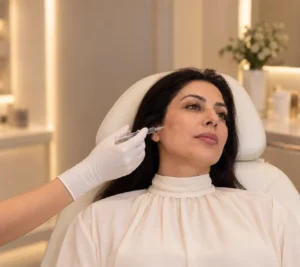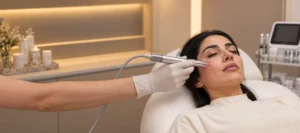
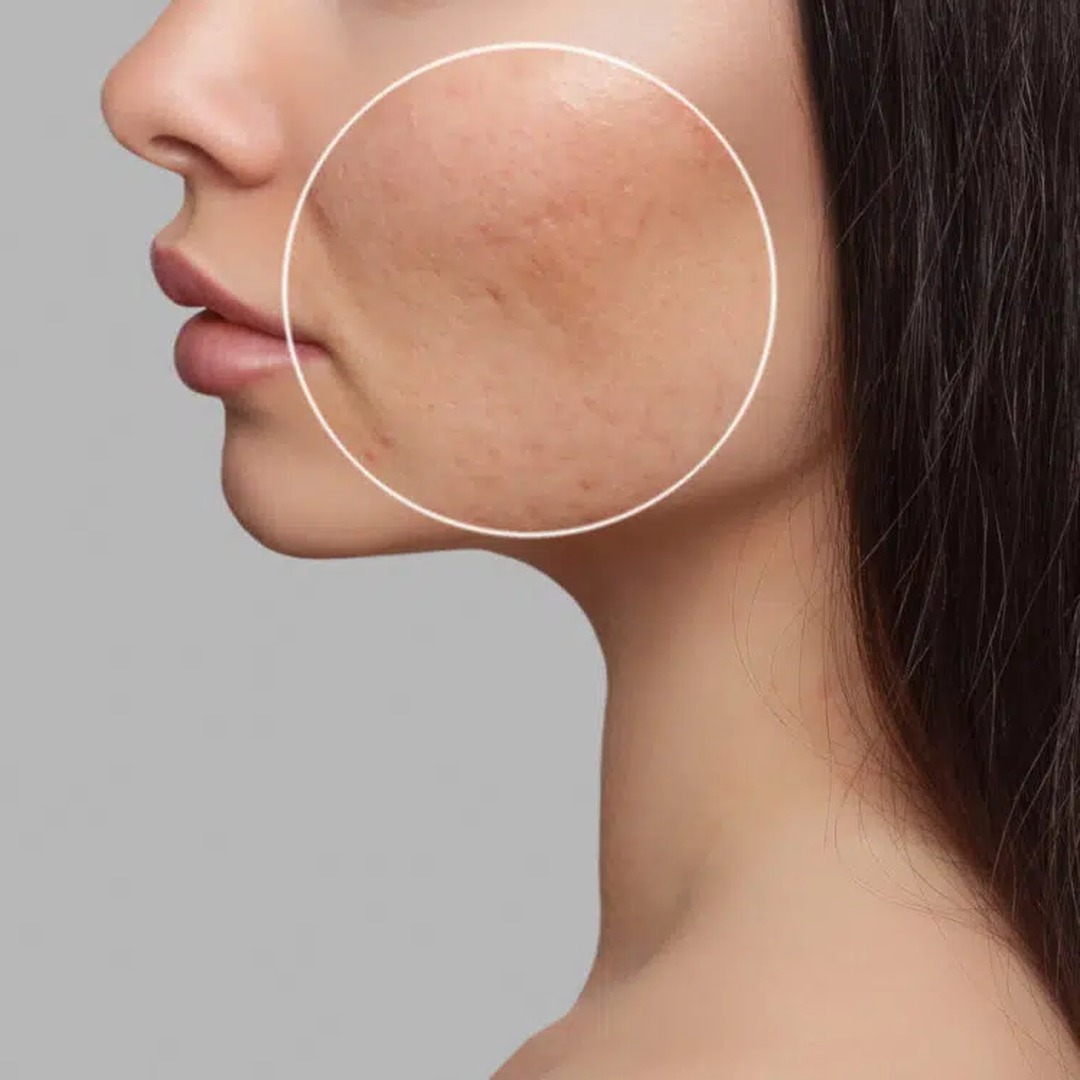
Air-assisted intradermal botulinum toxin + PDRN is an emerging acne-scar treatment concept that combines very superficial botulinum toxin to influence dermal tension and skin quality, controlled air-assisted dermal separation to create localized mechanical stimulation, and PDRN to support fibroblast activity, angiogenesis and extracellular-matrix repair. It’s best understood as a regenerative scar-remodeling approach — not a replacement for subcision, fractional resurfacing or structural filler in scars that clearly need those treatments.
Why acne scars often need more than one mechanism
Acne scars are the end result of abnormal tissue injury and repair. Collagen can be lost, reorganized or tethered; the surface can become irregular; redness or pigmentation may remain; and the mechanical behavior of scarred skin can differ from normal surrounding skin.
This is why a treatment that addresses only one component may leave another unchanged. A scar can be depressed and red, tethered and texturally rough, or shallow but surrounded by enlarged pores and poor dermal quality.
Scar remodeling: mechanical + neuromodulatory + regenerative
| Component | Primary action | Potential target | What it doesn’t automatically solve |
|---|---|---|---|
| Air-assisted dermal stimulation | Localized dermal separation and microtrauma | Scar tissue mechanics and local wound-healing response | Strong deep tethering requiring formal subcision |
| Intradermal botulinum toxin | Neuromodulation + influence on fibroblast behavior and skin-quality pathways | Texture, tension, pores, sebum, selected erythema | Major volume deficiency or deep scar tracts |
| PDRN | Regenerative signaling through A2A-related pathways | Fibroblast proliferation, angiogenesis, collagen/ECM remodeling | Immediate structural elevation of deep scars |
What is intradermal botulinum toxin?
Conventional botulinum toxin treatment is usually designed to reduce selected muscle contraction. Intradermal microtoxin uses much more superficial placement and a different treatment logic — the goal is to influence the skin and superficial neuromuscular environment while preserving natural facial movement.
In acne-scar treatment, this concept is used to reduce local mechanical tension and support a more favorable remodeling environment. It may help scar quality by:
- Reducing local contractile tension that can act across scar edges
- Supporting more orderly collagen remodeling
- Influencing fibroblast behavior
- Improving selected aspects of texture and elasticity
- Reducing excessive sebum activity in suitable patients
- Making enlarged pores appear less prominent
- Potentially improving selected redness-related skin-quality concerns
Standard neuromodulator treatment is planned around muscle anatomy and dynamic wrinkles. Intradermal microtoxin is placed much more superficially and is used for a skin-quality or scar-remodeling objective — the dose, depth and distribution strategy are therefore different from facial Botox.
What is PDRN?
Polydeoxyribonucleotide, usually abbreviated PDRN, is a DNA-derived regenerative compound commonly sourced from highly purified salmon-derived material. Its aesthetic role centers on tissue repair rather than structural filling — supporting a healthier environment for fibroblasts, vascular repair and extracellular-matrix remodeling.
PDRN interacts with adenosine A2A-related pathways associated with tissue repair. The downstream effects include support for angiogenesis, fibroblast proliferation and extracellular-matrix renewal — relevant because atrophic scars contain areas of disorganized collagen, altered mechanical support and impaired tissue quality.
Fibroblasts are central to collagen and extracellular-matrix maintenance, so a regenerative treatment aims to improve the local environment those cells work in, rather than simply covering the scar with surface hydration.
PDRN isn’t used to create the same projection or structural volume as a cheek, chin or jawline filler. Its role is regenerative. If an acne scar remains depressed because true support is missing, filler or another structural treatment may still be needed.
What does the air-assisted technique add?
The air-assisted technique introduces a small controlled amount of air into the dermal layer before or alongside a tiny intradermal toxin deposit. This produces a temporary wheal and creates localized tissue separation, with two intended effects: distributing the intradermal treatment across the target dermis, and creating controlled microtrauma that may stimulate a repair response.
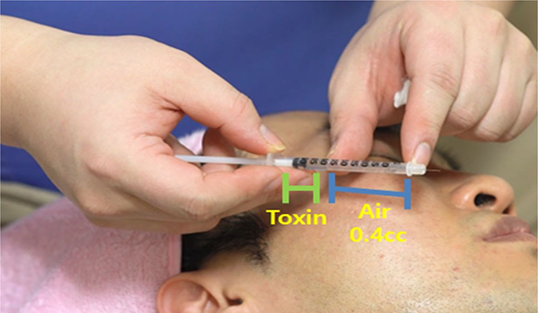
Dermal wheal formation
The needle is placed at a low angle with the bevel facing upward. Correct dermal placement creates a small temporary air pocket or wheal and brief blanching at the injection point.

Air-assisted injection vs. traditional subcision
| Feature | Air-assisted dermal injection | Traditional subcision |
|---|---|---|
| Primary mechanism | Localized dermal separation + microtrauma + delivery of regenerative agents | Mechanical cutting/release of fibrous tethering |
| Typical plane | Dermal | Subdermal / scar-tether plane |
| Main target | Skin-quality remodeling and selected scar irregularity | Tethered rolling scars |
| Trauma level | Designed to be relatively limited | Can create more bruising and deeper tissue release |
| Can one replace the other? | No | No — choose according to scar anatomy |
Technical procedure framework
The following section preserves the complete technical framework represented in the supplied clinical material. It is not a universal dosing recommendation. Product labeling, local regulation, individual anatomy and clinician training must determine the actual protocol.
Botulinum toxin preparation
A technical example uses a 100-unit vial of botulinum toxin reconstituted with 2.5 mL of normal saline, giving a concentration of 4 units per 0.1 mL. A small quantity of the toxin solution is placed in a 0.5 mL insulin syringe, with an air space created so a controlled air-toxin sequence can be delivered into the dermal layer.
Air and toxin delivery
The technical setup uses a small dermal air component together with approximately 0.1 mL of prepared toxin solution in the syringe. Because the practical air volume can vary during syringe handling and recharging, the important procedural concept is controlled dermal wheal formation rather than treating a fixed air volume as a universal prescription.
Topical anesthesia
Topical anesthetic can be applied to the scarred areas before treatment and allowed enough time to provide adequate comfort. The original technical protocol uses an extended topical-anesthetic period before injection.
Injection depth and angle
The needle is inserted just into the dermis at a low angle with the bevel facing upward. The air component is delivered rapidly enough to create a small superficial wheal, followed by a very small toxin deposit.
How a treatment course can be structured
Because scar remodeling is gradual, this approach is better thought of as a treatment course rather than a one-time instant correction. A practical framework uses three sessions spaced at approximately four-week intervals, followed by reassessment after the final treatment — though the schedule should still be individualized around active acne, skin sensitivity, healing speed, scar type and combination procedures.
| Phase | Purpose | What to assess |
|---|---|---|
| Initial session | Establish response and tolerance | Wheal formation, bruising, redness, early scar behavior |
| Second session | Build regenerative response | Texture, scar stiffness, redness, surface uniformity |
| Third session | Complete initial course | Residual depression and skin-quality change |
| Follow-up | Judge remodeling after treatment has settled | Scar depth, texture, color, pliability and patient satisfaction |
How improvement should be assessed
Good scar assessment includes both what the clinician sees and what the patient experiences — improvement isn’t only about depth. Important domains include pain, itching, color, stiffness, thickness, surface irregularity, vascularity, pigmentation, relief, pliability and total scar area.
| Patient-reported domain | Clinician-observed domain | Why it matters |
|---|---|---|
| Pain | Vascularity | Inflammation and sensitivity can change even if scar depth changes little |
| Itching | Pigmentation | Symptoms and color are separate from contour |
| Color difference | Thickness | Scar color and scar thickness need different endpoints |
| Stiffness | Relief | Mechanical behavior matters in fibrotic scars |
| Thickness | Pliability | A softer scar may be clinically better even before it looks flat |
| Irregularity | Surface area | Texture and overall scar field should both be documented |
| Overall opinion | Overall clinical impression | Patient benefit and clinician assessment should be considered together |
Clinical appearance
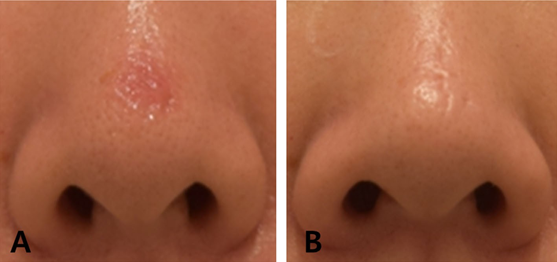
Nasal atrophic scar
The nose can be difficult to treat because the skin, sebaceous activity and scar geometry differ from the cheeks. A regenerative approach may be considered when the main issue is a superficial atrophic depression accompanied by texture irregularity.
Cheek and zygomatic scarring
Cheek scars are often mixed in morphology — broad textural irregularity, shallow atrophic scars, redness and pore changes can overlap in the same region.

What changes can this approach target?
- Scar surface irregularity
- Shallow atrophic depressions
- Dermal texture and skin elasticity
- Pore appearance and sebum-related skin quality
- Residual erythema or red acne-scar appearance in selected patients
- Scar stiffness and tissue pliability
- Overall skin uniformity
Why red acne scars may look better
Residual erythema can remain after acne inflammation has settled. Intradermal neuromodulation may influence superficial vascular behavior and skin tone, while regenerative repair may improve the surrounding tissue environment. This shouldn’t be confused with a dedicated vascular-laser treatment — persistent telangiectasia, rosacea or a primary vascular disorder still needs its own diagnosis and treatment plan.
Pores, sebum and skin texture
Very superficial botulinum toxin can reduce selected secretory and contractile influences around the skin surface. In the right patient, this can make pores look less prominent and improve the appearance of oiliness — but these benefits are secondary to the scar-remodeling objective and shouldn’t be used to promise a pore-free or permanently oil-free face.
Which acne scars are most logical for this treatment?
This technique should not replace scar classification. Before treatment, scars should still be mapped as rolling, boxcar, ice pick or mixed.
| Scar type | Potential role of air-toxin + PDRN | What may still be needed | Planning note |
|---|---|---|---|
| Shallow rolling | Skin-quality remodeling + limited mechanical separation | Formal subcision if strong tethering persists | Stretch test and palpation are important |
| Boxcar | May support texture and dermal remodeling | Fractional resurfacing, RF microneedling or focal correction depending on depth | Sharp edges may remain |
| Ice pick | Limited role for the deep tract itself | CROSS or another focal deep-scar treatment | Do not rely on superficial injection alone |
| Mixed scars | Useful as one component of a staged plan | Different modalities for different scar structures | Treat the dominant structural problem first |
How it compares with other acne-scar treatments
| Treatment | Main target | Where it’s strongest | Where it’s limited |
|---|---|---|---|
| Air-toxin + PDRN | Dermal quality + regenerative remodeling + limited mechanical separation | Texture, shallow atrophy, redness, pores, skin quality | Deep tethering and deep focal tracts |
| Subcision | Fibrous tether release | Tethered rolling scars | Surface texture and pigment |
| RF microneedling | Dermal thermal remodeling | Rolling/boxcar texture, pores | Does not mechanically release every tether |
| Fractional laser | Resurfacing + collagen remodeling | Boxcar edges and overall texture | Pigment risk and downtime; does not replace tether release |
| TCA CROSS | Focal chemical reconstruction | Ice pick / narrow deep scars | Broad rolling scars |
| Filler | Structural elevation | Residual distensible depressions | Does not improve every texture problem |
How it can fit into combination acne-scar treatment
The strongest acne-scar plans are usually based on structure rather than loyalty to one device or injectable. Air-assisted intradermal toxin + PDRN can be positioned as a regenerative skin-quality layer within a broader plan:
- Tethered rolling scar: release the tether first if necessary, then use regenerative treatment for texture and skin quality
- Boxcar scar: address sharp scar edges or dermal depth with resurfacing/RF, then use regenerative treatment as an adjunct when appropriate
- Ice pick scar: treat the deep focal tract directly; use regenerative treatment for surrounding skin quality rather than as the only scar procedure
- Red atrophic scar: consider whether erythema, scar depression and skin texture each need a separate treatment component
- Mixed acne scars: map scar type by zone and stage procedures rather than treating the entire face with one method
Candidacy
Safety and expected short-term reactions
The treatment uses multiple intradermal injection points, so short-term local reactions are expected — mild swelling, redness and pain or tenderness can occur. The air-assisted portion also creates temporary visible wheals; cooling can improve comfort while the small air pockets disperse.
Potential risks to discuss
- Bruising
- Temporary swelling or redness
- Injection-site pain
- Temporary surface irregularity from dermal wheals
- Infection
- Unwanted neuromodulator effect if product is placed too deeply or spreads beyond the intended superficial field
- Hypersensitivity or product-related reaction
- Incomplete scar improvement
Increasing redness, heat or pain instead of gradual improvement; pus, drainage or fever; marked asymmetry or unexpected muscle weakness; persistent or worsening swelling; skin discoloration or tissue changes outside expected injection-site recovery; or any reaction that feels disproportionate to the expected short-term response.
Aftercare
- Use cooling only as instructed to reduce discomfort and visible wheals
- Avoid repeated rubbing, pressure or manipulation of treated skin during early recovery
- Use gentle skin care while injection sites are sensitive
- Use broad-spectrum sunscreen consistently
- Delay irritating acids, retinoids or strong exfoliation until the skin barrier has settled
- Follow individualized instructions regarding exercise, sauna, heat exposure, makeup and other procedures
This technique is best described as an emerging regenerative option for acne-scar remodeling. It should not be marketed as a proven replacement for established scar procedures, and it should not be used to guarantee a fixed percentage of scar clearance. Long-term durability, ideal product concentration, ideal treatment interval and the best combination sequence still require further refinement.
What a good consultation should clarify
- Which of my scars are rolling, boxcar, ice pick or mixed?
- Are any rolling scars strongly tethered and better treated with subcision first?
- Is my main concern scar depth, texture, redness, pores, oiliness or a combination?
- Would intradermal toxin add a meaningful skin-quality benefit in my case?
- Which PDRN product and formulation will be used?
- How superficial will the toxin be placed, and how will unwanted muscle weakness be avoided?
- What does the air-assisted component add compared with standard intradermal injection?
- How many sessions should be performed before reassessment?
- Which scars are unlikely to respond enough to this technique alone?
- Would RF microneedling, laser, CROSS, filler or subcision be more appropriate for any part of my scar pattern?
- What swelling, redness and wheal formation should I expect immediately after treatment?
- How will standardized photographs and scar-quality measurements be used to judge the result?
Patient scar questionnaire
A complete scar evaluation should include symptoms and the patient’s own perception, not only photographs. The following 1-to-10 framework can be used before treatment and during follow-up.
| Question | Low end of scale | High end of scale |
|---|---|---|
| Did your scar hurt in the last few weeks? | 1 = no pain | 10 = very much |
| Have you had itchy scars in the last few weeks? | 1 = no itching | 10 = very much |
| Is the current scar color different from normal skin color? | 1 = like normal skin | 10 = very different |
| Is the stiffness of the current scar different from normal skin? | 1 = like normal skin | 10 = very different |
| Is the current scar thickness different from normal skin? | 1 = like normal skin | 10 = very different |
| Are the scars more irregular than normal skin? | 1 = like normal skin | 10 = very different |
| What is your overall opinion of the scar compared with normal skin? | 1 = like normal skin | 10 = very different |
Clinician scar assessment framework
Clinical follow-up can use a parallel 1-to-10 framework for objective scar features. Each domain should be judged against nearby normal skin and documented consistently.
| Parameter | Clinical categories to document | Why it matters |
|---|---|---|
| Vascularity | Pale / pink / red / purple / mixed | Tracks erythema and vascular change |
| Pigmentation | Hypopigmented / hyperpigmented / mixed | Separates color change from depth |
| Thickness | Thicker / thinner | Tracks atrophy or hypertrophic change |
| Relief | More / less / mixed | Describes surface elevation or depression |
| Pliability | Supple / stiff / mixed | Measures scar mechanics |
| Surface area | Expansion / contraction / mixed | Tracks overall scar-field change |
| Overall opinion | 1 = normal skin to 10 = worst imaginable | Provides a global clinician endpoint |
Frequently asked questions
What is air-assisted botulinum toxin for acne scars?
It’s a superficial injection technique that combines a small dermal air pocket with intradermal botulinum toxin to create localized dermal separation and a skin-quality neuromodulatory effect.
What is PDRN?
PDRN is a DNA-derived regenerative injectable used to support fibroblast activity, angiogenesis, extracellular-matrix remodeling and tissue repair.
Why combine botulinum toxin with PDRN?
The combination targets different parts of scar remodeling: dermal tension and skin quality from superficial neuromodulation, controlled mechanical stimulation from the air component, and regenerative signaling from PDRN.
Is this the same as Botox for wrinkles?
No. Wrinkle treatment usually targets facial muscles. This technique uses much more superficial intradermal micro-aliquots for a skin-quality and scar-remodeling objective.
Is the air injection the same as subcision?
No. Air-assisted injection creates localized dermal separation. Traditional subcision mechanically releases deeper fibrous bands beneath tethered scars.
Can this treatment replace subcision?
Not when strong tethering is the main structural problem. Tethered rolling scars may still need formal subcision.
Can it treat ice pick scars?
It may improve surrounding skin quality, but narrow deep ice-pick tracts usually need a focal deep-scar treatment.
Can it treat boxcar scars?
It may help texture and dermal quality in selected boxcar scars, but deeper or sharp-edged boxcar defects may need resurfacing or structural correction.
Can it treat rolling scars?
Shallow rolling scars may benefit, but strongly tethered rolling scars should be assessed for subcision.
Can it reduce scar redness?
It may improve selected erythema-related features, but persistent vascular redness may still need a dedicated vascular treatment.
Can it improve pores?
Superficial botulinum toxin can make pore appearance less prominent in some patients by influencing skin-surface and sebaceous activity.
Can it reduce oily skin?
Intradermal microtoxin can influence sebum activity, although oil control is a secondary benefit rather than the primary scar-treatment goal.
Does PDRN build collagen?
PDRN supports fibroblast and extracellular-matrix activity, which can contribute to collagen remodeling as tissue repairs.
Does PDRN fill acne scars?
Not in the same way as a structural dermal filler. Its primary role is regenerative rather than volumizing.
How is the treatment injected?
A low-angle intradermal technique creates small superficial wheals and distributes very small toxin deposits, followed by or combined with dermal PDRN placement.
Why does the skin turn white at the injection point?
Temporary blanching can occur when a superficial air pocket or wheal forms in the dermis.
How long do the air bubbles last?
The visible wheals are temporary and typically flatten as the air disperses over the early post-treatment period.
Does it hurt?
Multiple small intradermal injections can cause discomfort. Topical anesthesia and cooling can be used to improve treatment comfort.
How many sessions are needed?
A staged course can be used, often with several sessions spaced weeks apart, followed by reassessment. The exact number should be individualized.
When do results appear?
Scar remodeling is progressive. Texture and skin-quality changes should be judged over follow-up rather than immediately after injection.
What is the downtime?
Temporary wheals, redness, mild swelling and tenderness can occur. Bruising is also possible.
What are the main side effects?
Common short-term effects include swelling, redness and injection-site pain. Infection, unwanted neuromodulator spread or product reactions are less common but require proper medical management.
Can it cause facial weakness?
Superficial placement is intended to limit deep muscle effects, but unwanted weakness is possible if toxin reaches unintended structures.
Can I have this with active acne?
Severe uncontrolled inflammatory acne or active infection in the treatment field should be addressed before elective regenerative injections.
Can it be combined with RF microneedling, laser, filler or subcision?
Potentially, yes, for all four. RF microneedling and laser address different aspects of texture and resurfacing; filler suits true structural volume loss; subcision addresses deep fibrous tethering. Timing should allow appropriate healing between procedures, and tethering is usually released before or alongside regenerative treatment.
Is the treatment established for every acne scar patient?
No. It’s an emerging regenerative technique and should be selected carefully rather than used as a universal acne-scar protocol.
What is the biggest mistake with this treatment?
Using it without classifying the scars first. Deep tethering, narrow ice-pick tracts and major structural depressions may need different treatments.