
What Is Acne Scar Subcision?
Subcision is a small office-based procedure used to release depressed scars that are being pulled downward from beneath the skin. The technique is sometimes described as an incisionless subcutaneous release because the scar is approached through a needle puncture rather than a surgical skin incision.
The goal is not to remove the scar. The goal is to separate the underside of the scar from the fibrotic attachments that keep it depressed. Once the tether is released, the surface can rise and the healing response can add new connective-tissue support below the scar.
Why Some Acne Scars Stay Depressed
A depressed acne scar can remain low for more than one reason. In the scars most suited to subcision, fibrotic tissue acts like a set of small anchors between the skin and deeper tissue. These attachments restrict the scar from moving freely and create a visible depression.
When the surrounding skin is stretched, a tethered rolling scar may become less obvious because the surface can temporarily flatten. This distensibility is one of the practical clues that scar release may be relevant.
Rolling Acne Scars: The Main Subcision Target
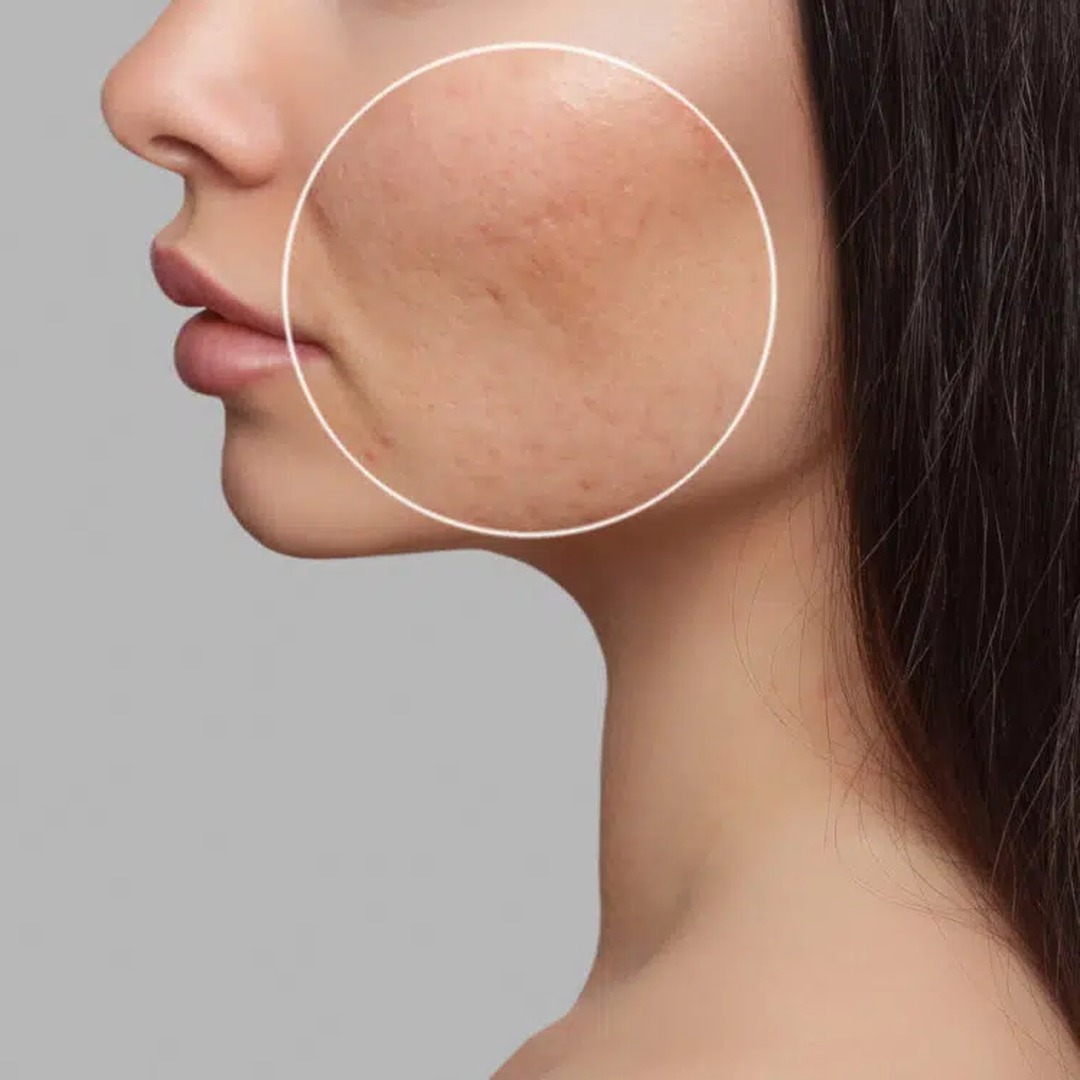
Rolling scars are broad, shallow-to-deeper depressions with smooth or gently sloping edges. Rather than looking like a sharply punched-out hole, they create an uneven or wave-like surface across the cheek.
They are particularly suited to subcision when the depression is caused by tethering beneath the skin. The treatment therefore addresses the mechanical cause of the contour change rather than simply resurfacing the top of the scar.
Not Every Acne Scar Needs Subcision
| Scar Pattern | Typical Appearance | Role of Subcision | Planning Point |
|---|---|---|---|
| Rolling / tethered depressed scar | Broad depression with gentle edges; may improve when skin is stretched | Often highly relevant | Release the tether first when it is the main cause of the depression |
| Depressed scar without obvious tethering | Low surface but less mobile relationship to deeper tissue | May be less predictable | The scar may need a different or additional technique |
| Surface texture problem | Fine irregularity rather than a clear tethered depression | Usually not the main treatment | Resurfacing or collagen-remodeling treatment may be more relevant |
| Mixed acne-scar pattern | Several scar mechanisms present together | One part of a combination plan | Treat each scar according to its dominant mechanism |
The Fibrotic Band: The Main Structure Being Released
Fibrotic scar strands can connect the underside of the depressed scar to the deeper dermal or subcutaneous plane. These bands behave like internal tethers. The surface remains pulled downward even when the surrounding skin has reasonable volume.
Subcision works by moving a cutting edge horizontally beneath the scar so that the fibrous strands are divided. A characteristic resistance may be felt as the band is engaged and released.
Why the Needle Is Kept Parallel to the Skin
Traditional subcision technique keeps the needle oriented horizontally, parallel to the skin surface. The purpose is to work beneath the scar within the intended tissue plane rather than directing the sharp edge vertically toward the skin surface or deeper structures.
Maintaining orientation is a technical safety point. If the cutting edge rotates unpredictably, the operator can lose control of which tissue is being released.
How Acne Scar Subcision Is Performed
The exact technique varies by clinician and scar pattern, but the basic principle remains consistent: anesthetize the area, create a small puncture, enter beneath the scar, release the tethering bands, control bleeding and allow the treated area to heal.
| Step | What Happens | Why It Matters |
|---|---|---|
| 1. Assessment | The scar is examined for rolling contour and tethering | Confirms that mechanical release is relevant |
| 2. Local anesthesia | Topical and/or injected local anesthesia is used | Improves comfort during the release |
| 3. Entry point | A small puncture is created adjacent to the scar | Provides access without a conventional surgical incision |
| 4. Horizontal placement | The needle is advanced parallel to the skin into the deep dermal or dermal-subcutaneous plane | Keeps the treatment at the level of the fibrotic bands |
| 5. Scar release | Back-and-forth and fan-like movements divide tethering strands | Reduces the downward pull responsible for the depression |
| 6. Hemostasis | Pressure and cooling are used to control bleeding and swelling | Limits excessive hematoma while allowing normal healing |
| 7. Follow-up | The scar is reassessed after healing | Determines whether another session or combination treatment is needed |
What Does the Release Feel Like?
Even with local anesthesia, patients may feel pressure, movement or pulling beneath the skin. The operator may feel resistance as fibrotic strands are engaged and released. Treatment comfort depends on scar number, scar density and the area being treated.
Why a Fan-Like Motion Is Used
A single tether can have multiple attachments under a broader rolling scar. Fan-like movement allows the operator to approach the scar from slightly different directions through the same access point and release a wider fibrotic field.
Why Bruising and a Small Hematoma Can Occur
Subcision intentionally disrupts fibrous tissue beneath the skin, so small blood vessels can also be disturbed. A controlled collection of blood may develop in the released space. This can temporarily create swelling, firmness or blue-purple discoloration.
The aim is controlled release, not a large expanding hematoma. Pressure and cooling are used immediately after treatment to reduce excessive bleeding and swelling.
How Many Subcision Sessions Are Needed?
Many rolling scars do not fully correct after one session. A scar may contain multiple fibrotic attachments, and different scars on the same cheek can have different depths and degrees of tethering.
Repeat treatment can therefore be planned after the area has healed and the true remaining depression can be reassessed. The endpoint is based on scar response rather than a fixed session number.
Why Staging Many Scars Can Be Helpful
Treating a large number of scars in one sitting can increase swelling and bruising. When scar burden is high, a clinician may choose to treat selected scars or one cheek at a time and stage the remainder. This approach can make the recovery more manageable and allows the response of the first treated area to guide the next session.
Why Subcision Is Often Combined With Other Acne-Scar Treatments
Acne scars are frequently mixed. One scar may be tethered, another may be primarily textural, and another may require a different form of scar revision. Subcision solves tethering, but it does not automatically resurface every irregularity in the epidermis or dermis.
Subcision + Fractional Laser
Once a tethered scar has been released, fractional resurfacing can be considered for residual surface irregularity and dermal remodeling. The two treatments address different components of the scar: subcision releases the mechanical attachment, while fractional laser works on the skin and scar matrix from above.
Subcision + Dermaroller / Microneedling
Microneedling-type treatment can be used as an adjunct when broader collagen remodeling is needed after the scar has been mechanically released. It should not be expected to cut a strong deep fibrotic tether by itself.
Subcision + Other Scar-Revision Techniques
Some patients have scars that need more than one type of revision. A staged plan may include subcision together with other localized scar procedures. The most important principle is to match each technique to the structure responsible for that particular scar.
When Subcision Alone May Not Be Enough
- The scar is not actually tethered.
- The dominant problem is surface texture rather than a depressed tethered contour.
- The scar has sharply defined architecture that needs a different scar-revision technique.
- There is a broad mixed-scar pattern requiring several treatment modalities.
- The patient expects completely smooth, scar-free skin rather than realistic improvement.
- Active acne or an active inflammatory skin problem is still creating new scars.
Facial Anatomy and Safety
Subcision is performed beneath the skin, so knowledge of facial anatomy is essential. The goal is to remain in the correct scar plane while avoiding injury to important nerves and vessels.
The preauricular, temporal and mandibular regions deserve particular care because major vessels and branches of the facial nerve can be present in these areas. Scar location therefore influences technique, entry point and whether subcision is appropriate.
Expected Short-Term Effects After Subcision
- Bruising or blue-purple discoloration
- Swelling
- Tenderness or soreness
- Temporary firmness under the treated scar
- Small puncture marks at entry points
- Asymmetry during the early swelling phase
The appearance immediately after treatment is not the final result. Swelling can temporarily make a scar look more elevated, while bruising can make the surrounding skin look darker. The scar should be reassessed after the acute recovery period has settled.
Potential Risks and Complications
Subcision is generally a small office procedure, but it is still a surgical release performed below the skin surface. Potential complications should be discussed before treatment.
| Potential Issue | What It May Look Like | Why Follow-Up Matters |
|---|---|---|
| Bruising / hematoma | Blue-purple discoloration, swelling or localized firmness | Usually monitored conservatively, but expanding swelling requires reassessment |
| Edema | Puffiness around the treated area | Often temporary; excessive or worsening swelling should be reviewed |
| Pain / tenderness | Soreness at the treated scar or entry point | Persistent or increasing pain can signal a complication |
| Infection | Increasing redness, warmth, drainage or worsening pain | Requires prompt medical assessment |
| Vessel or nerve injury | Unusual bleeding, sensory or motor change | Risk is reduced by anatomical knowledge and careful technique |
| Incomplete release | Residual depression after healing | May require a repeat session or another scar technique |
Aftercare After Acne Scar Subcision
- Use cold packs or ice as advised during the early post-treatment period.
- Avoid repeatedly pressing, rubbing or massaging the treated area unless the clinician specifically instructs you to do so.
- Keep puncture sites clean while they close.
- Use gentle skin care while bruising or tenderness is present.
- Follow individualized instructions regarding medication, exercise, heat exposure and timing of other acne-scar procedures.
- Use sunscreen consistently, particularly if the skin is bruised or inflamed.
- Contact the clinic if swelling, heat, redness or pain is worsening instead of settling.
When to Contact the Clinic Urgently
- Rapidly increasing swelling or an expanding hematoma
- Severe or worsening pain
- Persistent bleeding that does not stop with pressure
- Increasing warmth, redness, pus or fever
- New facial weakness or unusual sensory change
- Skin color change that appears concerning or unexpected
Who May Be a Good Candidate?
- Patients with rolling acne scars that are visibly depressed and tethered
- Patients whose scars soften or flatten when the surrounding skin is stretched
- Patients who understand that acne-scar treatment is usually improvement rather than complete scar removal
- Patients willing to accept temporary bruising and swelling
- Patients who may need more than one treatment session
- Patients with mixed acne scars who are willing to use combination treatment when necessary
Who May Need a Different or Additional Treatment?
- Patients whose main scar problem is not tethering
- Patients with active inflammatory acne that is still producing new lesions
- Patients with scar patterns that need a different form of revision
- Patients seeking mainly pigment correction rather than contour correction
- Patients expecting one procedure to completely erase a complex mixed-scar pattern
Acne Scar Subcision in Abu Dhabi: What a Good Consultation Should Clarify
- Are my scars truly rolling and tethered?
- Which scars need mechanical release and which scars need another treatment?
- How many scars should be treated in one session?
- Where will the entry points be placed?
- What tissue plane will be used for the release?
- What type of needle or scar-release instrument is planned?
- What amount of bruising and swelling should I realistically expect?
- Should my treatment be staged one cheek or one group of scars at a time?
- When should a repeat session be considered?
- Would fractional laser, microneedling or another scar treatment be useful after release?
- What warning signs should prompt an urgent review?
- How will progress be documented with standardized photographs?
Subcision vs Surface Acne-Scar Treatments
| Treatment Concept | Main Target | Strength | Main Limitation |
|---|---|---|---|
| Subcision | Fibrotic tether beneath a depressed scar | Directly releases mechanical attachment | Does not resurface every surface irregularity |
| Fractional laser | Dermal / surface scar remodeling | Texture and collagen remodeling | Does not directly cut a deep tether |
| Microneedling / dermaroller | Dermal collagen stimulation | Broader textural remodeling | Less direct for strong fibrotic attachments |
| Scar-specific revision | Localized scar architecture | Useful for selected scar patterns | Not a single solution for a widespread mixed pattern |
Frequently Asked Questions
What is acne scar subcision?
Subcision is a minimally invasive procedure that releases fibrous strands underneath depressed acne scars so the scar can rise closer to the level of surrounding skin.
Which acne scars respond best to subcision?
Rolling scars with gentle sloping edges and clear tethering are the classic scars most suited to subcision.
What is a tethered acne scar?
It is a depressed scar that is attached to deeper tissue by fibrotic bands that pull the skin downward.
How do I know if a scar is rolling?
Rolling scars are usually broad depressions with smooth slopes rather than sharply punched-out edges. They can become less obvious when the skin is stretched.
Does subcision remove the scar completely?
The goal is improvement in depression and contour, not complete scar erasure.
How does subcision work?
A needle or specialized scar-release instrument is passed beneath the scar and moved in a controlled horizontal pattern to divide tethering fibrous bands.
Is subcision surgery?
It is a minor office-based surgical release performed through a small skin puncture rather than a conventional incision.
Is local anesthesia used?
Yes. Subcision is generally performed with local anesthesia, which may include topical and/or injected anesthesia depending on the treatment plan.
What needle is used for subcision?
Traditional techniques use an 18- or 20-gauge needle or a specialized beveled subcision needle. Instrument choice varies by clinician and scar pattern.
Why is the needle kept parallel to the skin?
Horizontal orientation helps the operator work within the intended deep dermal or dermal-subcutaneous plane and control the cutting edge.
What is the fan-like motion in subcision?
It is a controlled movement beneath the scar that releases fibrotic attachments from several directions through an access point.
Does subcision hurt?
Local anesthesia reduces pain, but patients can still feel pressure, pulling or movement beneath the skin.
Is bruising normal?
Yes. Bruising and blue-purple discoloration are common possibilities because small blood vessels can be disturbed during scar release.
Why can a small hematoma form?
A controlled blood collection can occupy the released space beneath the scar while healing begins. Excessive or expanding bleeding is not the goal.
How long is the downtime?
Downtime varies with the number of scars treated and the amount of bruising or swelling. Patients should plan for visible discoloration after treatment.
Can I go to work after subcision?
Some patients can work, but visible bruising or swelling may make it preferable to schedule treatment before a quieter period.
How many subcision sessions do I need?
There is no fixed number. Repeat sessions are often needed when tethering is extensive, and the decision should be made after healing and reassessment.
How long should I wait before another session?
Repeat treatment is generally planned after the treated area has healed enough to judge the remaining tethering. The interval is individualized.
Can all my scars be treated in one session?
Not always. When many scars are present, staged treatment can reduce excessive swelling and make recovery easier.
Can subcision be combined with fractional laser?
Yes. Subcision releases the tether, while fractional laser can address residual surface and dermal scar irregularity.
Can subcision be combined with microneedling?
Yes. Microneedling can be used as an adjunct for collagen remodeling after or around a scar-release plan.
Can subcision treat ice-pick or sharply edged scars?
Subcision is mainly designed for rolling tethered scars. Other scar patterns may need different scar-revision techniques.
Can subcision improve large pores?
Pore appearance is not the primary target of subcision. The treatment is intended to release depressed tethered scars.
Does subcision treat pigmentation?
No. Pigmentation and scar depth are different problems and may need separate treatment.
Can subcision make acne worse?
Subcision does not treat active acne. Ongoing inflammatory acne should be controlled so that new scars are not continually forming.
What are the main risks?
Bruising, swelling, hematoma, tenderness, infection, incomplete release and injury to deeper vessels or nerves are among the issues that should be discussed.
Why are the temple, preauricular and mandibular areas more sensitive?
Important vessels and facial-nerve branches are located in these regions, so scar release requires careful anatomical planning.
What should I do after treatment?
Follow the clinic’s instructions on cooling, wound care, skincare, activity and medication, and contact the clinic if symptoms are worsening rather than settling.
When should I worry after subcision?
Rapidly expanding swelling, severe pain, persistent bleeding, increasing warmth/redness, drainage, fever or new nerve-related symptoms need prompt review.
What is the biggest mistake in acne scar treatment?
Treating every scar with the same procedure. Good scar revision starts by identifying whether each scar is tethered, textural or structurally different and choosing treatment accordingly.