Can Radiesse improve a less-defined jawline?
Short answer: sometimes, yes. Radiesse, a calcium hydroxylapatite (CaHA) filler, may improve a jawline that has lost definition because of volume loss, pre-jowl hollows or poor mandibular support. It gives immediate structural support and may also stimulate surrounding connective tissue over time.
It is still an injectable contouring treatment. It cannot reliably tighten very loose skin or replace surgery when jowling is mainly caused by severe laxity or major tissue descent.
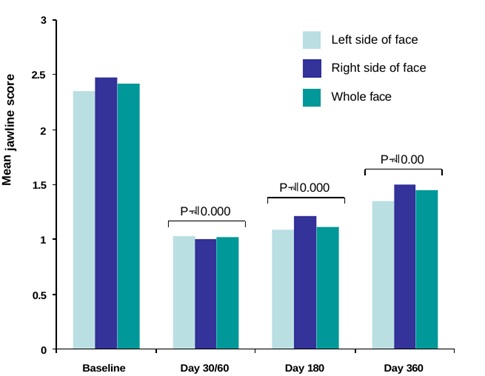
In a 2017 prospective study of 35 women, the mean jawline aging score improved from 2.42 at baseline to 1.02 at 30 to 60 days, and was 1.45 at one year among participants with follow-up data. These are published study results, not a personal guarantee. The study was small, had no untreated control group and lost participants over time.
If you are searching for a defined jawline in Abu Dhabi, the key question is not “which filler is strongest?” It is why your contour has changed. A good consultation separates volume loss from jowl fat, skin laxity, submental fullness, muscle anatomy and chin projection.
Why the jawline changes with age
The jawline is the boundary between the lower face and the neck. When the border is smooth, light reflects evenly from the cheek and chin, which usually reads as a youthful outline. With age, that border can become scalloped. A hollow forms in front of the jowl, the jowl itself looks more prominent, and the transition between chin, jaw and angle softens.
Several layers age at different rates:
- Bone: remodeling can reduce deep support.
- Fat compartments: they can shift or descend.
- Skin: elasticity declines through natural aging and sun exposure.
- Muscles and ligaments: they influence how tissue sits and moves.
The pre-jowl sulcus matters
The pre-jowl sulcus is the hollow just in front of the jowl. It can make a jowl look bigger than it really is. Restoring that depression in a carefully selected patient can make the jaw look straighter. Placing product directly into an already heavy jowl, however, can make the lower face look wider or puffier. This is why anatomy and judgment matter more than the number of syringes.
Skin laxity is not the same as volume loss
Filler restores shape and softens transitions. Energy-based devices target skin quality or laxity. Surgery repositions descended tissue. The most ethical consultations start by deciding what not to treat with filler.
What is Radiesse (calcium hydroxylapatite)?
Calcium hydroxylapatite is a biocompatible mineral compound. In Radiesse it is supplied as microspheres suspended in a gel carrier. Radiesse (+) is a lidocaine-containing version with specific labeled indications in some countries. Always confirm the exact formulation and its local authorization instead of relying on the brand name.
CaHA is of interest for the jawline for two reasons:
- Immediate structural support. The product occupies space and improves contour where projection has been lost.
- Longer-term tissue response. The microspheres may act as a scaffold around which the body lays down collagen and other matrix components. This does not guarantee visible skin lifting in every patient.
Structural CaHA vs hyperdiluted Radiesse
These are used for different goals. Structural jawline contouring replaces support or projection in selected areas. Diluted or hyperdiluted CaHA is mainly used for skin quality across broader areas. Photos of “Radiesse skin tightening” are not proof of a sharp jawline, and a jawline study does not prove every biostimulation protocol.
An important difference from hyaluronic acid
CaHA cannot be dissolved with hyaluronidase the way HA filler can. This makes correct indication, informed consent and conservative planning especially important, particularly for first-time patients.
The 2017 jawline study: what was actually tested
The main reference is Restoring jawline contour with calcium hydroxylapatite: A prospective, observational study by Baspeyras and colleagues, published in the Journal of Cosmetic Dermatology (DOI: 10.1111/jocd.12335).
- Design: prospective, open-label, postmarketing observational study at five sites in France
- Participants: 35 women, mean age 57 (range 42 to 76)
- Follow-up: up to 12 months, with a touch-up allowed at Day 30
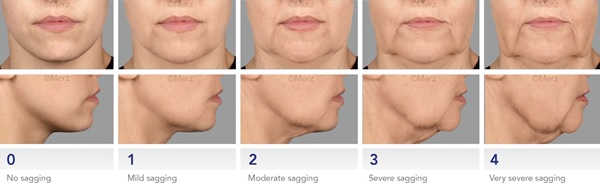
- Main measure: Merz Aesthetics Scale for the jawline, from 0 (no sagging) to 4 (very severe sagging); lower is better
- Secondary measure: marionette line severity, plus satisfaction and adverse events
- Technique: left to each experienced investigator, roughly half intradermal and half subdermal; mean total volume 5.18 mL (range 2 to 9 mL)
These volumes describe what happened in the study. They are not a recommended dose for any individual.
Jawline results at every time point
| Assessment | Patients with jawline data | Mean jawline score | Responders (at least 1-point improvement) |
|---|---|---|---|
| Baseline | 31 | 2.42 | n/a |
| Day 30/60 | 28 | 1.02 | 27/28 (96.4%) |
| Day 180 | 20 | 1.11 | 18/20 (90.0%) |
| Day 360 | 18 | 1.45 | 11/18 (61.1%) |
All post-treatment scores were statistically better than baseline. The gradual rise in score over the year also shows that the effect fades over time. It does not show that Radiesse lifts excess skin or creates a surgical result.
Marionette lines
The whole-face marionette score moved from 2.33 at baseline to 1.02 at Day 30/60, 1.02 at Day 180 and 1.50 at Day 360. Responder rates were 90.3%, 88% and 61.9%. Marionette lines have several causes, including volume, skin creasing and muscle pull, so they are not always a simple “fill the line” problem.
Safety findings
The most common events were bruising, redness, tenderness and swelling, lasting about four days on average. Most were mild, but five severe bruising or hematoma events were recorded.
Limitations you should know about
- Open-label with no control or sham group
- Only 35 women, so results may not apply to men, younger patients or other populations
- Attrition: only 18 women had one-year jawline scores, compared with 31 at baseline
- Techniques and volumes varied between injectors
- Funded by Merz Pharmaceuticals GmbH, which also funded medical-writing support
A larger 2024 trial of a lidocaine-containing CaHA formulation reported meaningful responses at 12, 24 and 48 weeks, with subgroup data to 60 weeks. It supports the same general conclusion, but the two studies differ in products, populations and methods and should not be pooled.
How long does Radiesse jawline contouring last?
Duration is a range, not a promise. Some patients enjoy results for a year or longer. It depends on the treated area, starting anatomy, technique, volume, lifestyle and how fast aging continues.
In the 2017 study, the mean score drifted from 1.02 to 1.45 by one year, yet stayed better than the 2.42 baseline. “Long-lasting” does not mean permanent, and your face keeps aging whatever is in it. Follow-up should reassess your whole current face rather than repeat the original quantity automatically.
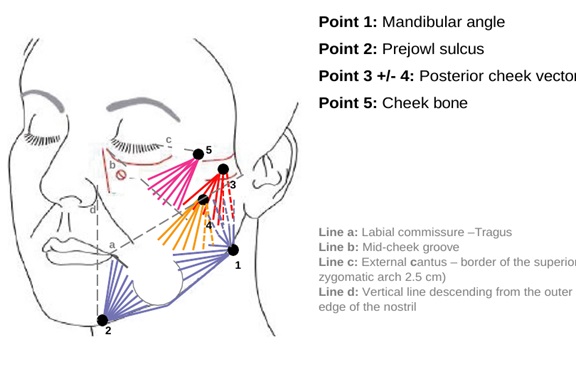
The four zones that shape a lower-face contour
There is no universal “jawline dot pattern.” Clinicians typically consider the following together.
- Chin and anterior border: a weak chin can blur the face-to-neck transition, while too much volume can look overfilled.
- Pre-jowl sulcus: smoothing a hollow can help, but the aim is continuity, not removing every shadow.
- Posterior mandibular angle: more definition suits some faces, while others look heavy or squared with added volume.
- Cheek and upper support: midface volume loss can change how the lower face looks, so treatment may start above the jawline.
Radiesse vs hyaluronic acid, Sculptra, devices and surgery
| Option | Main goal | Potential benefit | Key limitation |
|---|---|---|---|
| CaHA (Radiesse) | Structural support and selected biostimulation | May improve pre-jowl defects and jaw definition | No simple hyaluronidase reversal |
| Hyaluronic acid filler | Shape and volume | Many products; established dissolving pathway | Performance varies by product and area |
| PLLA (Sculptra) | Gradual biostimulation | Broad volume-loss patterns | Not an instant, sharp-contour option; staged |
| RF or ultrasound devices | Laxity and skin quality | Different tissue targets, no added volume | Do not replace filler projection |
| Surgical lift | Repositioning descended tissue | Better for advanced laxity | Invasive, with its own recovery and risks |
There is no “best” option without a defined goal. HA may suit patients who value reversibility. CaHA may suit those who want structural support. Tightening devices and surgery solve different problems from filler.
Is your goal volume, lift, definition or skin quality?
| What you see | What needs assessing | What to compare |
|---|---|---|
| Hollow before the jowl | Pre-jowl volume, chin contour | Targeted support vs whole-face plan |
| Heavy jowl or hanging skin | Descent, laxity, local fat | Devices vs surgical referral |
| Double-chin look | Submental fat, skin, chin projection | Fat-directed options or chin balance |
| Marionette lines | Creasing, volume, muscle movement | Filler, other modalities or a combination |
| Weak posterior angle | Gonial projection, face width | Conservative contouring vs no added volume |
| Crepey skin | Thickness and elasticity | Skin-focused treatment |
Who may be a good candidate?
Potential candidates have mild-to-moderate contour interruption, a pre-jowl deficit, limited angle definition or partial lower-face volume loss. They accept that outcomes vary and that study averages are not individual promises.
A different approach, or a specialist surgical opinion, may suit people with:
- Substantial loose skin or heavy jowls driven by descent
- Marked submental (under-chin) fullness
- Significant weight fluctuation
- Advanced skeletal or structural discrepancies
Screening should also cover active infection nearby, severe allergy (including lidocaine hypersensitivity), bleeding disorders, prior filler reactions, unknown previous filler products, and pregnancy or breastfeeding. Sometimes the right recommendation is no injectable at all.
What to expect at your consultation
- Define the goal. Soft oval lower face, sharper angle or enhanced chin? Your own sense of what looks natural comes first.
- Full-face analysis. Jaw, chin, cheeks, skin quality, neck and submental fullness, usually with standardized front, side and oblique photographs.
- Medical and aesthetic history. Medications, allergies, previous injectables, implants, surgery, dental work and recent weight change.
- Options and trade-offs. Why CaHA, why HA, whether a device or surgical opinion makes sense, and what may stay uncorrected.
- Consent and follow-up. Expected effect, asymmetry, lumps, rare vascular events, delayed reactions, the lack of HA-style reversal, cost and possible touch-up.
Natural results: avoiding overcorrection
A “sharp” jawline should still suit the face. Many women want a smooth line from chin to angle, and many men want more angular definition, but these are tendencies, not rules. Overcorrection can look artificial when you smile, speak or turn your head. A staged plan lets tissues settle and lets your clinician judge the result before adding more.
Treatment day, downtime and aftercare
- Brief pressure or discomfort is possible; early swelling can hide the final result.
- Typical effects are redness, swelling, tenderness and bruising, lasting around four days on average in the 2017 study.
- Avoid strenuous exercise, heat and strong sun for about 24 hours or until swelling settles, as your clinician advises.
- Do not massage or press the area unless instructed.
- Attend your review visit rather than demanding an instant touch-up.
Seek urgent care immediately if you notice
- Disproportionate or worsening pain
- Sudden vision changes
- Pale, mottled or rapidly darkening skin
- Stroke-like or neurological symptoms
Do not massage, cover it with makeup or wait for a routine appointment if these occur.
Safety in depth
The jawline has a complex supply of arteries, veins and nerves, and vessel position varies between people. Accidental injection into a blood vessel is rare, but severe outcomes reported with facial fillers include skin necrosis, vision loss and stroke. The safest clinic is not one that claims complications are impossible. It is one with trained injectors, careful patient and product selection, a documented emergency pathway and honest consent.
Negative aspiration is not a reliable guarantee of safety. Avoid self-injection, unregulated products and untrained providers. Long-lasting fillers can also appear on imaging, so tell clinicians and radiologists about your filler history.
Radiesse jawline treatment in Abu Dhabi
People in Abu Dhabi search for “Radiesse jawline Abu Dhabi,” “calcium hydroxylapatite for jowls,” “pre-jowl filler” and “non-surgical jawline rejuvenation.” Some are comparing products, some are worried about safety, and many are unsure whether their problem is sagging skin or lost support.
Dr. Erfan Rahmani’s consultation aims to identify the dominant anatomical issue, assess candidacy and discuss whether your goal is achievable with an authorized product within local clinical rules. A remote article cannot determine suitability, dose, area, price or number of sessions.
A clear plan should cover the problem found, why the treatment may help, a realistic degree of improvement, the alternatives (including doing nothing), and the safety and maintenance implications.
Book a jawline assessment
Find out whether Radiesse suits your jawline. Request a consultation with Dr. Erfan Rahmani in Abu Dhabi.
Frequently asked questions
What is Radiesse jawline contouring?
It uses calcium hydroxylapatite filler to restore structural support and improve the lower-face outline. It does not remove jowl fat and cannot match surgery for major tissue descent.
Is Radiesse the same as calcium hydroxylapatite?
Calcium hydroxylapatite is the active material. Radiesse and Radiesse (+) are specific branded formulations whose labeling and local authorization can differ.
Does Radiesse stimulate collagen in the jawline?
CaHA is associated with extracellular-matrix remodeling, including collagen production. The visible benefit varies, so the mechanism alone does not guarantee a result.
How long do Radiesse jawline results last?
Results vary. The 2017 study found scores still better than baseline at one year among women with follow-up data, and a 2024 trial reported responders through 48 weeks. Neither guarantees a duration for you.
Is there scientific evidence that CaHA improves jowls?
Yes, for improving jawline contour in some patients. The strongest claim is better jawline appearance, not disappearance of all jowl tissue.
Can Radiesse remove a double chin?
No. Filler does not remove submental fat. A better-defined chin may change how the neck looks, but an examination is needed to find whether fat, skin laxity or chin projection is the cause.
Is Radiesse a face-lift alternative?
It is a nonsurgical option for selected contour concerns, not a substitute for surgery. Very loose skin or pronounced jowls may gain limited benefit from filling alone.
Does Radiesse tighten loose neck skin?
A jawline study does not prove substantial neck-skin tightening. Laxity is a separate target and may need other treatments or a surgical opinion.
Which lasts longer: Radiesse or hyaluronic acid?
There is no universal ranking. Longevity depends on the product, site, anatomy and plan, so reversibility, regional evidence and safety are better comparison points.
Can you dissolve Radiesse like HA filler?
No. CaHA has no routine hyaluronidase reversal pathway, so managing an unwanted result may need specialist intervention. This should be part of consent.
Is Radiesse jawline contouring FDA approved?
In the US, Radiesse (+) is indicated for deep subdermal and/or supraperiosteal augmentation of moderate-to-severe jawline contour loss in adults over 21. US approval does not automatically set the legal indication in the UAE, so ask the clinic which product is proposed and how its use complies with local rules.
How many syringes do I need?
That cannot be set from a generic chart. The 2017 study’s mean of 5.18 mL is not a prescription, and about half the patients had a touch-up. Your plan must follow in-person assessment.
Is there downtime after Radiesse?
Temporary redness, swelling, tenderness and bruising are common, lasting about four days on average in the study. Zero downtime cannot be promised.
What are the most common side effects?
Bruising, redness, pain, swelling and tenderness. Most events in the 2017 study were mild, though five severe bruising or hematoma events were recorded.
Can jawline filler cause blindness or stroke?
These are rare but serious risks of accidental injection into a blood vessel. Sudden vision change, stroke-like symptoms, white or discolored skin or severe unusual pain need emergency care.
Can I combine Radiesse with XERF or another tightening device?
Possibly, when both volume support and laxity are present. Whether to combine, stage or avoid depends on the device, product and timing, and the 2017 study did not test a universal combined protocol.
Can I have Radiesse if I have had other fillers before?
Possibly, but your clinician needs to know the previous product, area, timing and any reactions. Unknown or permanent fillers complicate planning, so bring records if you have them.
How much does Radiesse jawline contouring cost in Abu Dhabi?
Cost depends on the product, quantity, areas treated, complexity and follow-up policy. Request an individualized written quotation through www.drerfanrahmani.com.
What should I ask before choosing an injector?
Ask about their authorization and training, the exact formulation and label, the diagnosis behind the plan, alternatives, risks, emergency pathways, follow-up and total charges.
Key takeaways
- Radiesse may improve a jawline that has lost definition through volume loss or pre-jowl hollowing.
- The 2017 study showed mean jawline scores of 2.42 at baseline, 1.02 at 30 to 60 days and 1.45 at one year, with real limitations.
- It is not a double-chin remover, a skin tightener or a face-lift replacement.
- CaHA cannot be dissolved like HA, so careful selection and consent matter.
- The right plan starts with diagnosing why your contour changed.