Quick answer: does lower face Botox work?
In carefully selected patients, lower face Botox (botulinum toxin type A, BoNT-A) can reduce muscle-driven changes in the lower face and neck, including prominent platysmal bands, some downward pull at the mouth corners, chin dimpling and excess masseter bulk. A 2026 report following 400 patients found improved clinician-rated neck banding and overall lower-face appearance after repeated treatments. However, it was a retrospective, single-centre study without an untreated control group; its results are encouraging, not proof that every patient can obtain a lasting non-surgical facelift.
The most important practical distinction is between relaxing muscles and lifting tissues. Botox changes neuromuscular activity. It does not physically remove skin, restore missing fat pads, reposition deeper structures or replace a surgical facelift. A successful treatment plan therefore starts by identifying what actually causes the contour concern—and whether muscle activity is the dominant component.
At a glance: the study in numbers
| Study feature | What was reported |
|---|---|
| Patients | 400 adults: 380 women and 20 men; 35–85 years |
| Design | Retrospective, one aesthetic clinic; no randomized untreated control group |
| Treatments | OnabotulinumtoxinA as part of full-face treatment, approximately every six months; at least three sessions |
| Dose | 120–160 units per FULL-FACE session in this cohort; not a stand-alone lower-face dosing recommendation |
| Follow-up | 24–60 months reported; the text states mean 36 months, whereas its demographic table states mean two years |
| Merz scale | 4.2 ± 0.6 at baseline; 2.1 ± 0.4 after one cycle; 1.8 ± 0.3 after three cycles |
| Independent global appearance score | 1.5 ± 0.7 before treatment versus 4.1 ± 0.4 after treatment |
| Reported safety | Bruising 12%; temporary local discomfort 8%; no severe events recorded in this cohort |
Study context and clinical relevance
The authors—Roberta D’Emilio, Maria Grazia Caputo, Giuseppe Rosati, Paolo Persichetti and Mauro Barone—examined long-term treatment records from January 2018 through December 2024. Their paper was first published online on 19 November 2025 and appears in the 2026 volume of Aesthetic Plastic Surgery. The distinction matters for medical citations: online release and print-volume year differ, but the DOI identifies a single study.
A cohort of 400 people provides a useful view of everyday longitudinal practice, particularly because repeated treatments were documented over multiple years. It is not equivalent to a multi-centre randomized controlled trial. The same patients may experience changes from natural aging, skincare, weight change, treatment expectations, photographic positioning and selection for continued care. Individualized clinical interpretation is needed before applying the findings to a new patient.
Patients were treated as part of a full-face approach, but the investigators primarily evaluated the lower third of the face and neck. That distinction prevents a frequent misconception: 120–160 units described the overall full-face session in the authors’ protocol. It should never be presented as the amount routinely injected into the lower face alone or as an individualized dosing prescription.
Why the lower face is anatomically different from the upper face
Wrinkle treatment around the forehead and crow’s feet chiefly addresses visible contraction lines. The lower face is more functionally integrated. Muscles that affect facial shape also help us smile, speak, chew, maintain lip closure, swallow and express emotion. Small changes in the wrong muscle can alter these functions.
The platysma spans the lower face and neck and may contribute to downward tension at the mandibular border and to vertical neck bands. The depressor anguli oris (DAO) pulls the oral commissure downward; the mentalis influences chin projection and characteristic dimpling; the depressor labii inferioris helps control the lower lip; and the masseter generates powerful chewing force. Their effects are interconnected with skin quality, bone structure, fat compartments and facial ligaments.
A lower-face assessment is therefore not merely an exercise in counting lines. It should evaluate the face at rest and in motion, compare left and right sides, consider bite and jaw function, and distinguish muscular enlargement from skin laxity or loss of structural support. The same patient can have both active platysmal bands and significant skin redundancy; treating only the muscle may improve the bands while leaving the lax skin unchanged.

The five major treatment targets
1. Platysma and vertical neck bands
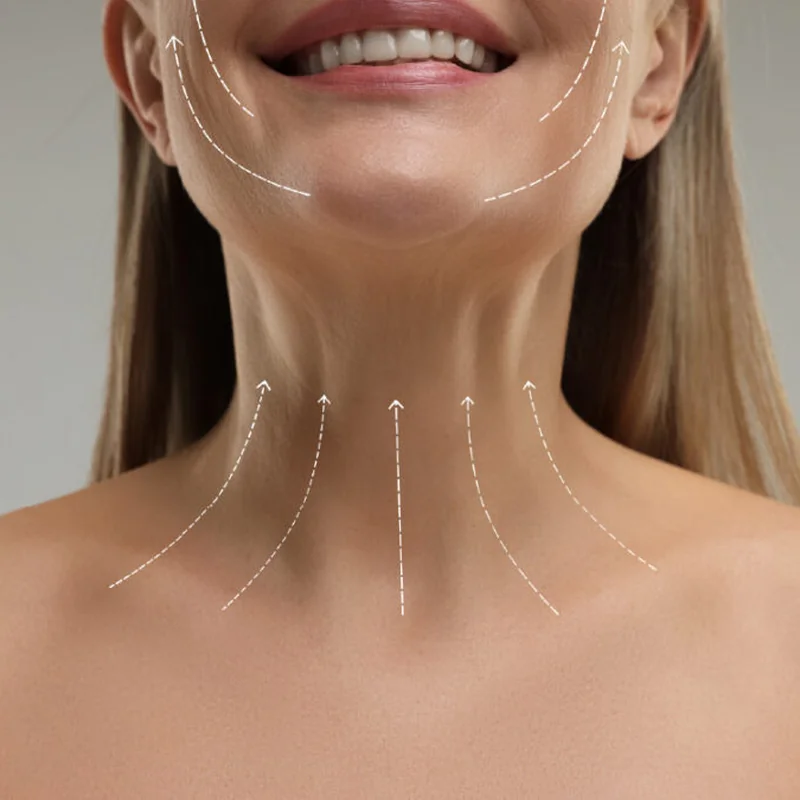
Prominent neck bands can become visible during expression, head movement or at rest as skin and muscular support change with age. Selective BoNT-A treatment can reduce muscular contraction and soften the visible cords. In some patients, it can lessen downward muscular pull along the jawline, improving the visual transition between lower face and neck. It is not a substitute for skin excision, liposuction or the correction of substantial fat descent.
The source paper assessed platysmal band severity using the Merz Aesthetic Scale. Neck injections require especially careful recognition of nearby swallowing-related and deeper neck muscles. A 2024 U.S. FDA indication for Botox Cosmetic includes adult moderate-to-severe platysma bands, but a U.S. approval does not automatically establish product labeling or the permitted scope of use in the UAE. Local product registration and clinician privileges must be checked separately.
2. Depressor anguli oris and downturned mouth corners
The DAO may create a characteristic downturned resting mouth and accentuate an unhappy or tired expression. In selected patients, reducing excessive DAO activity can allow competing elevator muscles to produce a less downward-facing oral commissure. This is a subtle neuromodulatory change, not the same as restoring lost cheek support or filling a deep marionette fold.
Mouth asymmetry can become more noticeable if toxin diffuses into neighboring lower-lip depressors or if the patient already has asymmetrical baseline movement. Treatment decisions should reflect a dynamic smile examination, not a uniform point-based diagram applied identically to everyone.
3. Mentalis, chin dimpling and lower-lip balance
Hyperactive mentalis contraction may produce a pebbled or orange-peel appearance of the chin, particularly while speaking or closing the lips. Modulation can smooth selected dynamic dimpling and improve apparent chin relaxation. Deeply etched static creases, chin retrusion and structural irregularities may need other options—or may not require treatment at all.
Mentalis treatment must consider lip competence and the individual’s natural relationship between chin, lower lip and teeth. An aesthetic improvement that compromises function is not an acceptable outcome. As with other lower-face sites, the target is anatomical balance rather than complete muscle immobilization.
4. Masseter hypertrophy and lower-face width
The masseter is often targeted when a wide or square lower face is driven mainly by bulky chewing muscles. Reducing muscle activity may gradually reduce muscle thickness, making the mandibular angle less visually prominent in suitable patients. This differs from the platysma or DAO effect, where visible dynamic contraction may change relatively quickly after treatment.
Masseter contouring is not a universal approach to facial slimming. A patient’s jaw width can arise from bone, fat or muscle; the patient may also have early jowling, pre-existing volume deficit, bruxism or a temporomandibular disorder. In a thin or lax lower face, reducing muscular support may increase the appearance of sagging. Functional concerns include bite fatigue, altered chewing performance and asymmetry. A separate clinical assessment of jaw symptoms may be appropriate.
5. Jawline definition and the so-called Nefertiti lift
The popular term “Nefertiti lift” is used for selective lower-face and neck neuromodulation intended to soften platysmal downward pull. The result may be an improved jawline silhouette in appropriately selected patients, but it should not be represented as actual surgical lifting or as a replacement for tissue-tightening treatment when skin laxity is dominant.
The best candidates have meaningful muscular contribution and enough structural support to show a visible change when downward pull is reduced. Patients with pronounced laxity, heavy jowls, a substantial submental fat compartment or advanced soft-tissue descent often require a different discussion, including energy-based devices or surgery where appropriate. A physician should distinguish these mechanisms before recommending a treatment.

How the investigators performed and measured treatment
The authors described treatment by two experienced aesthetic practitioners using an anatomical mapping approach and onabotulinumtoxinA. Sessions were repeated approximately every six months. The paper lists muscle-specific doses for mentalis, DAO, platysmal bands and selected masseter treatments; these are details of its research protocol, not instructions for self-treatment or a universal UAE protocol. Importantly, the paper’s total dose covered the full face.
For the primary evaluation, investigators used the five-point Merz Aesthetic Scale to grade platysmal bands. Standardized photographs and videos supported the secondary global aesthetic assessment, with scores recorded by two independent reviewers. This provides a stronger approach than a purely informal before-and-after comparison; still, photographic and subjective rating scales can reflect lighting, posing, scoring choices and study selection.
The published report states a minimum of three treatment sessions and describes a two-to-five-year follow-up interval. Its Results section gives a mean follow-up of 36 months, while a baseline table describes the mean as two years. The safest interpretation is to retain the stated range and report this inconsistency rather than fabricate a single reconciled value. Follow-up beyond three sessions does not prove that results persisted without ongoing treatment.
What changed in the study? Detailed efficacy results
Platysmal band severity: Merz scale
The average Merz score fell from 4.2 ± 0.6 before the first treatment to 2.1 ± 0.4 after the first cycle; after the third cycle it was 1.8 ± 0.3. In this scale, lower numbers indicated less severe banding. The authors reported statistically significant differences compared with baseline. These findings support improvement during repeated treatment, although they do not isolate how much benefit came specifically from the first, second or third injection cycle versus differences in assessment and other time-dependent factors.
An important limitation is that mean scores across 400 treated participants do not tell us what any particular person should expect. The paper does not establish a universal percentage of jawline lift or a guaranteed number of millimeters of improvement. Individual baseline anatomy, photodamage, tissue laxity, muscle distribution and injection selection change the likely outcome.
Overall aesthetic assessment: independent global score
Two independent doctors assessed standardized documentation on a five-point global improvement measure. The article reports scores changing from 1.5 ± 0.7 before treatment to 4.1 ± 0.4 afterward, with a statistically significant difference. This overall score combines impressions of facial contour and soft-tissue balance, so it should not be mistaken for a direct objective measurement of skin tightening, collagen formation or actual physical tissue elevation.
The two study graphics show selected categories of apparent change and satisfaction. Their direction and category-specific values should be interpreted through the authors’ captions, because image-based categories do not independently establish validated long-term causal changes. The principal quantitative endpoints remain the reported Merz and overall observer scores.
Does Botox have a cumulative or long-term “muscle retraining” effect?
One of the most interesting arguments in the study is that repeated injections may be associated with aesthetic improvements lasting beyond the conventional three-to-four-month pharmacologic window. The authors suggest a possible process of functional muscle retraining, or sustained rebalancing of the face’s depressor-elevator dynamics, after repeated neuromodulation. This is a hypothesis worth investigating, but it remains mechanistically unproven by this study.
It is essential to distinguish three different statements. First, the toxin’s direct action at the neuromuscular junction is temporary. Second, repeated treatment can be associated with longer-lasting changes in muscle bulk, habits of expression or appearance; clinical observations of this kind do occur. Third, demonstrating a durable retraining mechanism requires evidence that is not supplied here: controls, rigorous serial assessments during untreated intervals, objective muscle-function testing and potentially physiological biomarkers.
Because patients in the cohort kept receiving treatment at six-month intervals and there was no comparable untreated group, the research does not establish that Botox produces a permanent lift, prevents aging or predictably eliminates the need for future treatments. Clear patient counseling should explain that the duration of visible benefit varies, and maintenance may be needed even when an individual feels that their appearance has improved over repeated visits.
What the original multi-year photographs do—and do not—show
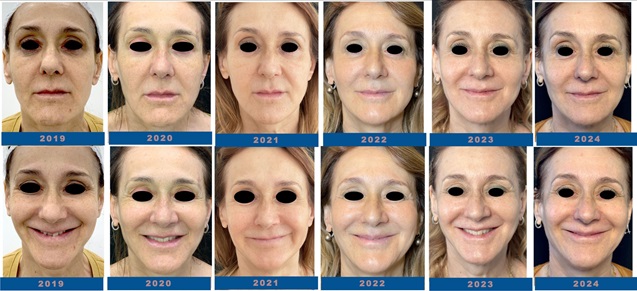
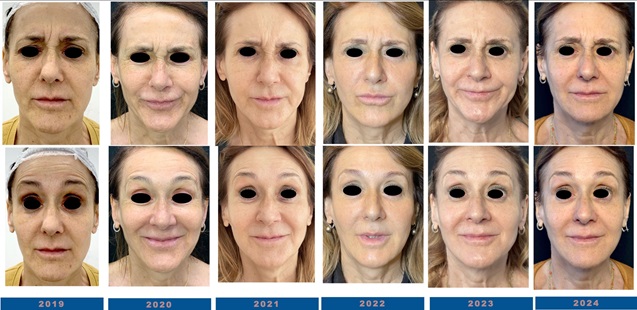
The authors included five figures documenting serial appearances of three patients across several years. These are valuable visual examples because patients can see how expression and lower-face contour were photographed repeatedly during a continuing treatment programme. They should be viewed as selected clinical illustrations, not as unfiltered outcome data for all 400 participants.
In particular, the original captions label these image sequences as “pre-treatment” photographs across successive years, rather than proving that a single injection continued working for the entire interval. Appearance can also change with age, lighting, head angle, facial expression, makeup, weight, dental position and normal tissue remodeling. A responsible webpage must not imply that the images were produced by Dr. Erfan Rahmani or that every patient will reproduce the displayed changes.

Figure 5 helps illustrate why longitudinal evidence differs from an isolated before-and-after pair. The timeline documents the individual during multiple years of care, but cannot establish a permanent Botox effect independently of maintenance treatment. The same interpretive caution applies to the following six-year photographic series.

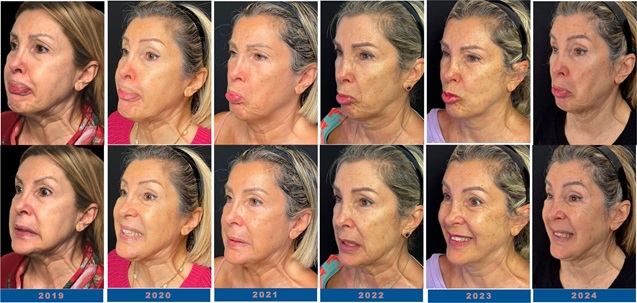
Dynamic photographs are especially informative in lower-face assessment because a relaxed resting photograph may conceal excessive mentalis or DAO activity, while a forced expression can exaggerate platysmal bands. Clinical photography should document both rest and movement consistently; neither a single flattering angle nor a single exaggerated grimace is a complete treatment outcome.
Safety: why lower face Botox needs a stricter risk assessment
In the 400-patient report, mild injection-site bruising was recorded in approximately 12% and short-lived local discomfort in approximately 8%. The authors did not report severe or permanent complications, nor dysphagia, ptosis or asymmetry within their dataset. These are reassuring observational findings for the treated cohort, but they are not proof that those adverse effects cannot occur in everyday practice.
Lower-face toxin complications may affect more than appearance. Unwanted weakening of muscles near the lips can alter smile symmetry, lip sealing, speech or drinking from a cup. Excessive or misdirected masseter treatment may cause chewing fatigue or an uneven mandibular contour. Treatments that influence the platysma and deeper neck structures must account for dysphagia, voice change and abnormal weakness. The U.S. prescribing information carries a boxed warning regarding potential distant spread of toxin effect, even though serious outcomes are uncommon with appropriately administered cosmetic doses.
A separate phase III repeat-treatment trial of onabotulinumtoxinA for platysma prominence reported mild adverse events of special interest, including dysphagia and facial paresis. This does not negate the 400-patient study; it shows why safety conclusions should incorporate a broader evidence base rather than relying on a single cohort with no serious events recorded.
Before treatment, the clinician should consider known neuromuscular disorders, relevant medications, past toxin response, facial asymmetry, swallowing or speech difficulty, active infection and pregnancy or breastfeeding. Product choice, label indication, practitioner training and individual consent must also be reviewed. New difficulty breathing, swallowing, speaking or significant weakness after injection warrants immediate medical evaluation.
| Issue | Why it matters clinically | Responsible approach |
|---|---|---|
| Smile or lower-lip asymmetry | Adjacent perioral muscles have overlapping actions | Assess dynamic smile and oral competence before and after treatment |
| Swallowing or voice symptoms | Neck muscles are functionally sensitive | Conservative selection; urgent assessment for symptoms |
| Masseter-related hollowing or jowling | Reducing jaw muscle bulk can reveal underlying laxity | Distinguish muscle hypertrophy from pre-existing support loss |
| Bruising or discomfort | Usually transient local effects | Discuss realistic recovery and follow-up |
| Limited skin tightening | Relaxing platysma does not excise skin | Do not promise surgical-level lift |
| Unexpected toxin spread | Rare potentially serious systemic symptoms | Review prescribing information and provide emergency advice |
How this study compares with stronger clinical evidence
The 2026 retrospective cohort primarily addresses a different question from randomized placebo-controlled trials. It suggests that selected patients undergoing repeated full-face and lower-face treatment can experience measurable improvement across years of clinical care. A randomized phase III study of platysma prominence, by contrast, compared onabotulinumtoxinA with placebo and demonstrated a treatment benefit for moderate-to-severe platysmal bands at a defined early endpoint. These two designs complement each other but cannot be combined as though they used the same patients, dose, endpoints or follow-up intervals.
There is also an important geographic and regulatory distinction. The U.S. FDA approved Botox Cosmetic for adult moderate-to-severe platysma bands in October 2024. That is a specific indication in a particular regulatory jurisdiction and should not be stretched to imply approval of every lower-face technique, every toxin brand, masseter treatment for every purpose, or approval of the same indication by the UAE authorities. Regulatory labels are formulation-specific; the biological units of different botulinum toxin preparations are not automatically interchangeable.
The biggest gap in the evidence remains causal proof of long-term neuromuscular retraining. Future multi-centre trials should incorporate untreated or active-comparator controls where feasible, validated quantitative facial measurements, clearly defined treatment breaks, standardized photographs and broader demographic representation. They should also distinguish sustained patient satisfaction from permanent pharmacological or anatomical change.
Who may be an appropriate candidate in Abu Dhabi or Dubai?
A suitable candidate is not simply someone who wants a sharper jawline. The clinical examination should show that a significant part of the concern is caused by muscular dynamics and that relaxing those muscles is unlikely to create a functional or aesthetic trade-off. Patients with strong platysmal bands, a hyperactive chin or downward mouth-corner pull may merit discussion of carefully planned neuromodulation. Muscle-predominant jaw width may warrant consideration of masseter treatment if its risks and likely effect on face shape are acceptable.
A patient whose dominant issue is loose skin, heavy lower-face fat descent, deep static folds, skeletal recession or substantial fat under the chin is less likely to obtain a dramatic result from toxin alone. In such cases, discussing alternate modalities, staged treatment or specialist surgical assessment may be more appropriate than simply adding more units.
For patients seeking lower-face Botox in Abu Dhabi, Nefertiti lift in Dubai, platysmal band treatment in the UAE or masseter Botox, the most useful consultation explains the relevant anatomy and compares expected changes at rest and with expression. It should include a plan for possible asymmetry, functional symptoms, review visits and realistic maintenance—not an automatic fixed-point injection template.
Botox versus other lower-face treatments
| Main concern | Botulinum toxin may help when… | When another approach may be needed |
|---|---|---|
| Vertical neck bands | Band prominence arises from platysma contraction | Significant loose skin or structural neck descent dominates |
| Downturned mouth corners | DAO pull is prominent and the lips function normally | Deep static folds or missing cheek support dominate |
| Pebbled chin | Mentalis overactivity causes visible dimpling | Chin shape is primarily skeletal or due to deep fixed crease |
| Square jaw | Masseter hypertrophy is the principal cause | Mandibular bone shape or fat determines width |
| Jowls and skin laxity | Muscular pull is a minor contributing factor | Significant tissue laxity may require an energy-based or surgical option |
| Submental fullness | Not directly addressed by relaxing facial muscles | Fat or tissue laxity requires separate assessment |
Clinical editorial perspective: a more precise non-surgical plan
Dr. Erfan Rahmani’s editorial approach emphasizes diagnosis before device or injectable choice. Facial harmony reflects muscle movement, fat volume, bone structure, skin quality and the relation between face and neck. A lower-face programme should determine whether the target is a hyperactive muscle, reduced collagen support, volume deficiency or true tissue descent. These categories are not interchangeable, and the treatment that benefits one category can worsen another.
For the neck, a person with obvious platysmal bands but relatively elastic skin may be a stronger toxin candidate than someone with minimal banding and significant laxity. For the masseter, a naturally narrow face may develop an unwanted hollowed appearance if muscle volume is reduced unnecessarily. Around the mouth, overtreatment risks trading a small cosmetic improvement for an altered smile. Appropriate treatment can therefore include a decision not to inject.
When structural skin laxity or submental contour contributes substantially, a discussion may extend to options such as Endolift or other energy-based treatments, but the evidence for those approaches is different and must be evaluated independently. No combination treatment was tested against Botox alone in the 400-patient study, so it cannot justify claims that pairing a device with toxin produces a superior or guaranteed result.
What should patients expect from an appointment?
An initial consultation should review the medical history, the precise aesthetic concern and the facial movements involved. Standardized photographs at rest and during animation can help identify the targeted muscles and later assess the result. The physician can then describe whether a muscle-specific strategy is likely to be useful, the potential benefits, what changes are not expected, and the alternative pathways.
BoNT-A usually does not create a fully settled visible result immediately. Muscle relaxation develops over days, while the visible effect of masseter size reduction can evolve more slowly. Reassessment should reflect the product used, the specific muscle and the patient’s response. Results are temporary, and repeat sessions should follow a medically appropriate, individualized plan rather than a promise of permanent change.
Patients should receive product-specific consent, discussion of bruising and functional risks, and clear instructions for contacting the treating clinician. They should avoid choosing a practitioner based only on a headline dose or a photograph that does not show consistent conditions. Clearer contours are possible for some patients, but natural expression and functional safety come first.
Frequently asked questions: lower face Botox, jawline and neck in the UAE
1. Can Botox lift my jawline without surgery?
Botulinum toxin can sometimes improve the visible jawline by reducing downward platysmal pull or balancing selected depressor muscles. It does not physically lift sagging deep tissues or remove extra skin, so results are usually more modest than surgical lifting.
2. Does a Nefertiti lift tighten loose neck skin?
Not directly. The technique modifies muscular traction. Patients with major skin redundancy may need assessment for a different treatment rather than expecting muscle relaxation to tighten the skin itself.
3. How long does lower face Botox last?
The pharmacological relaxation is temporary, often discussed in months rather than years. The 400-patient study reported improvement over years of repeated treatment; it did not show that one dose lasts for years.
4. Does regular Botox retrain muscles permanently?
Functional muscle retraining is a proposed explanation for persistent improvements. A retrospective study without an untreated control group cannot prove permanent neuromuscular reprogramming.
5. Is 120–160 units the recommended lower-face dose?
No. The published figure refers to the research team’s full-face session, not a lower-face-only recommendation. An individual plan depends on the formulation, muscles, anatomy, local labeling and clinician assessment.
6. What is platysma Botox?
It is a technique aimed at reducing active vertical neck bands by relaxing selected platysmal muscle activity. It is most relevant when the bands, rather than lax skin alone, are a prominent concern.
7. Can Botox soften marionette lines?
It may influence the downturned corner component when DAO activity is significant. Deep static marionette folds due to lost support or tissue descent cannot reliably be corrected with toxin alone.
8. Can mentalis Botox help an orange-peel chin?
If the dimpling results from overactive mentalis contraction, selected neuromodulation may make the chin appear smoother. It is less appropriate for purely structural chin concerns.
9. Can masseter Botox make the jawline slimmer?
It can reduce muscular bulk in selected cases. It does not shrink the jawbone and may worsen visible laxity or hollowing if performed in a poorly selected patient.
10. Could masseter Botox make jowls worse?
Yes. In some faces, masseter volume contributes to external support. Reducing that bulk may reveal pre-existing laxity; the balance of likely benefit and cosmetic trade-off should be considered.
11. What are the risks of lower face Botox?
Bruising and temporary discomfort are common minor concerns. Unwanted smile asymmetry, lip weakness, chewing changes, dysphagia and voice changes are among more consequential risks that require careful assessment.
12. Is neck Botox approved?
U.S. Botox Cosmetic labeling includes moderate-to-severe platysma bands in adults following a 2024 FDA approval. UAE registration, particular formulation, practitioner privilege and local permitted use must be confirmed separately.
13. Is Botox better than Endolift for the jawline?
Neither is universally better. Botox acts mainly on muscles, while Endolift and related treatments address different tissue targets. Whether muscle, skin or fat is dominant determines what approach might be appropriate.
14. Does Botox prevent facial aging?
It can temporarily reduce selected expression-related changes, but the 400-patient study does not demonstrate prevention of all facial aging, permanent tissue lifting or reversal of structural change.
15. How often do people repeat lower-face Botox?
The paper describes sessions approximately every six months. That research schedule is not a universal rule, and timing must be tailored to product information, patient response, goals and clinical safety.
16. Is the procedure appropriate for men?
Men may be candidates, but only 20 of 400 participants were male. The study does not establish equivalent outcomes in every gender or facial morphology.
17. Can Botox change my smile or speech?
Yes, if treatment affects muscles involved in lip movement or oral competence. A baseline dynamic assessment and precise technique are therefore particularly important around the mouth.
18. Are the published before-and-after photos Dr. Erfan Rahmani’s patients?
No. They are figures from the 2026 published paper by D’Emilio and colleagues and are shown only to explain that study. They should not be labeled as patients of the medical editor.
19. What is the most important selection factor?
Whether the cosmetic concern is primarily muscular. Patients with significant fat, skin laxity or skeletal contributors need a different treatment discussion.
20. Where can I learn more about neck or masseter Botox in Abu Dhabi?
The website drerfanrahmani.com provides separate educational guides about neck Botox, masseter Botox and related lower-face treatments. A medical consultation is required to determine suitability.