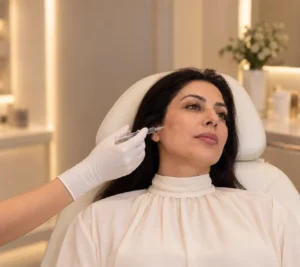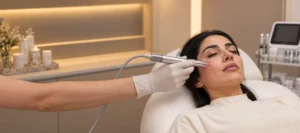
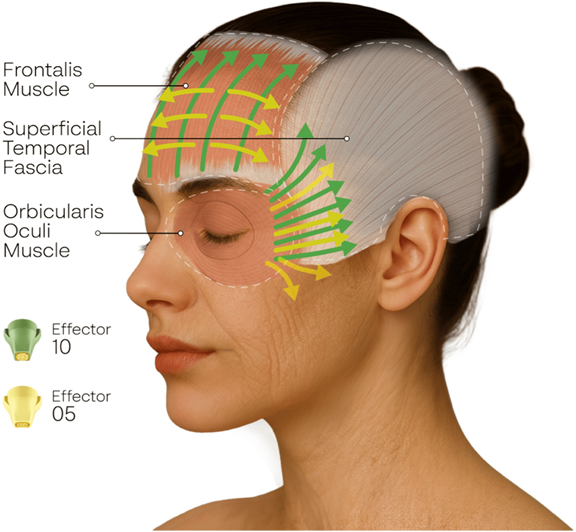
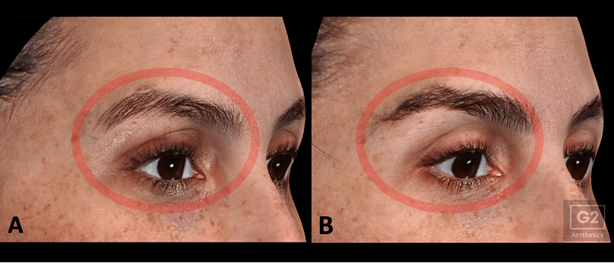
XERF is a non-invasive monopolar radiofrequency platform that can deliver dual-frequency energy using 6.78 MHz together with 2 MHz in deep treatment mode. This combination is designed to distribute thermal effects across different levels of the facial support system rather than concentrating treatment in only one superficial layer. Periorbital aging is more than a skin-surface problem. The source report describes progressive changes involving the dermis, the superficial musculoaponeurotic system (SMAS) and ligamentous support. These changes alter fat distribution, weaken structural support and reduce resistance to gravity, contributing to lateral brow descent, upper-eyelid redundancy, canthal descent and more visible forehead and crow’s-feet wrinkles. This multilayered model is important because a treatment designed only for superficial fine lines may not address the deeper support structures involved in a heavy or descending upper-eye complex. Non-invasive monopolar radiofrequency (NMRF) delivers thermal energy through tissue without surgical incisions. The report states that NMRF can engage the dermis and deeper supporting structures, with prior clinical studies showing measurable periorbital tightening, eyebrow elevation and wrinkle reduction. The challenge with conventional small RF tips is depth: smaller electrodes concentrate current density more superficially. This can be useful for fine rhytids but may be less suitable when the goal is contraction of deeper supporting tissue such as the periorbital SMAS. The XERF platform described in the paper combines 6.78 MHz and 2 MHz radiofrequency simultaneously. The authors state that this dual-frequency output produces thermal effects in the superficial dermis and superficial/deep fascial layers, and they hypothesize that this may help overcome the depth limitations of conventional small applicators. Importantly, the authors explicitly describe this as a theoretical or procedural advantage rather than a proven clinical superiority claim. The technical report was written to explain the protocol while a prospective outcome study was still ongoing. The report provides a highly specific technical workflow. Patients were positioned supine, makeup and topical products were removed, and ultrasound gel was applied to improve energy conduction and controlled tip movement. Topical anesthetic was optional because the procedure was generally described as well tolerated. Treatment was performed in deep mode with simultaneous 6.78 MHz and 2 MHz output. Effector 10 was used first after impedance synchronization at the temple. The authors delivered 100 pulses per side using lateral and upward vectors. Treatment began along the orbital rim with the applicator angled away from the globe. Gentle upward traction was used to stabilize and elevate the upper-eyelid skin, while pulses were initiated outside the orbital rim and vectors were directed away from the eye. Effector 5 was then used for static rhytids. The applicator was aligned with each wrinkle’s natural axis and 50 pulses per side were delivered across the targeted lines. The authors titrated energy to patient tolerance, targeting moderate discomfort (score 3 on a 4-point pain scale). Integrated contact cooling was maintained at level 1 and could be increased up to level 3 if additional comfort was required. At baseline, immediately after treatment, one month and three months, standardized LifeViz 3D imaging was used for documentation. The report describes qualitative improvement at one and three months in eyebrow position, upper-eyelid redundancy and fine lines. The most evidence-accurate answer from this source is: possibly, but the magnitude and predictability are not yet established by this report. The authors observed qualitative improvement in eyebrow position on follow-up imaging, and eyebrow elevation was one of the primary treatment objectives. However, the paper is not designed to prove a specific number of millimeters of lift or a responder percentage. The 2026 technical report suggests potential improvement in eyebrow position after dual-frequency monopolar RF, but it does not provide quantitative proof of a predictable brow lift. Results should therefore be described as tightening and possible brow-position improvement rather than guaranteed lifting. The protocol was designed specifically to target upper-eyelid skin redundancy and the infra-eyebrow/orbital-rim region. Early imaging was described as showing enhanced upper-eyelid contour. However, this does not mean RF can reproduce blepharoplasty. The report evaluates a nonsurgical tightening approach and does not compare it directly with surgery. Yes, fine lines were a direct target of the published protocol. Effector 5 was used along the natural axis of static rhytids, and qualitative follow-up impressions included improvement in periorbital fine lines. Again, the report does not quantify the percentage reduction in wrinkle severity. The forehead, temple and orbital rim are curved surfaces, and the report emphasizes the need for perpendicular tip contact. Smaller tips were developed to improve contact across anatomical variation in forehead convexity and frontal-sinus width. The authors found the smaller applicators easier to handle and less dependent on repeated repositioning to maintain full contact. This ergonomic advantage may improve procedural precision, but it should not be interpreted as independent evidence of superior clinical efficacy. The report proposes that combining 6.78 MHz and 2 MHz in deep mode may mitigate the superficial penetration limitations associated with conventional small electrodes. The authors cite histological evidence for dual-frequency RF effects on collagen in superficial and deeper fascial layers. Still, the clinical paper itself does not directly measure depth of heating in the treated patients. Periorbital RF requires strict attention to direction, contact and ocular safety. In this protocol, treatment was initiated outside the orbital rim, the tip was directed away from the globe and energy was not aimed directly toward the ocular surface. The manufacturer recommends corneoscleral protective lenses when energy is delivered directly toward the eye on the eyelid. In this specific protocol, treatment was confined to the infra-eyebrow region and orbital rim without directing energy toward the globe, so protective lenses were not used. In the procedures performed at the time of publication, the authors reported no unexpected or persistent adverse reactions. Mild transient erythema occurred in some cases and resolved within several hours. They reported no prolonged edema beyond 24 hours, burns, contour irregularities or pigmentary alterations. The report also reviews broader NMRF safety literature. In a retrospective observational study of 290 patients cited by the authors, severe pain occurred in 11.49% of sessions, second-degree burns in 2.7%, persistent erythema over 24 hours in 1.22%, and persistent edema in 0.68% beyond 24 hours and 0.53% beyond 48 hours. Rarer events included third-degree burns with scarring, headache, fat atrophy, atrophic scarring, return-pad burns and neuralgia with facial palsy, each reported in no more than 0.26% of sessions. Patients were advised that temporary erythema, warmth, mild edema or tingling could occur and would generally resolve within several hours. They were instructed to avoid hot showers, saunas, strenuous exercise and potentially irritating topical products for 48 hours, use a non-irritating moisturizer and maintain broad-spectrum SPF 50 during follow-up. These were study-protocol exclusions reported by the authors and should not be treated as a complete universal contraindication list for every RF device or every jurisdiction. This source evaluates only dual-frequency non-invasive monopolar RF. It does not directly compare XERF with botulinum toxin, filler, laser resurfacing, HIFU, RF microneedling or blepharoplasty. Therefore, any comparison should be based on treatment goals rather than claiming superiority. XERF is a dual-frequency non-invasive monopolar radiofrequency platform. In the published periorbital technical report, it delivered 6.78 MHz and 2 MHz simultaneously in deep mode. The protocol was designed to improve eyebrow position, upper-eyelid skin redundancy and periorbital rhytids. The authors reported qualitative improvement in eyebrow position at follow-up, but the paper did not provide quantitative brow-height measurements or responder rates. Upper-eyelid tightening was a primary treatment objective, and the article describes qualitative improvement in upper-eyelid contour after one session. Quantitative validation is still pending. The protocol used Effector 5 to treat static rhytids along their natural wrinkle axes. The report describes qualitative improvement in periorbital fine lines. Figure 2 shows a 39-year-old woman at baseline and three months after a single treatment session. The protocol used E10 at 100 pulses per side and E5 at 50 pulses per side. Energy levels 4–6 were used, titrated to moderate patient discomfort, with integrated contact cooling at level 1. It is a 1 cm² applicator (10 × 10 mm) used for broader upward and lateral vectors. It is a 0.5 cm² applicator (10 × 5 mm) used for precise treatment of focal static wrinkles. The protocol targeted moderate discomfort, corresponding to score 3 on a four-point pain scale. Topical anesthetic was optional. The report describes transient redness, warmth, mild swelling or tingling that generally resolved within hours. Patients were told to avoid heat, strenuous exercise and irritant topicals for 48 hours. At the time of writing, the authors reported no burns in the procedures described. The broader NMRF literature cited in the article has reported burns as uncommon but recognized complications. The authors describe a technique designed to direct energy away from the globe and maintain controlled contact. Periorbital RF still requires careful technique and appropriate ocular-safety precautions. The paper states that the manufacturer recommends corneoscleral lenses when energy is delivered directly toward the eye on the eyelid. In the authors’ protocol, energy was not directed toward the globe, so lenses were not used. The technical report followed patients to three months and does not establish long-term durability. The report used baseline, immediate post-treatment, one-month and three-month imaging. This technical report does not provide a head-to-head comparison, so superiority cannot be concluded from this source. The paper does not directly compare XERF with RF microneedling. The procedures differ in delivery method and treatment goals. The source does not support that claim. It describes nonsurgical tightening, not surgical tissue removal or repositioning. The report does not compare XERF with botulinum toxin. Dynamic wrinkles and skin laxity are different treatment targets. No volume replacement is described in this protocol. Tear-trough volume deficiency is a different structural problem. The prospective protocol excluded pregnancy/breastfeeding, implanted electronic devices, interfering metal hardware, active skin disease, keloid/impaired healing history, uncontrolled systemic conditions and certain recent periorbital procedures. The article states that no financial support was received for the project, while lead author Guy Erlich disclosed personal fees and an international-trainer relationship with Cynosure-Lutronic. This article summarizes a 2026 technical report on dual-frequency non-invasive monopolar radiofrequency for periorbital rejuvenation. It is for general information only and is not medical advice. Book a consultation with a licensed clinician to discuss suitability.What Happens to the Periorbital Area With Aging?
What Is Non-Invasive Monopolar Radiofrequency?
What Makes XERF Different in This Report?
The Two Small Applicators: Effector 10 and Effector 5
Applicator
Surface Area
Role in the Protocol
Reported Pulses Per Side
Effector 10
1 cm² (10 × 10 mm)
Broader treatment with lateral and upward vectors across forehead, temple, infra-eyebrow and orbital-rim regions
100
Effector 5
0.5 cm² (10 × 5 mm)
Focused treatment of static rhytids aligned with each wrinkle’s natural axis
50
How Was the Published XERF Periorbital Protocol Performed?
Deep Mode and Vector-Based Treatment
Fine-Line Treatment With Effector 5
Published Treatment Parameters
Effector
Energy Level
Cooling (ICD)
Pulses/Side
Effector 10
4–6
1
100
Effector 5
4–6
1
50
What Did the Report Show After One Session?
The paper does not provide measured brow-height change, validated wrinkle-score improvement, statistical analysis, responder rates or patient-satisfaction outcomes. The authors repeatedly state that the published observations are preliminary and reflect clinical impressions while a prospective study is still collecting objective and subjective outcomes.
Can XERF Lift the Eyebrows?
Can XERF Tighten the Upper Eyelid Without Surgery?
Can XERF Improve Crow’s-Feet and Periorbital Fine Lines?
Why Small Tips Matter Around the Eyes
Does Dual Frequency Mean Deeper Treatment?
Safety Around the Eyes
What Side Effects Were Reported?
Expected Downtime After the Published Protocol
Who Was Excluded From the Prospective Protocol?
What the Paper Supports – and What It Does Not
Supported by the 2026 Technical Report
Not Established by the Report
A standardized XERF periorbital treatment protocol using E10 and E5 small applicators was described.
A proven average number of millimeters of eyebrow elevation.
Procedures performed to date were described as well tolerated with no persistent unexpected adverse reactions.
A definitive complication rate for XERF periorbital treatment.
Early imaging showed qualitative improvements in brow position, upper-eyelid redundancy and fine lines.
Statistically validated efficacy or durability.
The small tips may improve contact and vector control on curved anatomy.
Clinical superiority over every other monopolar RF platform.
Dual-frequency deep mode may address depth limitations of small electrodes.
Direct in-patient measurement proving a specific treatment depth.
The protocol can be performed with limited downtime in the authors’ experience.
That every patient will have minimal discomfort or downtime.
How XERF Periorbital Tightening Differs From Other Eye-Area Treatments
Concern
What This XERF Protocol Targets
What the Source Does Not Establish
Upper-eyelid redundancy
Nonsurgical thermal tightening
Equivalence to surgical blepharoplasty
Eyebrow descent
Possible improvement in brow position
Guaranteed or measured brow lift
Static fine lines
Focused E5 passes along rhytids
Direct superiority over laser or RF microneedling
Dynamic crow’s-feet
May improve skin quality/tightness
Replacement for neuromodulator treatment
Volume loss / tear trough
Not the primary mechanism of this protocol
Correction of structural volume deficiency
XERF Periorbital Tightening in Abu Dhabi: What a Good Consultation Should Clarify
Frequently Asked Questions
What is XERF?
What is XERF used for around the eyes?
Can XERF lift the eyebrows?
Can XERF tighten upper eyelids?
Does XERF treat crow’s-feet?
How many treatments were used in the published case image?
How many pulses were used?
What energy settings were reported?
What is Effector 10?
What is Effector 5?
Is the procedure painful?
What downtime should I expect?
Were there burns in the XERF cases reported?
Is XERF safe near the eye?
Are protective eye lenses always required?
How long do results last?
When should results be assessed?
Is XERF better than Thermage or other monopolar RF devices?
Is XERF better than RF microneedling?
Can XERF replace blepharoplasty?
Can XERF replace Botox for crow’s-feet?
Can XERF fill a tear trough?
Who should avoid the treatment?
Did the authors have a conflict of interest?
Quick Answer
Critical evidence limitation
Does XERF give a non-surgical brow lift?