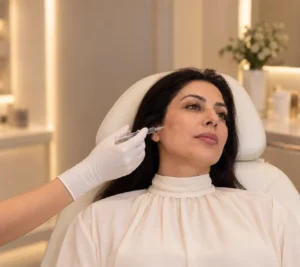

What Is PRP Facial Rejuvenation?
Platelet-rich plasma (PRP) is autologous plasma – meaning it is prepared from the patient’s own blood – with a platelet concentration above baseline. The source review describes facial PRP as a regenerative approach that aims to influence the biological processes involved in skin aging rather than simply adding external volume.
Platelets contain alpha granules rich in signaling molecules and growth factors. The paper highlights platelet-derived growth factor, transforming growth factor-beta, vascular endothelial growth factor, basic fibroblast growth factor and epithelial growth factor among the biologically relevant factors released from platelets.
Why Might PRP Affect Aging Skin?
Facial aging involves visible and microscopic changes, including wrinkles, altered pigmentation, texture changes and reduced elasticity. At a tissue level, the review describes progressive collagen and elastin degradation together with reduced and disorganized fiber production.
The proposed regenerative logic is that platelet-derived signals may activate fibroblasts, support extracellular matrix remodeling and increase collagen-related activity. The review also cites laboratory and clinical evidence showing changes in collagen expression, water retention and gene pathways linked to photoaging.
What Does the Evidence Say About Wrinkles?
Wrinkle outcomes were among the most frequently reported benefits, but the magnitude of improvement differed between studies. Elnehrawy and colleagues reported significant wrinkle improvement after a single PRP injection, with nasolabial folds particularly responsive. Everts and colleagues reported a reduction in wrinkle count and volume after a three-session protocol, with effects sustained during the six-month follow-up.
However, Alam and colleagues found a more nuanced result: participants perceived better texture and wrinkles on the PRP-treated side, while masked dermatologist ratings did not show a significant difference compared with saline. This illustrates a recurring issue in aesthetic trials – patient-perceived skin quality may not always match photographic or external evaluator scoring.
Does PRP Improve Skin Texture, Smoothness and Firmness?
Several studies reported improvements in texture and tactile skin quality. Cameli et al. found improvements in skin texture, gross elasticity, smoothness, barrier function and capacitance after three monthly injection sessions. Du and Lei also reported reduced texture irregularity and pores compared with buffered saline.
Everts et al. described improved skin firmness, while studies combining PRP with energy-based or microneedling procedures also reported stronger texture and tightness outcomes than the comparison treatment alone.
What About Pigmentation, Radiance and Skin Color?
Pigmentation outcomes were mixed. The review reports improvement in hyperpigmentation or skin color in several studies, including a large erbium fractional laser combination study. Periorbital dark circles improved in Banihashemi et al., with statistically significant findings in selected evaluations.
On the other hand, Diab et al. did not find improvement in periorbital pigmentation even though wrinkles improved. This is an important counseling point: PRP should not be presented as a guaranteed treatment for every form of facial pigmentation or dark circles.
PRP for Under-Eye Rejuvenation and Dark Circles
The periorbital area was assessed in several included studies. Banihashemi et al. reported improvement in dark circles and wrinkles after two PRP sessions. Other split-face studies compared PRP with platelet-poor plasma gel for tear trough appearance, wrinkles and hyperpigmentation.
In those direct comparisons, PPP gel often produced a stronger short-term visual effect. The review explains that plasma gel forms a three-dimensional fibrin matrix and behaves more like an autologous dermal filler, producing immediate tissue support. That is a different mechanism from PRP’s proposed regenerative effect.
PRP vs Platelet-Poor Plasma Gel
| PRP | PPP gel | Interpretation from the review |
| Platelet-rich autologous plasma | Platelet-poor plasma converted into a fibrin gel | They are not interchangeable treatments. |
| Proposed regenerative signaling and dermal remodeling | Acts partly as an autologous filler with immediate structural effect | PPP may look stronger early in tear trough correction. |
| In one comparison, no severe complications and 2.5% moderate complications | Same comparison reported 10% severe and 17.5% moderate complications | One study favored PRP on complication severity, but this is not a universal safety comparison. |
PRP With Microneedling: Is the Combination Better?
One split-face study compared microneedling alone with microneedling plus PRP or microneedling plus 15% TCA. Both combination strategies improved wrinkles and skin texture more than microneedling alone. Histologically, PRP showed a particularly favorable effect on dermal extracellular matrix architecture.
PRP With Fractional CO2 or Erbium Laser
Three included studies evaluated PRP with fractional laser treatment. Across these studies, adding PRP was associated with stronger improvement in aging signs and, in some cases, faster or more comfortable recovery.
Hui et al. reported better wrinkles, texture and tightness with fractional CO2 laser plus PRP than with laser plus saline, along with less erythema, edema and crusting. A separate erbium fractional laser study reported clear improvement in skin color, pores and texture after laser followed by PRP/PPP application.
The review proposes a biological explanation: fractional lasers create microscopic channels into the dermis, while PRP may enhance collagen-related remodeling and regenerative signaling.
PRP vs Readymade Growth-Factor Mesotherapy
Gawdat et al. compared injected PRP with a readymade growth-factor solution. Both approaches improved skin turgor, overall vitality and tissue thickness. PRP achieved higher patient satisfaction and longer-lasting effects in that study, while the readymade solution was associated with more burning.
The review notes that activated platelets release a very large range of bioactive proteins, which may help explain why an autologous platelet product can behave differently from a fixed manufactured growth-factor cocktail.
PRP With Facial Fat Grafting
The evidence for adding PRP to facial lipofilling was less convincing. In the randomized study included in the review, PRP reduced the recovery time reported by participants but did not improve skin elasticity, retained volume or overall satisfaction compared with lipofilling alone.
This is another reason to avoid treating PRP as a universal enhancer of every aesthetic procedure. Its usefulness appears to depend on the treatment goal and context.
What Biological Changes Were Seen?
Several studies went beyond photographs or patient ratings and examined histological or molecular changes. The review reports increased collagen-related gene expression, improved dermal collagen and elastin content, improved water retention and changes in genes involved in the response to ultraviolet-B exposure.
Du and Lei reported changes involving MMP-1, tyrosinase, fibrillin and tropoelastin expression. Draelos et al. observed collagen-related molecular changes even though the visible clinical difference was not statistically significant. That contrast highlights an important concept: biological activity does not always translate into a dramatic visible result.
How Many PRP Sessions Are Needed for Facial Rejuvenation?
The review does not establish a single standardized session count. Included protocols ranged from one injection to repeated sessions every two weeks or monthly. Some of the clearer clinical improvements were reported in multi-session studies, while two single-session studies produced more modest external evaluator results.
That does not prove that more sessions are always better. It means the evidence base is heterogeneous and that a treatment course should not be presented as scientifically universal when the literature itself uses multiple approaches.
When Should Results Be Judged?
Follow-up periods varied widely, from several weeks to six months and, in the lipofilling study, one year. Because PRP is being studied for regenerative remodeling rather than only immediate correction, short follow-up may miss delayed changes. At the same time, the review does not define one exact time point at which every patient’s final result should be judged.
Why Do PRP Studies Give Different Results?
- Different platelet concentrations and preparation systems
- Different activation methods
- Single-session vs multi-session protocols
- Direct injection vs topical application after skin permeation
- Different anatomical targets and aging concerns
- Different comparison groups such as saline, PPP gel, growth-factor solutions or another procedure
- Different outcome tools: patient satisfaction, physician ratings, photographs, devices, histology and molecular analysis
- Different follow-up durations
The review repeatedly identifies heterogeneity as the central limitation. This is why the correct evidence-based message is that PRP is promising for facial rejuvenation, not that one specific protocol has been proven superior for every patient.
Who May Be a Reasonable Candidate? – Evidence-Based Clinical Interpretation
The source review does not publish a formal candidate checklist or contraindication guideline. Based on the outcomes studied, PRP is most relevant to patients seeking improvement in skin quality concerns such as texture, fine wrinkles, early photoaging, selected pigmentation changes or under-eye skin quality rather than patients seeking major structural lifting or predictable volumization.
A proper consultation should therefore define the main problem first. A patient whose primary concern is volume loss, a deep tear trough, substantial laxity or a specific pigment disorder may need a different or combined strategy. Those treatment-selection decisions go beyond what this narrative review alone can prove.
Safety: What Does This Review Support?
This narrative review was designed primarily to evaluate rejuvenation outcomes, not to perform a dedicated safety meta-analysis. Safety reporting was therefore less standardized than efficacy reporting.
One useful comparison came from periorbital PRP versus PPP gel: the review reports no severe complications with PRP and moderate complications in 2.5% of participants, while PPP gel was associated with higher moderate and severe complication rates in that particular study. This should not be generalized to every PRP protocol or every clinical setting.
Frequently Asked Questions
Does PRP really rejuvenate facial skin?
The review found that many of the 16 included clinical studies reported improvement in wrinkles, texture, pigmentation, firmness or other skin-quality measures, but results were heterogeneous and not every study showed a strong objective benefit.
How strong is the evidence?
The review included 16 clinical studies and 586 participants. Eight studies used split-face comparative designs. The evidence is promising, but the wide variation in PRP preparation, treatment protocols and outcome assessment limits certainty.
Can PRP improve wrinkles?
Yes, several studies reported reduced wrinkle appearance or count. However, in at least one randomized split-face trial, participant ratings improved more than masked dermatologist ratings.
Can PRP improve skin texture?
Texture was one of the more consistently improved outcomes across several studies, including both direct-injection and combination protocols.
Does PRP tighten the skin?
Some studies reported improved firmness, elasticity or tightness. The review does not establish PRP as a substitute for procedures designed specifically for significant laxity.
Can PRP improve pores?
Du and Lei reported reduced pores in PRP-treated skin compared with buffered saline, and the large erbium fractional laser combination study also reported improvement in enlarged pores.
Does PRP help pigmentation?
Some studies reported improvements in pigmentation or skin color, but results were not consistent across every facial area or protocol.
Does PRP help dark circles?
Selected studies reported improvement in periorbital dark circles, but direct comparisons sometimes favored PPP gel for short-term visible correction.
Is PRP the same as plasma gel?
No. PRP is platelet-rich plasma used for regenerative signaling, whereas PPP gel forms a fibrin matrix and can behave more like an autologous filler.
Is PRP better than microneedling alone?
One split-face study in the review found that microneedling plus PRP improved wrinkle appearance and texture more than microneedling alone.
Is PRP useful after CO2 laser?
In the studies reviewed, PRP used with fractional CO2 laser was associated with stronger improvements and, in one study, less erythema, edema and crusting than laser alone.
Is PRP useful after erbium laser?
A large study using fractional erbium laser followed by PRP/PPP reported improvement in skin color, pores and texture.
Is PRP better than mesotherapy growth factors?
One split-face study found both improved skin quality, but PRP produced higher satisfaction and longer-lasting effects, while the readymade growth-factor solution caused more burning.
Does PRP improve collagen?
The review reports histological and molecular findings consistent with increased collagen-related activity and improved dermal matrix architecture in several studies.
How many PRP sessions do I need?
The review does not establish one ideal number. Protocols ranged from a single session to repeated treatments every two weeks or monthly.
Is one PRP session enough?
Some single-session studies reported improvement, but external evaluator results were relatively modest in certain trials. Multi-session studies were common among studies reporting clearer changes.
How long do PRP facial results last?
Follow-up varied considerably. Some studies followed patients for six months, but the review does not establish one universal duration of benefit.
Can PRP replace dermal filler?
The review does not support that conclusion. PRP was studied mainly for skin rejuvenation and biological remodeling, while structural volume correction is a different treatment goal.
Can PRP replace laser treatment?
No universal substitution can be concluded from this review. In fact, several studies examined PRP as an adjunct to fractional laser treatment.
Why do some patients see little change?
Possible reasons reflected in the literature include protocol variation, single-session treatment, differences in preparation, delivery method, baseline aging concerns and how outcomes are measured.
Is PRP facial rejuvenation proven?
The evidence is promising rather than definitive. The review concludes that most included studies showed some degree of benefit but emphasizes that facial PRP remains controversial because protocols and outcomes are not standardized.
Is PRP facial rejuvenation suitable for every skin concern?
No. The review covers specific aging outcomes, and it does not establish PRP as the best treatment for every cause of pigmentation, laxity, volume loss or under-eye change.