Clinical Evidence • Practical Patient Guide • Abu Dhabi
1. What Is a Mouth-Corner Lift? An Evidence-Based Definition
A mouth-corner lift is an intervention intended to improve the resting position and/or appearance of the oral commissure—the place where the upper and lower lips meet. People sometimes describe downturned corners as a “sad,” “tired,” or “unhappy” appearance. Those perceptions do not describe the patient’s actual mood or personality. They describe the effect of a resting mouth contour on facial expression. The objective is a comfortable, balanced position that remains natural when speaking, drinking, smiling and laughing.
In medical aesthetics, “mouth-corner lift” is an umbrella phrase, not a single standardized operation or injection recipe. A clinician may address dynamic downward pull with a neuromodulator such as botulinum toxin A, restore lost structure with hyaluronic acid (HA) filler, consider a combined treatment, or refer a patient for an appropriate surgical assessment. The review by Wollina and Goldman emphasizes this individualized approach, including the functional importance of the lips in addition to appearance. [1]
Short answer: A nonsurgical mouth-corner lift usually means targeted reduction of downward muscle pull, added soft-tissue support with HA filler, or both. It may soften the appearance of downturned mouth corners but does not duplicate the tissue repositioning achieved by surgery. Results vary with anatomy, muscle activity, baseline volume, age-related changes, product choice and treatment technique. [1,4,5]
2. Why Do the Corners of the Mouth Turn Down?
A downturned oral commissure can arise from more than one mechanism. The depressor anguli oris (DAO) muscle pulls the mouth corner inferiorly; its activity can be more conspicuous at rest in some patients or during expressions such as frowning. The platysma can also contribute to inferior tension along the lower face. Aging changes in collagen, elasticity, underlying fat and support structures can exaggerate this appearance without any unusually strong muscle contraction. Dental position and loss of lower-face skeletal support may further alter the way the mouth sits.
Structural changes matter because botulinum toxin cannot create missing volume or replace lost support. Likewise, filler cannot selectively switch off a hyperactive muscle. Treating one contributor while ignoring the other may produce an incomplete result. The patient who has strong DAO action and little volume loss may require a different approach from someone whose corners are descending because of laxity and tissue deflation. [1,11]
A clinical assessment also distinguishes normal resting asymmetry from pathological asymmetry. Facial palsy, prior surgery, scarring, congenital asymmetry or changes in oral competence can produce differences that require a distinct medical or reconstructive pathway rather than routine cosmetic injections. [1]
The four main mechanisms
Muscle-driven: prominent DAO or platysma activity creates inferior pull. Support-driven: a hollow, marionette groove or adjacent lip/chin deficiency reduces structural counterbalance. Skin and tissue-driven: laxity, photodamage and changes in the lower-face retaining system change contour. Functional or postoperative: scar tissue, facial palsy, dental changes or previous permanent fillers may alter both motion and shape. Combinations are common, which is why a personalized plan has more value than a one-technique promise.
| Primary concern | Likely contributor | Treatment discussion | Important caution |
|---|---|---|---|
| Corners drop mainly during expression | Dynamic DAO / platysma pull | Conservative neuromodulation may help | Preserve speech, smile and lip closure |
| Resting hollow beside oral commissure | Volume/support deficiency | Conservative HA support may help | Avoid creating an overfilled lower face |
| Marionette lines and skin creasing | Multifactorial aging | Combination or other modality | Filler alone may not correct significant laxity |
| Marked asymmetry after illness or surgery | Neuromuscular / scar or structural issue | Specialist evaluation first | Do not presume a cosmetic DAO problem |
| Advanced descent or very long upper lip | Anatomic excess / laxity | Possible surgical opinion | Injections do not replace tissue repositioning |
3. Anatomy Behind Lip Enhancement and Mouth-Corner Lifting
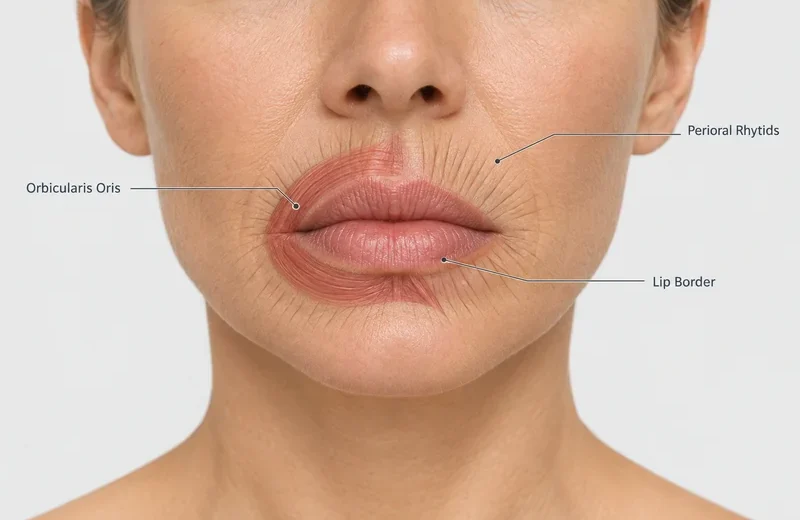
The modiolus is a dense muscular convergence near the oral commissure. Several muscles contribute to the position and mobility of this region: DAO, depressor labii inferioris (DLI), orbicularis oris, risorius, zygomaticus major and minor, levator anguli oris, buccinator and the platysma. Some pull down, others lift or draw the mouth laterally, and the orbicularis oris helps maintain lip seal. Changing the activity of one can affect the balance of the whole group. The anatomy is therefore both three-dimensional and dynamic.
The DAO is not a uniform rectangular target that appears at one identical location in every face. Ultrasound-based research published in 2024 described variation in its width, thickness and overlap with DLI. A newer randomized study in 2026 evaluated different DAO injection regions and the additional effect of platysma treatment, underscoring that the location and accompanying muscle activity alter outcomes. These papers support expert anatomical planning; they do not justify applying a one-size-fits-all injection map from a blog. [4,6]
Vascular safety is equally important with HA fillers. The superior and inferior labial arteries form part of a branching system with variable courses and depths. The original 2020 review reports ultrasound and cadaver evidence of submucosal, intramuscular and occasional subcutaneous arterial positions. Such averages do not establish a universally safe depth or border, and an individual patient’s anatomy may differ substantially. When useful and available, ultrasound can assist assessment, particularly in cases of previous filler or uncertainty. [1,2]
Why preserving function changes the aesthetic goal
The lips must close comfortably and coordinate with chewing, speech, kissing, drinking and expression. Excessive weakening around the mouth can produce asymmetry, drooling, difficulty retaining liquids or changes in articulation. Conversely, too much HA product in the wrong compartment can feel bulky, create irregularities or accentuate marionette shadows. A conservative, incremental intervention is often preferable to trying to force an idealized position in one appointment. [5,7,8]
4. How a Proper Consultation Evaluates the Lower Face
A meaningful consultation begins by asking what the patient actually wants to improve: the resting mouth corners, loss of lip definition, a hollow beside the mouth, marionette folds, asymmetry during smiling or the entire lower-face balance. These concerns should not be combined into one vague request for “more filler.” A patient may dislike the expression projected by the corners without wanting fuller lips at all. Another may want increased lip volume but have an otherwise neutral commissure.
Assessment should include standardized photographs at rest, during gentle smile and full smile, while speaking if indicated, and from profile and oblique views. The clinician may observe the mouth-corner angle, the relative lip and chin relationship, dental show, symmetry, depressor movement, pre-existing bite or dental restoration issues, texture and volume of adjacent tissue, and any past filler migration or scar. Medical history includes prior aesthetic injections, allergies, active infection, neuromuscular disease, bleeding risk, pregnancy/lactation, medication and functional complaints. [1,5,8]
The shared decision is not “how many injections?” but “what change can reasonably be achieved without affecting normal expression?” An experienced clinician should be comfortable recommending a limited treatment, staging correction, seeking dental or surgical input, or declining an intervention if benefit is uncertain or disproportionate to risk. Informed consent includes the possibility of little visible change, asymmetry, need for review and relevant serious adverse events. [2,3]
5. What Does DAO Botox Do for Downturned Corners?
Botulinum toxin A reduces signaling to selected muscles, weakening their contraction temporarily. When the resting contour is significantly affected by the downward action of the depressor anguli oris, carefully targeted neuromodulation may reduce that pull and allow the balance of other muscles to create a modest elevation in the corners. This is not the same as creating a permanent structural lift, replacing lost tissue, correcting dental support or moving the upper lip surgically.
The original Wollina–Goldman review discusses DAO and platysma involvement, including the possibility that treating both muscular components benefits selected patients. An Italian expert consensus published in July 2026 likewise identifies downturned oral commissures as a key lower-face indication for DAO treatment. A 2026 prospective study reported improvement in oral-commissure position with both examined DAO approaches, with additional benefit in some measures when platysma treatment was added. Study populations, methods and follow-up should not be generalized to every patient. [1,4,5]
Results are usually more subtle than social-media demonstrations imply. Baseline asymmetry, muscular compensation, anatomical variation and the natural recovery of muscle function all affect appearance over time. DAO treatment is not a treatment for every marionette line and it does not physically replenish the volume under a crease. Unintended diffusion may affect DLI and other nearby muscles, causing smile imbalance or lower-lip weakness, so the area requires particularly conservative planning. [6–8]
Timing and reversibility are different from HA filler
The neurotoxin effect develops over days rather than producing an immediate volumizing change. It gradually wears off as neuromuscular activity returns; it cannot be promptly dissolved with hyaluronidase. Its effect varies by product, patient and treated muscle. Exact units are not interchangeable between toxin brands, and lower-face cosmetic indications may be off-label depending on jurisdiction and product labeling. The final dose and muscle plan require physician assessment and current local regulatory review. [5,8]
6. What Can Hyaluronic Acid Filler Do for the Mouth Corners?
Hyaluronic acid filler is a soft-tissue implant rather than a muscle relaxant. In carefully selected patients, it can add structural support adjacent to the oral commissure, improve a localized hollow, soften the transition into marionette lines, restore diminished lip border support or support an age-related deficit. Its mechanism is not to paralyze or shorten a muscle. The direction and amount of apparent lifting depend on the underlying deficit, local tissue quality, product behavior and where support is needed.
HA is commonly discussed for facial and lip augmentation because it is temporary and can often be reduced or dissolved with hyaluronidase when appropriate. Product choice requires consideration of integration, cohesivity, elasticity, the movement of this region and whether the target is superficial texture or deeper support. The original review covers multiple HA approaches for lip enhancement; these descriptions are historical clinical techniques, not a universal current protocol. [1,2]
It is especially important not to confuse mouth-corner support with indiscriminate filling of every marionette fold. Overfilling the tissue immediately beside the mouth may increase bulk, distort the lip outline, produce new shadows or make the lower face appear heavy. Significant jowling, laxity or loss of skeletal support may need another strategy or specialist referral rather than repeated filler top-ups. [1,11]
How much filler should be used?
There is no medically defensible universal syringe count for a mouth-corner lift. A modest structural deficit may require only a conservative amount, while another patient may have an issue that is not correctable with filler at all. The most useful plan is based on photographs, palpation, movement, treatment goals and a careful discussion of alternatives. Where larger correction is sought, a staged approach is often more judicious than substantial same-day volume. [1,2]
7. Botox or Filler for a Downturned Mouth: Which Is Better?
Neither treatment is categorically “better.” Their purposes differ. Botulinum toxin targets dynamic muscular pull; HA filler addresses a structural deficiency. Patients with a clear dynamic component and preserved volume may derive more meaningful improvement from judicious muscle relaxation, while patients with an isolated hollow or support loss may need only tissue support. Where both mechanisms are present, a combined plan may have a more rational basis than increasing the amount of either treatment alone. [1,4,5]
The choice is also about reversibility and timing. HA can frequently be adjusted using hyaluronidase, although this does not make injection complication-free. Neuromodulator effects generally cannot be reversed immediately, so the physician must minimize the chance of functional imbalance in advance. Expectations should be calibrated to a subtle change in resting expression, not guaranteed symmetry, a permanent smile or a literal upward relocation of the mouth. [2,7,8]
| Option | Primary action | May suit | Cannot reliably achieve |
|---|---|---|---|
| DAO botulinum toxin | Reduces targeted downward movement | Predominantly dynamic downturn | Restore missing volume or reverse advanced laxity |
| HA filler | Provides tissue support/contour | Hollow adjacent to commissure; local deflation | Relax a hyperactive DAO or replace a surgical lift |
| Combined individualized plan | Addresses both dynamic and structural components | Mixed contributors confirmed by assessment | Guarantee no asymmetry or permanent results |
| Energy-based/skin treatment | Addresses texture or selected laxity | Photoaging or surface change | Direct replacement of major lost volume |
| Surgical approach / referral | Anatomic repositioning in appropriate candidates | Pronounced excess skin or structural descent | A risk-free alternative to nonsurgical care |
8. Lip Flip vs Mouth-Corner Lift vs Lip Filler vs Surgical Lip Lift
These labels sound similar yet describe distinct targets. A lip flip uses a small, carefully selected neuromodulator treatment around the upper lip to alter the way the vermilion becomes visible with movement. It does not add actual HA volume. A mouth-corner lift concerns the commissure and its downward pull or support. Lip filler can increase volume, projection or contour of the red lip. A surgical upper-lip lift changes upper-lip length and tooth/vermilion show by an operative technique, and it requires assessment by a properly credentialed surgeon.
A “non-surgical lip lift” in older publications may refer to filler placement around lip tubercles rather than to the anatomic shortening achieved by surgery. It should not be promoted as an exact substitute for a bullhorn or direct lip-lift procedure. Likewise, “Mona Lisa smile” is a descriptive marketing term for one family of commissure-support techniques, not a validated indication that guarantees outcomes. [1]
For practical search intent: If the main question is “Why do my corners point down?”, assess DAO action and local support. If it is “Why is my upper lip long and my teeth are hidden?”, assess upper-lip anatomy and consider surgical consultation where appropriate. If it is “Why are my lips thin?”, evaluate HA lip augmentation. The most effective result may involve none, one, or more than one of these options. [1,9,11,12]
9. The Original 2020 Medical Review: What It Actually Found
Wollina and Goldman published a narrative review in Dermatologic Therapy in 2020 titled “Lip enhancement and mouth corner lift with fillers and botulinum toxin A.” It considered aesthetic, anatomical and functional indications. The review discussed labial vascular anatomy, HA techniques, botulinum toxin safety, the classification of mouth-corner shape and reconstructive uses after surgery or neurological problems. Because it was a narrative review, it did not test one unified combined-treatment protocol in a randomized controlled population. [1]
The paper summarizes an earlier meta-analysis of 22 HA lip-filler studies involving 3,965 participants and reports clinical response ranges of 71–93.2%; those statistics relate to overall lip fullness outcomes, not specifically to the degree of mouth-corner elevation achieved by DAO injections. Similarly, a cited four-point HA study treated 50 women and reported high satisfaction; that is an example of a published lip technique, not proof that it is the safest or most effective mouth-corner strategy. [1]
Other portions describe preliminary or relatively small series, including rehabilitation of postoperative lip deformity, patients with facial palsy and individuals with scleroderma-related microstomia. These illustrate a broader functional role of aesthetic injectables but should not be generalized to routine cosmetic clients or converted into promises of success. The authors’ own clinical photographs in Figures 1 and 2 illustrate multimodal treatment, not an isolated effect of a single product. [1]
Why interpreting a combination result requires caution
When one patient receives HA filler alongside platysma/DAO botulinum toxin, laser resurfacing or laser lipolysis, a before-and-after photograph shows the result of the combined approach. It cannot quantify the proportion of improvement caused by each component. Differences in lighting, posture and time point may also influence visual comparison. These limitations will remain explicit in every clinical figure caption below.
10. The Evidence Update: What Was Added in 2024–2026?
The original review remains useful for anatomy and clinical framing, but more recent research has refined our understanding of DAO treatment. A 2024 ultrasound investigation characterized DAO muscle structure and its overlap with DLI, which helps explain why seemingly minor placement differences can produce different functional results. Such anatomical mapping supports individualized treatment rather than reliance on fixed skin landmarks alone. [6]
A 2026 two-stage prospective study, including a randomized double-blind component, compared different DAO injection sites and assessed the additional effect of platysma injections. The investigators reported improvement in commissure-position measures, with a greater effect for their lower DAO strategy and additional improvement or satisfaction on selected outcomes in the DAO-plus-platysma group. Because the research was carried out in a defined clinical setting and the second stage was not randomized, it should not be overstated as proof that every patient needs a combined protocol. [4]
An Italian lower-face expert consensus published in 2026 identified DAO treatment for downturned commissures and emphasized attention to target anatomy and diffusion into neighboring DLI. An updated 2026 narrative review of injectable complications similarly highlighted smile asymmetry and oral sphincter incompetence from lower-face toxin diffusion. These advances strengthen the emphasis on function-preserving dosing and anatomical judgment. [5,7]
For HA fillers, current FDA guidance reinforces the fact that blood-vessel injection is uncommon but potentially serious, resulting in tissue necrosis, vision change or stroke. Slow and gentle injection by appropriately trained clinicians, product authenticity checks, knowledge of facial vascular anatomy and a practiced emergency plan are essential safety principles. These are not guarantees of safety and FDA product approvals do not automatically establish local UAE authorization. [2,3]
11. Interpreting Published Before-and-After Examples
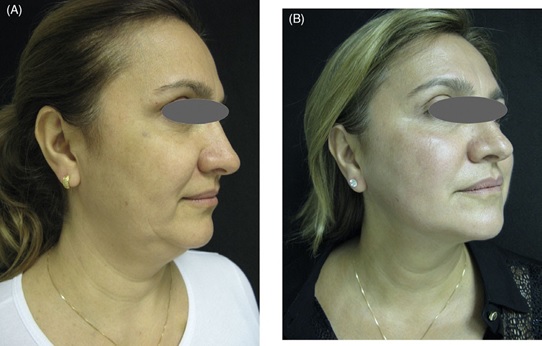
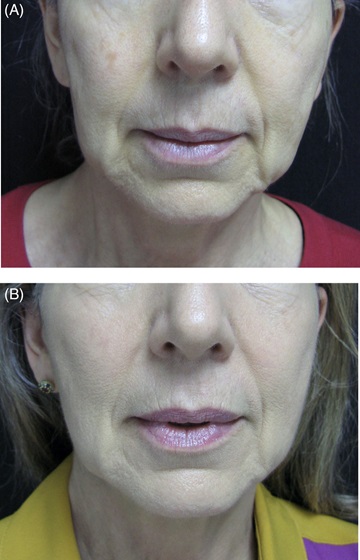
The photographs reproduced below are figures from the Wollina–Goldman 2020 article. They are educational source figures, not photographs of Dr. Erfan Rahmani’s patients, and they must not be labeled as results achieved by this editorial reviewer. Their purpose is to help explain which dimensions of lower-face appearance can change after multimodal care. They also demonstrate why treatment combinations should not be judged as if they were a single clinical trial. [1]
A photograph alone cannot reliably show functional lip closure, articulation, bite, dynamic facial movement, patient satisfaction or rare complications. Meaningful outcome evaluation benefits from consistent time points, lighting, facial position and independent assessment when available. Even an appealing external result cannot prove that a method is superior to alternatives.
Published Clinical Figure 1 — lower-face contour and corner support
The first published example involves a 52-year-old patient with lower-face and neck adipose contours, laxity, nasolabial folds and downturn of the oral commissure. The authors describe the later photograph as six months after facial and cervical laser lipolysis with HA treatment of the mouth corner and nasolabial folds. This image illustrates the appearance after combination treatment; it does not establish which single procedure produced a particular share of the change. [1]
Published Clinical Figure 2 — oral commissures and perioral skin
The second example involves a 63-year-old patient with perioral wrinkles and drooping mouth corners. The publication attributes the four-month follow-up appearance to a combination of HA treatment at the oral commissure, botulinum toxin involving DAO/platysma and full-face fractional CO₂ laser. Because several therapies were given, the case cannot prove a specific Botox dose, filler brand or isolated success rate. Its value is showing the integrated lower-face and skin-restoration concept. [1]
12. How Long Do the Results Last?
There is no single duration that applies to all mouth-corner treatments. Botulinum toxin gradually takes effect over days, then diminishes as neuromuscular signaling recovers; duration depends on preparation, muscle, dose and patient factors. HA correction may be visible soon after treatment but the initial impression is affected by edema, and cosmetic persistence varies according to gel properties, volume, tissue and activity. A review visit after swelling settles can be more informative than judging the result the same afternoon.
It is helpful to separate product presence, visible aesthetic benefit and patient satisfaction. A small residual filler deposit may remain even when the perceptible lifting effect has faded. Conversely, the patient may continue to like the overall contour after a neuromodulator has begun wearing off. A conservative, personalized maintenance plan is preferable to automatic scheduled refilling without reassessing underlying anatomy. [1,2]
For web readability, avoid promising a fixed number of months for every patient, a defined number of millimeters of lift, or guaranteed perfect symmetry. Quoted trial responses depend on the outcome scale and the period when they were measured. The patient should understand both likely benefits and uncertainty.
13. Recovery and Aftercare: What Patients Can Expect
For many appropriately performed outpatient injectable treatments, routine activity can resume soon, but swelling, redness, pressure sensitivity or bruising may occur. Lower-face HA treatment can temporarily look more prominent because of swelling, and localized neurotoxin injection may cause pinpoint marks. The clinician should give written advice specific to the product, area and the patient’s medication history. Avoid manipulating or massaging an injection area unless instructed by the treating clinician.
For a patient with an imminent wedding or photo event, it is generally prudent to allow time for swelling, bruising and any unexpected asymmetry to settle rather than scheduling the first trial of a new lower-face intervention at the last moment. A follow-up consultation may be appropriate if the initial change is inconsistent, if a touch-up is being considered or if there are questions about function.
Important distinction: normal expected tenderness is not the same as rapidly worsening pain, pale or mottled skin, sudden vision symptoms, rapidly expanding swelling, increasing heat/redness, or difficulty with speech, swallowing or breathing. Those symptoms need urgent evaluation as described in the next section. [2,7,8]
14. Safety: Filler and Botulinum Toxin Risks Are Not the Same
The most important HA filler emergency is unintended injection into a blood vessel. Depending on location and extent, this can compromise skin perfusion or, in rare high-risk settings, contribute to visual loss or stroke. Warning signs include unusual or disproportionate pain, blanching, livedoid/mottled change, delayed capillary refill and visual or neurological symptoms. Injection should stop immediately and the patient requires prompt treatment by a team prepared to manage vascular complications, including urgent specialist referral where appropriate. Do not delay emergency care while awaiting a routine office appointment. [2,3]
Other filler complications include bruising, swelling, tenderness, asymmetry, surface irregularity, overcorrection, migration, infection, inflammatory nodules, delayed reactions and occasional granulomas. An apparent lump may reflect edema, a misplaced deposit, inflammation or infection; these have different management pathways. Patients should not try to dissolve, puncture or massage a suspicious lump themselves. Hyaluronidase is used by trained professionals for selected HA complications but is not a solution for every filler material or complication. [1,2]
Lower-face botulinum toxin carries a distinct risk of diffusion to neighboring muscles. Transient asymmetric smile, reduced lower-lip control, difficulty keeping liquids in the mouth, abnormal articulation or drooping can occur. The FDA’s official labeling also warns about rare spread-of-toxin effects involving swallowing or breathing difficulties and notes that product units are not interchangeable. New-onset significant swallowing, speech or respiratory symptoms require urgent medical evaluation. [7,8]
Patients deserve balanced information. “Minimally invasive,” “reversible filler,” “small Botox dose” and “experienced injector” do not mean zero risk. The most responsible plan combines correct candidate selection, documented consent, authenticated products, appropriate clinical setting, skill in complication recognition and emergency readiness. [2,3]
| Finding | More typical of | Reason to act |
|---|---|---|
| Mild stable bruising or swelling | Expected transient local response | Follow clinician-specific aftercare and review if persistent |
| Severe or increasing pain, pallor, mottling | Possible vascular compromise after HA | Urgent same-day emergency clinical evaluation |
| Sudden blurred vision, visual loss, stroke symptoms | Potential vascular emergency | Immediate emergency services / specialist pathway |
| Growing hot tender lump or fever | Possible infection/inflammation | Prompt medical examination, do not self-treat |
| Crooked smile or difficulty holding liquids after toxin | Possible unintended muscular weakness | Urgent assessment if severe; contact clinician promptly |
| Trouble breathing or swallowing after toxin | Rare serious systemic/toxin effect | Emergency medical assistance immediately |
15. Advanced and Reconstructive Uses Are Different from Routine Cosmetic Requests
The 2020 article also explores medical indications outside routine lip enhancement. Patients with lip deformity after surgery or removal of permanent fillers, facial paralysis and scleroderma-related mouth restriction may experience functional and psychosocial consequences. Such individuals may benefit from interdisciplinary assessment involving dermatology, plastic surgery, maxillofacial surgery, neurology, rheumatology, dentistry and rehabilitation as indicated. Cosmetic assumptions should not dictate these complex treatment plans. [1]
In patients with facial palsy, facial asymmetry can arise from a failure of elevating muscles on one side, compensatory pull on the other side or altered oral competence. Treating a conventional cosmetic DAO pattern without understanding the neurological problem can worsen function. Studies describing HA and botulinum toxin in facial paralysis support clinical investigation of individualized rehabilitation but do not imply universal restoration of normal smile function.
The review cites a small scleroderma study in which a combined intervention involving HA and platelet-rich plasma was associated with improved mouth opening, but the design cannot isolate the effect of HA itself. Similarly, case reports of repaired lips after removal of permanent filler cannot establish broad effectiveness in all post-surgical deformities. These topics belong in specialist care and should not be presented as a standard cosmetic package offered to every patient. [1]
16. Natural Results: What Does Success Actually Mean?
A successful result is not necessarily the most dramatic difference between two photographs. For an oral commissure intervention, the most meaningful endpoint may be a slightly less downturned resting contour with a normal smile and normal speech. For an older lip with deflation, a modest return of shape and structure can have more aesthetic value than a visibly larger border. For an asymmetric mouth, complete numerical symmetry may be unattainable or undesirable if it changes the patient’s natural expression.
Anatomy-based treatment avoids forcing everyone into one fashionable template. The relationship of the lip to the chin, midface, dental arch, marionette region and platysma matters. Patient preference also matters: some patients welcome volume, while others dislike even subtle fullness. Shared planning should use photographs and a specific goal that can be assessed after treatment rather than an abstract promise of being “younger” or “happier.”
Finally, treatment success must include safety, preserved function and the patient’s ability to decide on retreatment without pressure. More syringes and more procedures are not automatically better. In selected patients, the right recommendation is to leave a normal anatomical variation untreated.
17. Planning Mouth-Corner Rejuvenation in Abu Dhabi
A practical consultation in Abu Dhabi should begin with a clear description of the concern and a dynamic facial assessment. Dr. Erfan Rahmani’s website already has dedicated educational pages for Lip Filler, Botox, Lip Flip and Lower Face Rejuvenation. This article is designed to complement those service pages with an in-depth discussion of mouth-corner downturn and lower-face muscular balance, rather than duplicate their broad information about lip augmentation. [9–12]
For local relevance, patients may ask whether they need Botox for the downward-pulling muscle, HA support beneath the mouth corner, combined perioral rejuvenation or referral for a different procedure. Product selection, availability, clinician privileges, cost, potential off-label use and aftercare should be checked during an actual appointment. The consultation should not assume that a named technique, clinical figure from literature or a quoted clinical trial is offered in identical form by a particular facility.
Clinical editorial principle: individual anatomy first; careful choice of material and target second; conservative treatment third; functional follow-up always. The goal is to help patients in Abu Dhabi understand reasonable options and safety considerations before they consent to an intervention. [1,2,5,11]
18. Frequently Asked Questions: Mouth Corner Lift in Abu Dhabi
These concise answers are intended to address patient-search and AI-answer questions directly. They are educational, not individualized medical advice. References are listed in Section 19.
1. What is a nonsurgical mouth-corner lift?
It is an individualized approach to improve the resting appearance of downturned oral commissures using neuromodulator treatment, HA structural support or both. It does not remove or physically reposition skin as surgery does. The correct option depends on muscular activity and underlying support. [1,4]
2. Why do my mouth corners point downward even when I am happy?
The contour can reflect DAO muscle tone, platysma contribution, natural anatomy, skin laxity or loss of volume. A downturned appearance does not mean the person feels sad. Assessment at rest and while smiling helps distinguish dynamic pull from structural descent. [1,11]
3. Can Botox lift the corners of the mouth?
In selected individuals, botulinum toxin can reduce the pulling force of the depressor anguli oris and modestly improve commissure position. The effect is temporary, not guaranteed, and should preserve speech, lip seal and an unrestricted natural smile. [1,4,5]
4. What is the DAO muscle?
The depressor anguli oris is a lower-face muscle that can pull the mouth corner downward. Its anatomical position and overlap with nearby muscles vary, so accurate clinical assessment is more important than a rigid surface injection diagram. [6]
5. Is mouth-corner Botox the same as a lip flip?
No. A lip flip generally targets selected upper-lip muscle activity to alter vermilion display, while DAO treatment targets the lower pull on the oral commissure. Both use neuromodulators, but the indications and risks differ. [1,12]
6. Can hyaluronic acid filler lift downturned mouth corners?
HA may support a localized hollow or soft-tissue deficit adjacent to the commissure, improving appearance in selected patients. It cannot directly switch off muscular pull. Excessive filler can make the mouth region heavy, so the need for volume must be demonstrated first. [1,2]
7. Is a mouth-corner lift a surgical procedure?
The phrase can describe surgical or nonsurgical techniques. In this article it mainly refers to nonsurgical treatment with Botox and/or filler. A surgical mouth-corner lift or upper-lip lift has different indications, scars, recovery and surgical risks and requires specialist evaluation.
8. Can Botox and filler be used together?
Yes, a combined approach can be considered where dynamic downward pull and lack of soft-tissue support coexist. The 2020 review discusses combination care, but it does not establish a single best regimen. A staged plan may help clarify what each component achieves. [1]
9. Which is better for marionette lines: Botox or filler?
Neither is universally better. If the line reflects volume deficiency, strategic support may be more useful; if muscular pull is prominent, DAO treatment may be considered. Deep static folds and laxity can require other approaches. [1,11]
10. Will I look like I am constantly smiling?
That should not be the treatment goal. An aesthetically balanced result aims to soften downward pull without creating an exaggerated expression. It cannot ensure that every facial expression is unchanged, which is why conservative functional assessment matters.
11. How much of a lift can I expect?
No reliable universal number of millimeters applies to every patient. Some clinical studies measure average changes in oral-commissure position, but individual variation is substantial and larger trial effects cannot be promised during a consultation. [4]
12. When do DAO Botox results begin?
The neuromodulator effect develops over the following days rather than immediately. A clinician typically assesses the evolving change after adequate time for the product to act, while recognizing that different brands and individuals behave differently. [8]
13. How long do mouth-corner Botox results last?
Botulinum toxin effects are temporary and fade as muscle activity returns. Duration varies with the product, muscle, dose and patient; it should not be described as a permanent surgical lift. Repeat treatment should follow a fresh assessment, not an automatic schedule.
14. How long does filler support at the mouth corner last?
HA persistence depends on its formulation and the dynamic tissue environment. Some cosmetic improvement may persist for months, but a guaranteed duration cannot be provided without knowing the product and patient. Swelling and the desired support may change at different rates. [1,2]
15. Does mouth-corner Botox cause pain?
There may be a brief injection sensation and temporary local tenderness or bruising. Pain experience varies. A proper consultation reviews both comfort measures and rare functional risks rather than promising treatment will be painless. [1,8]
16. Is mouth-corner lifting safe?
It can be appropriate when performed by a qualified clinician with proper assessment, product selection and emergency readiness, but no injectable intervention is risk-free. Filler vascular injury and lower-face toxin diffusion are distinct risks that deserve informed discussion. [2,7]
17. Can DAO Botox make my smile crooked?
Yes. Unintended weakening of the depressor labii inferioris or nearby muscles can result in temporary smile asymmetry or changes in lower-lip movement. This is a key reason for conservative treatment and follow-up. [5,7]
18. Can lower-face Botox affect drinking or speech?
If toxin diffuses into muscles important for lip closure, some patients can experience temporary functional problems, including difficulty keeping liquids in the mouth or altered articulation. Clinically important symptoms require prompt assessment. [7,8]
19. Is DAO Botox FDA approved for lifting mouth corners?
Botulinum toxin products have indication-specific regulatory approvals. Cosmetic DAO mouth-corner lifting may be off-label depending on the product and jurisdiction. A US FDA approval does not establish permission for the same use in the UAE; your clinician should clarify the applicable local rules. [8]
20. Do Botox units mean the same thing across brands?
No. Botulinum toxin unit measurements are product-specific and should not be converted directly between manufacturers. Patients should ask which product will be used and whether that product is approved and authentic. [8]
21. Do I need an ultrasound before mouth-corner Botox?
Not everyone does. Ultrasound research demonstrates meaningful DAO and adjacent-muscle variability, and imaging may add value in selected cases or complex anatomy. It does not replace skilled functional examination or transform treatment into a zero-risk procedure. [6]
22. Can ultrasound help with mouth-corner filler?
Ultrasound may help identify previous filler deposits, vessels or other relevant anatomy in selected cases. Its usefulness depends on equipment, practitioner expertise and clinical question. It is not a guarantee against arterial injection. [2]
23. Is the lower face a high-risk area for injectables?
It is anatomically complex. The mouth is surrounded by muscles essential for function and by variable facial and labial vessels. Risk reduction requires sound anatomical judgment, gentle technique and planning for complications. [1,2,7]
24. What are the most common filler side effects?
Bruising, swelling, tenderness, redness and occasional temporary lumps are common examples. Persistent or increasing pain, pallor, new color changes, hot tender nodules or visual symptoms are not routine signs and require medical assessment. [2]
25. What are the warning signs of vascular occlusion?
Severe or unusual pain, blanching, mottled discoloration, worsening perfusion or visual/neurological symptoms should be treated as urgent warning signs. If they occur during treatment the injector should stop, activate the complication plan and arrange emergency care. [2,3]
26. Can mouth-corner filler be dissolved?
Many HA fillers can be reduced using hyaluronidase by an appropriately trained clinician. Dissolution is not instantaneous for every scenario and should follow a diagnosis. The same enzyme does not dissolve all non-HA or permanent products. [2]
27. What if the corners look uneven the day after treatment?
Early swelling or bruising can create temporary asymmetry. Do not self-massage or request a rushed top-up. Contact the treating clinic, follow its assessment plan and seek immediate care for alarming symptoms such as severe pain or marked discoloration.
28. Can the treatment fix naturally uneven mouth corners?
It may improve selected asymmetries, especially when they relate to an identifiable muscular or structural cause. Complete symmetry is not a realistic or necessary goal in every person, and a functional or postoperative asymmetry may need specialist assessment. [1]
29. Can I combine mouth-corner Botox with chin Botox?
Both muscles can contribute to lower-face expression, but a combined treatment should not be automatic. A clinician first checks whether mentalis activity, DAO action or adjacent support actually explains the visible concern. Additional muscle treatment introduces additional opportunity for imbalance. [5]
30. Can this treatment improve a sad or tired appearance?
It may soften a particular contour that observers interpret that way, but it does not alter a person’s mood. It is better to describe concrete anatomy and achievable appearance changes than promise personality or emotional transformation. [1]
31. Does filler help with fine lines around the mouth?
Selected superficial or structural lines may respond to carefully chosen filler, but fine dynamic rhytides and photodamage may require skin-directed treatment such as resurfacing. More HA is not always the best solution. [1,11]
32. Can Botox fix all vertical lip lines?
No. Botox can affect movement-related lines but cannot fully reverse photodamage, static dermal creasing or volume loss. Excess treatment near the lips can compromise function, so multimodality options and conservative goals should be reviewed. [7,12]
33. Is it possible to lift my mouth corners without fuller lips?
Sometimes. If the problem is predominantly dynamic DAO pull, neuromodulation may be considered without increasing lip volume. Structural filler is not necessary for every patient. [1,4]
34. Can filler make mouth corners look worse?
Yes. Unnecessary or poorly positioned volume can create irregularity, an overfilled lower face, new shadows or asymmetry. The treatment should be limited to a demonstrated support deficit rather than a desire to inject every visible line.
35. How many syringes are needed for mouth-corner filler?
There is no standard number. Many people need little product or none; volume decisions depend on the tissue deficit and whole-face balance. A consultation is required before assigning a treatment amount or price.
36. Can a strong platysma pull contribute to mouth corners?
Yes, some people have lower-face muscular patterns in which the platysma contributes to inferior tension. The 2020 review and selected newer 2026 research discuss an individualized DAO–platysma approach, but it is not necessary for everyone. [1,4]
37. Does treating the neck improve the mouth corners?
Only when the relevant neck or platysma activity contributes meaningfully to the patient’s lower-face expression. Treating neck muscles merely because mouth corners are downturned would not be evidence-based, and diffusion can affect important function. [1,5]
38. Can mouth-corner lift be combined with laser treatment?
Possibly, when photoaging, wrinkles or texture changes are also present. The source clinical example combined filler, neuromodulation and fractional CO₂ laser. It illustrates multimodal care rather than proving that every patient benefits from laser. [1]
39. What is the Mona Lisa smile technique?
It is a historical label for a filler approach intended to support the oral commissure. It is not a universally standardized procedure or a guarantee of fixed elevation. Treatment should be based on actual anatomy rather than technique branding. [1]
40. Is a French Kiss lip technique the same as a mouth-corner lift?
No. The French Kiss technique refers to an anatomy-oriented lip augmentation/eversion approach, whereas mouth-corner treatment specifically aims at commissure position and supporting tissues. A named lip technique does not automatically correct DAO-driven descent. [1]
41. Is Four-Point lip augmentation proven better than conventional filler?
No. A small published 50-patient study reported favorable patient satisfaction, and the 2020 review describes it, but it does not prove that it is superior for all anatomy or that it is free from vascular risk. [1]
42. Can a mouth-corner lift treat a gummy smile?
Not directly. Gummy-smile assessment involves upper-lip elevation, tooth/gingival display and dental relationships, distinct from DAO-driven inferior commissure pull. An unrelated lower-face injection should not be used as a substitute for diagnosing gummy smile.
43. Can I get this treatment after previous filler?
Sometimes, after identifying the previous product, its location, any existing nodules and its effect on anatomy. Old or migrated filler can change the plan; ultrasound or referral may be useful in difficult cases. [2]
44. Can permanent fillers be used around the lips?
The risk-benefit profile is unfavorable for many permanent materials, especially in highly mobile perioral tissue. They may be hard or impossible to remove and can cause chronic inflammation or nodules. Discuss alternatives and regulatory indications with a specialist. [1,2]
45. Are smokers or people with sun-damaged lips candidates?
The answer depends on skin and vascular status, wound-healing risks, creasing, expectations and overall health. Prominent photodamage or deep lines may need skin treatments rather than filler alone. Tobacco history should be part of the consultation.
46. What about patients with facial paralysis or prior lip surgery?
They should have a functional assessment before cosmetic treatment. A combination of rehabilitative strategies may help some patients, but routine cosmetic DAO Botox can be inappropriate if it worsens existing weakness or oral closure. [1]
47. Can people with scleroderma receive lip filler?
This is a specialist issue rather than routine cosmetic care. The 2020 review describes small preliminary investigations in patients with microstomia and perioral fibrosis, but the evidence does not support simple extrapolation to all patients or an unqualified treatment claim. [1]
48. Does Botox or filler treat true surgical lip length?
No. Filler adds volume or support and Botox changes muscle movement. A genuinely elongated cutaneous upper lip or structural need for operative repositioning may merit specialist surgical consultation instead. [1]
49. What should I ask my injector before treatment?
Ask what causes the downturn, why the proposed product is suitable, what change is realistic, whether the indication is locally approved or off-label, what functional risks exist, which photographs will document the result and what emergency protocol the clinic follows. [2,3,8]
50. What if I feel severe pain after HA treatment?
Do not assume it is normal swelling. Contact the treating clinician immediately and seek emergency care if the pain is disproportionate, worsening or associated with pallor, mottling, visual change or neurological symptoms. [2]
51. What if I have trouble swallowing or breathing after Botox?
Seek immediate emergency medical assistance. These may be serious symptoms of toxin effect and should never be managed by waiting for the routine two-week follow-up. [8]
52. Is mouth-corner lift suitable for men?
Sex alone does not determine eligibility. The physician should assess individual facial anatomy, baseline expression, functional goals and preferences rather than impose one gender-based template. A subtle contour change may be preferable to standardized upturn.
53. Can results be guaranteed?
No ethical provider can guarantee a defined millimeter lift, perfect symmetry, zero swelling or no complications. A responsible consultation explains expected benefit, alternatives, uncertainty and how adverse events will be addressed. [2,3]
54. Can I travel or attend events straight after treatment?
Many people return to routine activities, but bruising, swelling and treatment evolution may affect photographs or plans. For a major event, schedule a consultation early enough to allow follow-up. Travel decisions should reflect the procedure and any complication risk.
55. Where can I learn more about lip filler and Botox in Abu Dhabi?
The linked educational resources on Dr. Erfan Rahmani’s website cover lip filler, Botox, lip flip and lower-face rejuvenation. These pages provide additional context but an in-person consultation is required for suitability and treatment availability. [9–12]