The short answer: can Botox change the shape of your nose?
Yes—but only in particular situations and usually only by a small amount. Botulinum toxin type A may temporarily reduce the downward movement of a hyperdynamic nasal tip during smiling, soften excessive nostril flare caused by active muscles, or address selected muscular asymmetries after rhinoplasty. It does not remove a dorsal hump, shorten nasal bones, narrow fixed cartilage, correct a deviated septum, or replace structural rhinoplasty. These are not interchangeable outcomes. The most useful question is not “Can I get nose Botox?” but “Is the feature that bothers me caused by muscle movement or by the nose’s underlying structure?”
The best direct source examined here is a 2024 systematic review by Modarresi, Beshkar and Bakhtiari. It included 23 papers on nasal aesthetic applications of botulinum toxin, spanning clinical investigations, case reports and expert recommendations. Findings are encouraging for carefully selected, predominantly dynamic concerns, but the evidence varies in quality, and larger trials are required. Treatment of the nasal tip or nostril shape with botulinum toxin should not be presented as an established substitute for surgery or as a predictable method of making a nose smaller.
What is nose Botox?
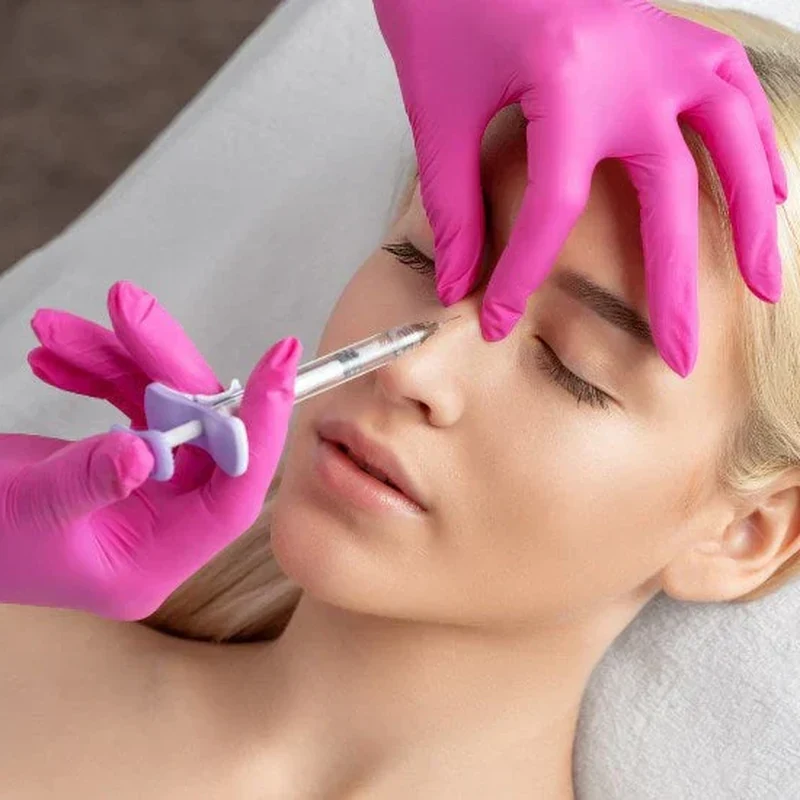
“Nose Botox” is a convenient search term for botulinum toxin treatment directed at muscles that influence nasal appearance. Clinicians may use the term nasal Botox, Botox nose lift, nasal tip Botox, nose tip lift without surgery, Botox for nostril flaring, nasal alar Botox or non-surgical nasal tip correction. The term “Botox” commonly functions as shorthand in consumer searches, but Botox Cosmetic is a specific formulation of onabotulinumtoxinA; other botulinum toxin A formulations have different proprietary units and are not dose-equivalent.
Botulinum toxin reduces acetylcholine release at the neuromuscular junction, temporarily weakening selected muscle contraction. The consequence depends on the exact target. If a muscle repeatedly pulls the nasal tip downward while smiling, diminishing that pull can slightly change the tip’s dynamic orientation. If muscles widen the nostrils during expression, their relaxation may lessen movement. A nose with a prominent hump caused by bone or cartilage, however, does not shrink when facial muscles are relaxed.
The clinical goal is usually subtle movement modification, not volume creation or reconstructive reshaping. This is a useful distinction in online information because searches for “Botox rhinoplasty,” “liquid nose job” and “non-surgical nose job” often mix procedures with very different mechanisms and risks.
How the 2024 systematic review was conducted
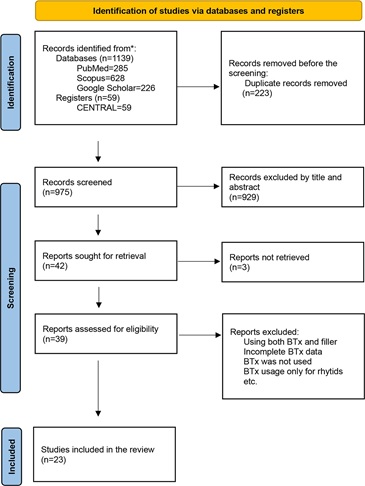
The investigators searched PubMed, Scopus, Google Scholar and the Cochrane Central Register of Controlled Trials, with the final search extending to 20 May 2023. They used a PRISMA-based selection process and reviewed research where botulinum toxin was used for nasal aesthetic changes. Studies combining the same nasal treatment with fillers, non-nasal investigations, animal/laboratory work and publications limited to wrinkle treatment alone were excluded. Two reviewers screened and extracted study information, including product, injection region, dose and outcomes, and resolved disagreements through discussion.
The final review included 23 publications. They were not all equivalent: some provided clinical outcomes, others were reports of a few cases, and others were expert viewpoints or consensus descriptions. This explains why a promising conclusion in a narrative review must not be confused with a pooled efficacy rate from 23 randomized controlled trials. The authors explicitly stated that high heterogeneity prevented meta-analysis and that many underlying reports lacked comparator groups.
What the study design can and cannot prove
A systematic review can map a field, reveal consistent mechanisms and identify unanswered questions. It cannot make low-quality studies high-quality merely by collecting them. For nasal toxin therapy, the clinical questions differ substantially: some focus on smiling-related tip droop, some quantify alar mobility with three-dimensional imaging, some evaluate postoperative asymmetry and others report isolated nasal dorsum or columella changes. Brands, dose scales, follow-up and outcomes also differ. A narrative synthesis is therefore appropriate, but direct comparison of different dose regimens or calculation of a universal success percentage would be misleading.
The clinical studies in the source include a 43-patient dynamic tip series, a 60-participant postoperative investigation, a 14-person dorsal-volume pilot, and a 20-participant prospective analysis of alar mobility. The review also included a larger full-face treatment series in which only a small subset received nasal injections. These are highly different denominators. A reliable medical blog should explain those differences rather than reporting every study as if it treated the same nasal condition.
Anatomy: the muscles that actually change nasal movement
Depressor septi nasi: downward nasal-tip motion
The depressor septi nasi is an important contributor to downward movement of the columella and tip in selected patients, particularly during smiling. When overactive, this muscle may create a “plunging nasal tip”: the nose appears noticeably lower during expression than at rest. Carefully assessed weakening may produce a subtle apparent lift or prevent the tip from plunging. The ideal candidate has a reproducible dynamic movement, not merely a naturally low tip with substantial cartilaginous ptosis.
The upper lip and the nasal base share closely related muscle anatomy. Over-treatment or unintended spread may compromise lip elevation and produce altered smile dynamics. This is one of the reasons that treatment planning is based on clinical examination and detailed anatomy rather than a social-media injection diagram.
Nasalis and dilator naris: flaring nostrils
The nasalis has transverse and alar components; the dilator naris contributes to active widening of the nostril openings. Some people have conspicuous flaring with smiling, anger or other facial expressions despite a relatively narrow resting nasal base. In those people, weakening carefully selected alar muscles may reduce movement. It does not generally change the width of fixed alar cartilage, the structural attachment of the nostrils or a broad nose at rest.
Levator labii superioris alaeque nasi: nasal ala and upper lip
The long-named levator labii superioris alaeque nasi (LLSAN) helps lift the upper lip and the alar region. An asymmetry or excessive pull may change nostril shape or tip orientation during smiling. Yet this same function makes unintended weakening especially consequential: the philtrum may look longer, upper-lip elevation may decline and smiling may become asymmetric. Its role must be differentiated from the depressor septi nasi; one muscle cannot substitute for another in an anatomical plan.
Procerus and neighbouring muscles
The procerus acts around the nasal root and glabellar region. The source review discusses a small pilot exploring apparent nasal dorsum augmentation with treatment of superficial procerus fibres, and case reports involving unusual muscle synkinesis after rhinoplasty. These represent exploratory, selective applications, not evidence that Botox grows a nasal bridge or substitutes for hyaluronic-acid augmentation.
Botox for a drooping nose tip when smiling
This is among the most frequently discussed nose-Botox applications. The treatment rationale is straightforward: if the tip is drawn downward by a contraction that is stronger than desired, modifying the contraction can change the tip’s position during expression. The systematic review describes doses ranging from 1.5 to 10 units across different products and studies, with 2–4 units often cited in reports for particular techniques. These are published research observations, not a universal clinical dose or patient instructions. Products are not interchangeable by unit, and anatomy, dilution, placement and individual risk must be professionally assessed.
In the review, a 43-person report by Redaelli described improvement in tip drooping while talking or smiling. Other research and consensus reports also discuss more neutral tip position after selected depressor treatment. However, the scale of improvement is generally limited, and published measurements do not justify promises of a millimetre-specific tip lift for every patient.
Patient selection matters more than advertising language. A person whose nasal tip looks appropriately supported at rest but plunges during smiling is conceptually different from someone with a structurally heavy, overprojected or under-supported nasal tip at all times. The former may be considered for temporary muscular modulation; the latter may require structural assessment, surgical discussion or no intervention.
Who may be a reasonable candidate for a nasal-tip Botox consultation?
An adult with observable downward tip movement on smiling, healthy local skin, realistic expectations, no relevant contraindication and willingness to accept temporary results may merit assessment. Standardized frontal, profile and smiling photographs are useful, but video of natural animation may be more informative. Prior surgery, an elongated upper lip, reduced vermilion display, history of facial asymmetry or a preference for a substantial structural change may alter or negate suitability.
What Botox cannot do for a drooping tip
It cannot reliably shorten an overlong nose, remove a prominent hump, remodel weak lower lateral cartilage, repair an unstable nasal base or correct internal breathing problems. In a patient with significant structural ptosis, injecting toxin into otherwise normal muscles may add functional risk without meaningful cosmetic benefit. This is precisely where a high-quality consultation may end with a recommendation not to inject.
Botox for nostril flare and a wide-looking nasal base
“Nostril flare” can describe two different problems. Dynamic alar flare is visible widening of nostrils during an expression; static nasal width is present in a relaxed face. Botulinum toxin targets selected contractile forces and is therefore biologically more plausible for the first problem. It does not remove tissue or narrow the bony nasal aperture.
In one prospective study summarized by the review, Zhong and colleagues investigated alar mobility using three-dimensional dynamic facial imaging. Reported alar flaring mobility decreased from approximately 10.05% to 4.91% in the toxin-treated group, and alar-base mobility from approximately 16.83% to 12.50%, with reported statistical significance. These are mobility measurements under the study’s imaging conditions, not percentages by which each patient’s resting nose became smaller. The distinction matters because an AI-generated snippet that simply says “Botox narrows nostrils by 50%” would be inaccurate.
Reports describe variable doses, with frequently cited ranges around 2–4 units in certain alar techniques and other regimens in different toxin formulations. The anatomical target and brand must be documented; units must never be copied from a different formulation as if they are directly equivalent. More importantly, excessive weakening near the upper lip may alter pronunciation, lip movement, smiling, eating or drinking through a straw. A person already experiencing functional lip asymmetry is not an appropriate candidate for casual trial treatment.
Can Botox help after rhinoplasty?
Previous rhinoplasty can change soft-tissue tension, create scar tissue and alter the way muscles exert force around the nose. Some published work in the review considers botulinum toxin for selective postoperative muscular imbalance and asymmetry. A 60-participant investigation by Lee and colleagues evaluated botulinum toxin as an adjunct following corrective rhinoplasty for deviation and alar asymmetry, with postoperative assessments extending to six months. The authors described benefits in selected outcomes, but these findings do not establish toxin as a treatment for a truly deviated septum, recurrent bony deviation or all revision-rhinoplasty problems.
The review also discusses unusual oculonasal synkinesis: involuntary nasal-root contraction in response to eye movement after surgery. A very small case report describes improvement after targeting implicated muscles. This is a specialized functional problem, not routine cosmetic “nose lifting.” Patients with postoperative irregularities, numbness, weakness, breathing changes or new asymmetry require a focused examination and, when appropriate, referral to the operating surgeon or an ENT specialist.
Important safety distinction after previous surgery
Surgery can make surface landmarks less representative of the deeper anatomy. Botox and nasal filler are also different interventions: previous rhinoplasty may affect both the functional muscles and the vascular risk of fillers, but it does not make their complications identical. The expected cosmetic change and the medical risk of any proposed treatment need to be evaluated separately.
Can Botox add volume to the nasal dorsum?
A small pilot study discussed by Modarresi and colleagues investigated whether modulation of the procerus and nearby soft tissues could change measured nasal dorsal volume. Salakshna and colleagues studied 14 participants using three-dimensional imaging and blinded photo assessments, describing a temporary measurable difference and participant satisfaction for a limited observation period. This is intriguing, but it must be interpreted narrowly: the technique did not build cartilage or bone, and the data did not establish predictable structural augmentation or sustained clinical performance.
For a low bridge or contour depression, Botox should not be marketed as equivalent to a nasal filler. A hyaluronic-acid filler physically adds volume and may camouflage a contour; Botox changes muscle activity. Filler also has important, distinct vascular risks in the nose, including potential skin ischemia and rare visual loss. A comparison must explain both mechanism and complications, not simply call all injections “non-surgical rhinoplasty.”
Can Botox reduce excessive columellar show?
The columella is the tissue column separating the nostrils. Excessive columellar show can arise from several anatomical causes, including retracted alar rims, a hanging columella, septal configuration and muscular movement. Only some presentations are influenced by muscles. The review describes a three-case series by Turkmani and De Boulle, in which selective muscular treatment improved upper columellar show but the effect had nearly disappeared at four months. They also noted limitations where the main cause was lower or structural columellar show.
Therefore, “Botox for a hanging columella” cannot be promised without identifying the source of the appearance. A patient might need observation, a detailed rhinoplasty consultation, or no treatment. Small series are hypothesis-generating rather than proof of broad clinical predictability.
Other applications described in the research
The review includes a case report involving unwanted nasal grimacing and speech-related concerns in a patient with cleft lip and palate. This is a highly specialized reconstructive and functional setting requiring a multidisciplinary team. It should not be extrapolated to aesthetic treatment of an otherwise healthy adult. The review also mentions abnormal postoperative synkinesis and reports of treatment to address selected involuntary movements. Such applications illustrate the range of neuromuscular effects but do not support expanding consumer indications without appropriate evidence.
The search excluded studies focused solely on nasal wrinkles or “bunny lines.” Patients searching for bunny-line Botox should understand that treating upper-nose wrinkles is anatomically and clinically different from changing nasal tip projection or alar flare. Likewise, gummy-smile treatment may sometimes involve LLSAN, but a gummy smile and nostril flare are separate diagnoses with distinct goals and side-effect considerations.
Practical evidence table: the major clinical studies
| Study or report | Participants / design | Main question | Reported finding | Important limitation |
|---|---|---|---|---|
| Redaelli | 43 participants | Dynamic tip droop | Less downward movement when speaking | Short follow-up; non-generalizable outcome |
| D’Emilio and Rosati | 394 full-face/neck cases; 12 nasal cases noted | Selected nasal sagging | Nose treatment required in a small subgroup | Nasal subset very small |
| Lee and colleagues | 60 participants | Postoperative deviation/asymmetry adjunct | Favorable selected postoperative assessments | Surgical context; cannot generalize to nonsurgical tip lift |
| Salakshna and colleagues | 14-person pilot | Apparent dorsal-volume change | Short-lived measured volume/appearance change | Very small pilot, not structural augmentation |
| Zhong and colleagues | 20 participants in prospective comparison | Dynamic alar mobility | Lower flaring and alar-base movement metrics | Motion outcome, not resting nasal width |
The dose and site information in these studies differs by indication and manufacturer. The table deliberately summarizes research rather than providing an injection protocol, because the latter would require patient-specific examination and formulation-specific standards. In the source review, some observations derive from fewer than five cases; those observations are discussed in the relevant sections but are not presented as broadly validated treatments.
Treatment timeline: how soon might a change appear and how long does it last?
The neuromuscular effect of botulinum toxin develops gradually rather than reshaping the nose at the moment of injection. In general aesthetic practice, effects commonly begin over several days and are assessed after approximately one to two weeks, although onset and response vary by product, muscle and patient. The review specifically reports that nasal-tip effects across cited studies persisted around two to five months, while reduction in excessive alar movement was often described for roughly three to four months. Some reports of columellar-show reduction showed little remaining benefit at four months.
Duration is not the same as permanence or proof of muscle retraining. A person whose tip plunges during smiling may regain the original pattern as function returns. Repeat treatment should not be scheduled automatically: reassessment of benefit, symmetry, upper-lip function and any side effects is warranted before further injections. A person hoping for permanent nasal refinement should discuss whether a surgical approach better matches that objective.
Safety and risks: why the upper lip matters
Nose Botox is frequently advertised as “quick, safe and downtime-free.” A needle-based consultation and treatment may indeed be brief, and many patients resume ordinary activities shortly afterwards. However, “minimally invasive” does not mean risk-free. The systematic review specifically flags pain, diffusion to neighbouring muscles, lip asymmetry, flattening of the philtrum, upper-lip ptosis, altered facial expression and functional difficulties. Treatments around the alae can interfere with the mechanics used for smiling, speaking, eating and drinking.
Less common but potentially significant toxin-related reactions can include troublesome muscular weakness, swallowing or breathing symptoms, or allergic reactions. These require prompt clinical assessment. The BOTOX Cosmetic prescribing information also contains a boxed warning concerning distant spread of toxin effect. Such labelling does not imply that every low-dose cosmetic treatment leads to systemic effects; it means the risk information must not be ignored.
An experienced clinician should establish baseline symmetry, observe dynamic expressions, review allergies, neuromuscular conditions, previous facial treatment, pregnancy or breastfeeding, medicines that may affect neuromuscular transmission and the patient’s reasons for seeking treatment. A treatment aimed at improving appearance must be weighed against the importance of preserving normal lip function.
When should treatment be deferred or avoided?
- The concern is structural rather than muscular (for example a large dorsal hump, significant fixed alar width or airway obstruction).
- The expected benefit is too subtle to justify the possibility of lip weakness or asymmetry.
- The patient has an infection at the planned injection site or relevant hypersensitivity, or a condition that makes toxin use inappropriate.
- The patient is pregnant or breastfeeding, or there are unresolved safety concerns that favour postponing an elective procedure.
- There is pre-existing upper-lip weakness, important speech or swallowing difficulty, pronounced facial asymmetry or uncertain postoperative anatomy that requires specialist review.
- The patient seeks a guaranteed permanent lift or wants to change cartilage, bone or the septum.
Urgent warning signs
New difficulty swallowing, speaking or breathing, extensive weakness, or symptoms of a serious allergic reaction warrant urgent medical evaluation. A persistent abnormal smile, marked lip dysfunction or unexpected asymmetry should be reported to the treating clinician rather than hidden or corrected by unplanned additional injection. This educational article cannot replace medical evaluation.
Nose Botox vs nose filler vs surgical rhinoplasty
| Question | Nose Botox | Hyaluronic-acid nose filler | Surgical rhinoplasty |
|---|---|---|---|
| Main mechanism | Reduces selected muscle contraction | Adds volume to selected contours | Changes bone, cartilage and/or soft tissues |
| Useful for | Some dynamic tip droop or nostril flare | Selected profile irregularities or contour support | Major reshaping, reduction, functional reconstruction |
| Can make nose structurally smaller? | No | No; adds volume | May reduce structural size |
| Can repair deviated septum or breathing? | No | No | Sometimes, with functional surgery |
| Onset | Progressive over days | Immediate contour with early swelling | Healing over weeks to months |
| Longevity | Temporary; often several months | Temporary; variable by product and anatomy | Structural results generally long-lasting |
| Key risk to discuss | Spread causing upper-lip/smile dysfunction | Vascular occlusion, tissue injury, rare vision loss | Surgical/anesthetic/scarring and functional risks |
| Best decision point | Dynamic muscle assessment | Detailed vascular and contour risk assessment | Structural and functional assessment |
One of the most consequential misunderstandings in internet content is describing any “nose injection” as an equivalent alternative. In particular, nasal fillers and neurotoxins do not share the same primary complication profile. Both require trained practitioners and informed consent, but a Botox patient needs special attention to muscular function while a filler patient must understand the potential vascular consequences of injecting nasal soft tissues.
For a fuller explanation of filler-based contouring, see Dr. Erfan Rahmani’s dedicated page: nose filler. For general botulinum toxin treatment information, see Botox in Abu Dhabi.
Clinical consultation: how an experienced doctor evaluates a candidate
A responsible consultation begins with the patient’s specific visual concern in natural language. Is the tip low only while smiling? Is the nose wide at rest or only during laughter? Is the apparent irregularity on the bridge related to contour, light reflection, previous surgery or skeletal deviation? Has the person undergone rhinoplasty, filler placement or another procedure? Do they have obstruction, facial weakness or asymmetrical upper-lip movement? Each of these questions changes the treatment options.
Assessment includes facial proportions, frontal and profile views, oblique angles, a relaxed expression, maximum smile, speech-related facial movement and often short video documentation. The physician determines whether a suitable muscular target exists; whether the desired outcome is realistic; whether toxin may create an unnatural smile; and whether another treatment, referral or observation would be safer. Documenting a normal relaxed nose is not enough to confirm a dynamic target.
A shared decision should describe the expected magnitude, onset, temporary nature, uncertainty of results, product identity, adverse-event monitoring and alternatives. Treatment should not be sold as a guaranteed nose lift with a universal number of units. The final decision may be to avoid treatment, especially where a patient seeks changes that only structural intervention can provide.
Evidence-based nasal aesthetics in Abu Dhabi, Dubai and the UAE
People searching for “nose Botox Abu Dhabi,” “Botox nose lift Dubai,” “nostril flare Botox UAE,” or “non-surgical rhinoplasty Abu Dhabi” often have different needs despite using similar terms. An Abu Dhabi patient may want a small change in tip motion during smiling; another person in Dubai may be comparing a filler-based bridge contour with a surgical reduction. Local relevance in medical content comes from explaining actual treatment indications, safety, access to consultation and realistic outcomes—not from repeating city names without useful information.
This article provides educational information for adults in Abu Dhabi, Dubai and elsewhere in the UAE. Availability of a product or a particular indication in a clinic should never be assumed from international publication alone. Use of botulinum toxin for nasal tip positioning or alar modification is not among the indications listed in the US BOTOX Cosmetic label reviewed for this article; applicable UAE permissions, facility privileges, product registration and professional scope should be independently verified at the point of care.
For information about the clinician’s approach and credentials, visit the about page. For contact information and arranging an individualized assessment, visit the contact page.
Frequently asked questions about nose Botox
1. Can Botox really lift the tip of my nose?
In selected patients it may modestly reduce the downward pull of a hyperactive depressor septi nasi, particularly during smiling. It does not physically restructure the cartilage or guarantee a measurable lift at rest.
2. Is nose Botox the same as a non-surgical nose job?
No. The phrase “non-surgical nose job” is often used for fillers, which add volume. Botox changes selected muscle contraction. They solve different problems and have different risks.
3. Can Botox make a wide nose narrow?
It cannot remove bone, cartilage or skin. If the width mainly increases because nostrils flare during expression, selected muscle treatment may reduce that movement. Fixed width is not corrected by Botox.
4. What is nasal tip ptosis?
It describes a downward-positioned nasal tip. Some cases are dynamic, becoming more apparent with smiling; others are structural. Only the muscular component is relevant to botulinum toxin.
5. Does Botox work for a drooping nose when smiling?
It may help if an overactive muscle is demonstrably pulling the tip down. A physician must assess anatomy, upper-lip function and the likely size of the cosmetic change.
6. What is the depressor septi nasi muscle?
It is a muscle involved in movement around the nasal base and upper lip. In selected people its contraction contributes to a downward-moving nasal tip during facial expression.
7. Can Botox reduce nostril flaring?
A small prospective study reported reduced movement of the nasal alae during expression. This is not evidence of permanently smaller nostrils or a change in static cartilage width.
8. How long does nose Botox last?
The review describes nasal-tip outcomes lasting roughly two to five months and selected nostril-flare effects around three to four months. Individual response is variable.
9. How many units of Botox does the nose need?
There is no universal dose. The review includes several formulations and different indications; units from separate brands cannot be simply converted or copied. Dosing must be decided clinically.
10. When will I notice a result?
Neuromuscular effects usually develop over days, and aesthetic assessment is commonly undertaken after around one to two weeks. The exact course varies by preparation, injection region and individual.
11. Can Botox fix a dorsal hump?
No. A fixed hump made of bone or cartilage remains. Botox does not remove tissue, although a small experimental study explored apparent dorsal contour changes by modifying soft-tissue dynamics.
12. Can Botox build a higher nose bridge?
Not structurally. A 14-patient pilot reported a temporary measured change in dorsal appearance or volume, but that is not proof of cartilage or bone growth or a reliable replacement for other procedures.
13. Can Botox improve my nose after rhinoplasty?
There are studies of selected postoperative muscular asymmetry and deviation-related outcomes, but toxin is not a general correction for residual structural deformity. The original surgeon or an ENT specialist may need to assess the problem.
14. What is columellar show, and can Botox help?
It refers to visible tissue between the nostrils on profile or frontal view. A very small case series described temporary improvement in a specific muscular form of upper columellar show, not all causes.
15. Can nose Botox make my upper lip droop?
Yes, unintended spread or over-weakening of muscles near the nasal base can change upper-lip function, lip height and smiling. This is a central reason for careful selection and conservative medical planning.
16. Will my smile change after treatment?
Most patients seek no change to their smile, but undesirable changes are possible because nasal-base muscles interact with lip elevators. Any new asymmetry or weakness should be reviewed by the treating clinician.
17. Does Botox correct a deviated septum or improve breathing?
No. Mechanical nasal obstruction, septal deviation and valve problems require an appropriate functional assessment. Botox should not be sold as corrective airway surgery.
18. Is nose Botox safe?
It may be appropriate in selected adults in experienced hands, but evidence for particular nasal indications is limited and complications can occur. The treating clinician must explain both common and important potential reactions.
19. Is it painful?
A brief injection may cause local discomfort, tenderness or bruising. Pain has been reported as a common local complaint in nasal-tip studies. Severe or persistent symptoms require medical evaluation.
20. Is there any downtime after nose Botox?
Many people return to ordinary activities shortly afterwards, although small bruises or tenderness can occur. Individual aftercare should follow the treating physician’s instructions.
21. Can Botox be combined with nose filler?
Sometimes patients ask about both, but these are separate interventions with distinct indications and risks. Combination treatment requires its own assessment and consent; the source review generally excluded studies combining fillers with toxin in the same nasal intervention.
22. Is Botox a good option for a big nose?
Usually not if “big” refers to bone, cartilage or fixed volume. It may be relevant only when a small proportion of the perceived concern is caused by movement. Surgery may be better for substantial structural reduction.
23. Can I have nose Botox after a previous filler injection?
The physician needs to identify the product used, when it was placed, the current contour and whether the desired change is muscular. Previous filler may complicate assessment; it does not automatically mean Botox is indicated.
24. Is nasal Botox FDA-approved for lifting the tip?
The US BOTOX Cosmetic label lists facial-line and platysma-band indications, not nasal-tip lifting or nostril-flare reshaping. Regulations and professional requirements in the UAE must be checked separately; research evidence is not equivalent to approval.
25. What is the price of nose Botox in Abu Dhabi or Dubai?
A reliable quote depends on the indication, product, treatment assessment and the clinic. A single internet price cannot establish whether the procedure is appropriate, and no universal price is stated in the cited systematic review.
26. Is there a permanent non-surgical nose lift?
Botulinum toxin is temporary. If a patient wants a durable structural change, discussion of rhinoplasty or a decision not to intervene may be more appropriate than repeated toxin injections.
27. How do I know whether my issue is muscular or structural?
Compare the nose at rest with how it looks during a spontaneous smile and speech, but do not self-diagnose. An in-person facial assessment with movement examination distinguishes some of these patterns and assesses the possible consequences of treatment.
28. Who should administer nose Botox?
An appropriately licensed medical practitioner with relevant anatomical knowledge, training, safe product handling and the ability to identify and respond to complications. Treatment should be based on clinical suitability rather than price or a generic injection template.