
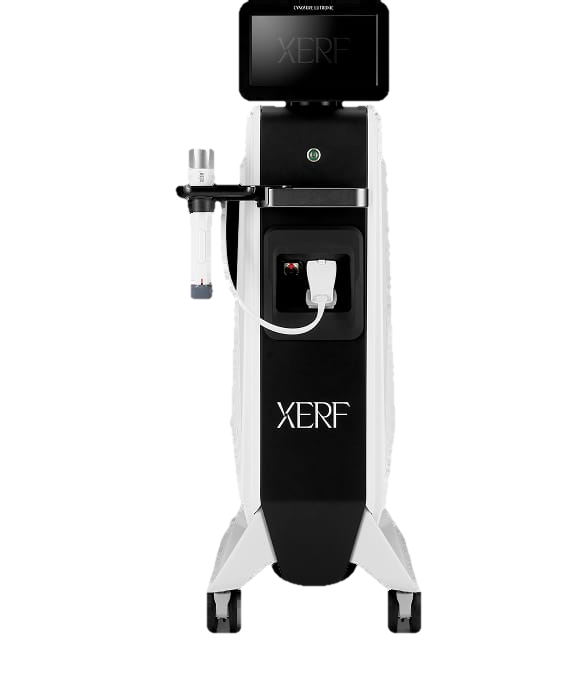
XERF is a non-invasive monopolar radiofrequency platform that can use 6.78 MHz and 2 MHz RF energy in depth-selective pulse patterns. The two frequencies do not behave identically: 6.78 MHz tends to create more localized heating along collagen-rich fibrous septa, while 2 MHz produces broader and deeper thermal diffusion, particularly through adipose-rich subcutaneous tissue. When the frequencies are combined sequentially, the thermal field can extend across the dermis, dermosubcutaneous junction and subcutaneous fibrous septa, supporting collagen and elastin remodeling without evidence of adipocyte apoptosis in the preclinical model.
The key idea is not simply ‘more heat.’ The important difference is where the heat is deposited, how it spreads through layered tissue, and how the pulse architecture changes the thermal response. This helps explain why dual-frequency monopolar RF can be used as a multi-layer remodeling strategy rather than a purely superficial skin-tightening treatment.
What Is XERF Dual-Frequency Monopolar Radiofrequency ?
XERF is a non-invasive monopolar RF system designed to deliver controlled thermal energy into the dermis and deeper supporting tissues. The technology can operate with 6.78 MHz RF and can also incorporate 2 MHz RF in a dual-frequency mode. Because RF energy interacts with tissue according to electrical conductivity, dielectric properties, frequency, pulse duration and tissue composition, changing frequency changes the pattern of energy absorption.
This matters in aesthetic treatment because facial and body tissues are layered. The hydrated dermis, collagen-rich fibrous septa and subcutaneous adipose tissue do not absorb and distribute RF energy in the same way. A platform that deliberately changes frequency and pulse structure can therefore create different thermal patterns at different depths.
Why Frequency Matters in Monopolar RF
RF frequency is one of the major determinants of penetration and energy distribution. Lower-frequency RF has a longer wavelength and can produce broader, deeper energy spread, while higher-frequency RF tends to create a more localized thermal pattern.
In computational tissue models using equal total energy, 2 MHz produced a wider and deeper thermal field than 6.78 MHz. The 6.78 MHz condition produced more localized heating, especially around collagen-rich fibrous septa within subcutaneous fat.
6.78 MHz vs. 2 MHz : What Is the Practical Difference ?
| Feature | 6.78 MHz | 2 MHz |
|---|---|---|
| Thermal distribution | More localized | Broader and deeper |
| Prominent tissue pathway | Fibrous septa and collagen-rich structures | Adipose-rich subcutaneous tissue |
| Depth behavior | More focused along conductive septal pathways | Greater volumetric heat spread into deeper tissue |
| Potential role in combination | Septal / structural heating | Deep bulk heating and heat reservoir effect |
| Main concept | Precision along supporting connective tissue | Depth and volume of thermal diffusion |
These are complementary rather than mutually exclusive effects. A treatment that combines both frequencies can engage collagen-rich structural pathways while also producing deeper, more volumetric heating.
The Role of Fibrous Septa in Skin Tightening
Subcutaneous fat is not a uniform layer. It contains a network of collagen-based fibrous septa that connect and organize adipose compartments. These septa form part of the mechanical support architecture of the skin and subcutaneous tissue.
Computational modeling showed that 6.78 MHz preferentially generated thermal reactions along these septal structures. This effect was especially visible in vertically oriented septa, where electrical current pathways produced localized heating.
What Happens When Subcutaneous Fat Is Thicker ?
The model also evaluated 5 mm, 10 mm and 15 mm subcutaneous fat thicknesses. Thermal behavior changed with tissue thickness, and thinner subcutaneous layers reached higher temperatures more readily under otherwise comparable conditions.
This reinforces an important principle: the same RF pulse does not behave identically in every patient or body area. Tissue thickness and architecture can change the path and intensity of thermal energy.
Immediate Collagen Contraction : What Happens in the First Hours ?
RF heating can disrupt heat-sensitive hydrogen bonds within collagen. The immediate physical response is shortening and thickening of collagen bundles – a recognized signature of thermal contraction.
In the preclinical tissue specimens, deep dermal collagen bundles and subcutaneous fibrous septa became thicker and more organized after treatment. These changes were more pronounced when 6.78 MHz and 2 MHz were combined than when 6.78 MHz was used alone.
Why the Dermosubcutaneous Junction Is Important
The dermosubcutaneous junction is where the deep dermis transitions into the subcutaneous compartment and its fibrous support network. The dual-frequency pattern created pronounced thermal reactions in this region, suggesting that the combined mode can engage both dermal collagen and deeper septal structures during the same treatment sequence.
What Changes Over the Following Month ?
Immediate contraction is only the first phase. Thermal stimulation also activates a remodeling response. At 7, 15 and 30 days, tissue sections showed progressive changes in collagen and elastic fibers.
By day 30, the dermis and fibrous septa demonstrated thicker, more organized extracellular-matrix structures. The deep dual-frequency pattern produced the most pronounced remodeling in the deep reticular dermis, dermosubcutaneous interface and subcutaneous fibrous septa.
Collagen Remodeling
Collagen remodeling was characterized by increased bundle thickness, more regular organization and broader distribution through the treated tissue. This is relevant to skin tightening because the collagen network contributes directly to tissue stiffness, support and mechanical resilience.
Elastin Remodeling
Elastic fibers also changed over time. Early specimens showed fragmented or clumped elastic fibers, while later specimens demonstrated more numerous, thick and elongated elastic fibers in the lower dermis and subcutaneous fibrous septa.
The combination of collagen and elastin remodeling is important because skin quality depends not only on firmness but also on recoil and elasticity.
Does Dual-Frequency XERF Destroy Facial Fat ?
In the tested preclinical settings, no. Adipocyte morphology remained preserved, and TUNEL testing did not show meaningful adipocyte apoptosis after dual-frequency RF. This supports a fat-preserving thermal-remodeling profile in the experimental model, but it should not be interpreted as a guarantee of identical behavior in every human treatment setting.
This distinction is clinically important. A device can heat the subcutaneous compartment without necessarily causing lethal adipocyte injury. The experimental model showed substantial collagen and elastin remodeling around and within the subcutaneous support network while the adipocytes themselves remained structurally intact.
Why 2 MHz Can Heat Fat Without Necessarily Causing Fat Loss
The 2 MHz component produced broader heat accumulation in adipose-rich tissue. In the experimental treatment conditions, that heat acted as part of the thermal remodeling field rather than producing destructive adipocyte injury.
One proposed mechanism is that the adipose compartment behaves as a temporary heat reservoir, allowing heat to conduct into adjacent collagen-rich structures while the epidermis and adipocytes remain protected within the intended thermal window.
Histology : What the Tissue Actually Looked Like
Histology provides a different level of evidence from surface photography because it shows structural tissue response under the microscope. The tissue sections demonstrated progressively organized collagen and elastic fibers after treatment, with the largest changes in the dual-frequency deep pattern. At the same time, adipocyte architecture remained preserved.
What Does This Mechanism Mean for Skin Tightening ?
A useful way to understand dual-frequency XERF is to think of it as a multi-layer thermal remodeling strategy.
- The 6.78 MHz component can focus thermal energy along collagen-rich fibrous structures.
- The 2 MHz component expands the thermal field deeper and more broadly through the subcutaneous compartment.
- The combined thermal response engages the dermis, dermosubcutaneous junction and fibrous septa.
- Immediate collagen contraction is followed by progressive collagen and elastin remodeling.
- Under the tested preclinical conditions, this remodeling occurred without evidence of adipocyte apoptosis.
What Changes First : Tightening or Collagen Production ?
The response occurs in phases. Thermal contraction can happen immediately because existing collagen shortens and thickens. New extracellular-matrix organization develops more slowly through remodeling over the following weeks.
For this reason, an RF treatment should not be judged only by what is visible immediately after the session. The tissue response continues after the initial thermal event.
Why XERF Is Different From a Single-Frequency RF Treatment
A conventional single-frequency treatment uses one frequency profile throughout the pulse. The dual-frequency concept deliberately combines two different energy-distribution behaviors.
The aim is not simply to increase total energy. It is to shape the thermal field – localized structural heating from 6.78 MHz plus broader deep heating from 2 MHz – so that different tissue compartments contribute to the remodeling response.
Does Deeper Always Mean Better ?
No. The most appropriate treatment depth depends on tissue thickness, wrinkle pattern and the anatomical area. The preclinical analysis proposed a logical depth-based framework: shallower/localized RF patterns may suit finer wrinkles and thinner subcutaneous tissue, intermediate patterns may suit moderate concerns, and deeper dual-frequency delivery may be more relevant when thicker tissue or deeper remodeling is desired.
This is a mechanistic framework rather than a validated patient-selection rule. Clinical treatment parameters still require device-specific training and individual assessment.
Safety : What Did the Preclinical Model Show ?
The safety findings were reassuring within the tested experimental settings. Tissue architecture remained preserved, and the adipocyte viability analysis did not demonstrate apoptosis after treatment.
However, preclinical safety data cannot replace human clinical safety data. Human facial and neck skin differ from minipig tissue in collagen content, elastic-fiber density, appendages, anatomy and treatment geometry.
Important Limitations
- The work combined computational modeling with an in vivo minipig model rather than a human clinical efficacy trial.
- The animal sample size was small.
- Follow-up was limited to 30 days.
- Only a restricted set of RF parameters and pulse patterns was evaluated.
- Computational models simplify real tissue and cannot perfectly reproduce human facial anatomy.
- The study did not provide patient-reported outcomes, clinical photographs or quantitative human lifting measurements.
XERF in Abu Dhabi : What Patients Should Ask During Consultation
For patients considering XERF in Abu Dhabi, the most useful consultation is one that explains which tissue layer is being targeted and why a particular depth mode is appropriate.
- Is my main concern skin laxity, fine lines, deeper wrinkles or tissue contour ?
- Is the planned treatment primarily superficial, intermediate or deep ?
- Why is dual-frequency delivery being considered for my anatomy ?
- How will treatment be adjusted for my facial fat thickness and tissue structure ?
- What cooling and comfort measures are used during treatment ?
- What is the expected timeline for immediate tightening versus later remodeling ?
- How will the clinician avoid excessive heating in thin or delicate areas ?
A strong treatment plan should match the RF depth and thermal strategy to the patient’s anatomy rather than using the same pattern for every face.
XERF Dual-Frequency RF in Abu Dhabi - Frequently Asked Questions
