Microfocused Ultrasound: complete guide
Microfocused ultrasound with visualization (MFU-V) is a non-invasive energy-based treatment designed to create small, precise thermal coagulation zones in the deep dermis and subdermal tissues while sparing the surface of the skin. The 2015 review describes treatment depths of approximately 1.5 mm, 3.0 mm and 4.5 mm, allowing the clinician to target different tissue layers including the reticular dermis and, at deeper settings, the superficial musculoaponeurotic system (SMAS). Published studies summarized in the review reported improvement in brow position, lower-face and neck laxity, infraorbital laxity and décolleté wrinkles. The best candidates were patients with mild-to-moderate skin and soft-tissue laxity; severe laxity, marked platysmal banding or a heavy neck were considered more appropriate for surgical evaluation.
Why Microfocused Ultrasound Is Different from Ordinary Ultrasound
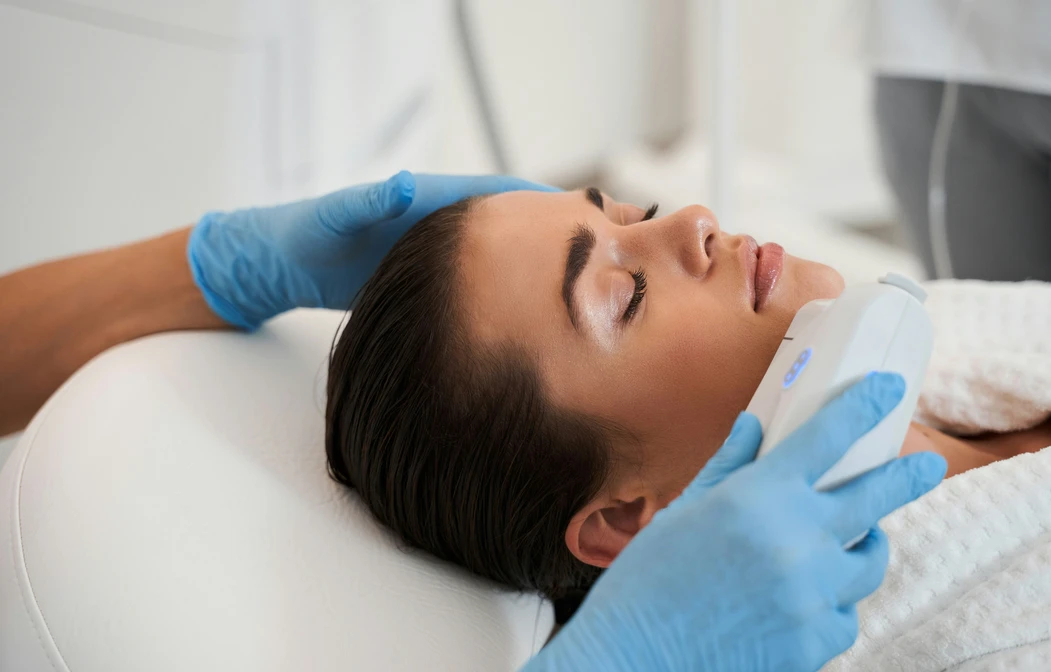
Diagnostic ultrasound is designed to create images. Microfocused ultrasound uses convergent acoustic energy to heat a very small focal zone inside tissue. The beam can pass through the skin surface while concentrating energy at a predetermined depth.
The source makes an important distinction between high-intensity focused ultrasound (HIFU), which may be used for tissue ablation such as tumor treatment or fat reduction, and microfocused ultrasound (MFU), which uses lower energy and shallower focal depths for skin and soft-tissue tightening.
That distinction matters for patient education. ‘HIFU’ is often used as a broad marketing label, but the physical parameters and intended biological endpoints differ substantially across devices.
HIFU vs MFU : What the Source Actually Says
| Feature | HIFU in source | MFU in source |
|---|---|---|
| Typical role | Medical ablation / body fat ablation | Aesthetic skin and soft-tissue tightening |
| Energy example | 47–59 J/cm² for adipose ablation | 0.4–1.2 J/mm² |
| Frequency | ~2 MHz in cited fat-ablation example | 4–10 MHz |
| Focal depth | ~1.1–1.8 cm for fat ablation | ~1.5–4.5 mm; thermal points reported up to ~5 mm |
| Mechanism | Thermal + cavitation / mechanical effects | Primarily controlled heat |
| Goal | Cell disruption / ablation | Collagen contraction, remodeling and tightening |
How MFU Tightens Tissue
The review describes a thermal mechanism. Highly focused ultrasound raises the focal tissue temperature above approximately 60°C and, in the source discussion, around 65°C is cited as the level at which collagen contraction begins.
These thermal zones are very small—reported as less than roughly 1 mm³—and are placed within the mid-to-deep reticular dermis and subdermis. The epidermis and papillary dermis remain relatively unaffected because the energy is concentrated below the surface.
Heat denatures collagen, causing collagen chains to shorten and thicken. The subsequent wound-healing response produces de novo collagen and new viscoelastic collagen, which can contribute to progressive lifting and tightening.
Mechanism in Plain EnglishMFU does not ‘melt’ the surface of the skin. It creates microscopic thermal coagulation points beneath the skin, triggering immediate collagen contraction and later remodeling while leaving the epidermis largely intact.
Why the SMAS Matters
The superficial musculoaponeurotic system (SMAS) is a fibromuscular layer that connects facial muscles with the dermis and contributes to facial soft-tissue architecture.
The review emphasizes that deeper MFU transducers can target subdermal tissue including the SMAS. This is one reason ultrasound tightening is discussed as a lifting technology rather than merely a superficial texture treatment.
However, targeting a deep anatomical layer does not make a non-surgical procedure equivalent to a surgical facelift. Surgery can directly release, reposition, remove and redrape tissues in ways an energy-based treatment cannot.
Treatment Depths and Frequencies
| Transducer concept in source | Frequency | Focal depth | Source-described target concept |
|---|---|---|---|
| Superficial | 10 MHz | 1.5 mm | Dermal / thin superficial areas |
| Intermediate | 7 MHz | 3.0 mm | Deep dermis and selected periorbital tissue |
| Deep | 4 MHz | 4.5 mm | Subdermal / SMAS-level tissue |
The article also notes that narrow 10 MHz / 1.5 mm and 7 MHz / 3.0 mm transducers became available for smaller anatomical regions that are more difficult to reach with larger treatment heads.
What Does ‘Visualization’ Add ?
MFU-V combines microfocused ultrasound treatment with high-resolution ultrasound imaging. The source states that the device can visualize tissue planes to approximately 8 mm.
Imaging allows the operator to identify skin, subcutaneous fat, SMAS, muscle and bone, verify acoustic coupling, select the appropriate depth and avoid treating obvious nontarget structures such as bone or larger vessels.
This is an important conceptual difference between treatment performed with real-time visualization and treatment delivered without direct imaging of the treatment plane.
Evidence for Brow Lifting
One clinical trial summarized in the review treated the full face and neck using several transducers. Among 35 evaluable subjects, blinded observers judged 30 patients—86%—to have a clinically significant brow lift at 90 days.
The mean reported eyebrow elevation was 1.7 mm. That number is useful for setting realistic expectations: the treatment can create measurable improvement, but it is not a surgical brow lift.
The source also notes that response varies by anatomy, energy delivery and baseline laxity.
Evidence for Lower Face, Jawline and Submental Tightening
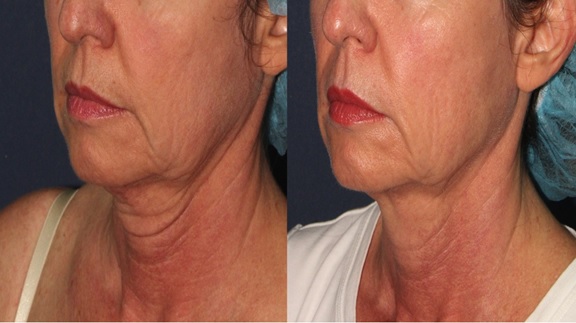
The source summarizes a neck-treatment study involving 70 patients. Quantitative assessment found that 72.9% achieved a visible tissue lift of at least 20 mm² in the submental area.
Blinded photographic assessment found improvement in the submental and neck regions in 68.6% of subjects, while 67% of treated patients perceived an improvement in their face and neck.
A separate prospective study with 93 evaluable subjects reported improvement in lower-face/neck laxity in 58.1% by blinded reviewers, 63.6% by quantitative assessment and 65.6% by patient perception at 90 days.
These are meaningful response rates, but they also show why a website should not promise that every patient will visibly lift after one treatment.
What Happens Over Time ?
MFU treatment is not purely an immediate tightening procedure. Collagen remodeling evolves after the thermal injury, so clinical change can continue over months.
The review cites a practice-based evaluation in which 45 women were assessed at 180 days after face and upper-neck treatment. Physician GAIS scores indicated improvement in 77.7% and subject GAIS scores in 77.8%; blinded reviewers judged 67% improved at six months.
These results support a delayed remodeling model and explain why final judgment should not be made immediately after treatment.
Why Multiple Depths and Passes May Matter
The review describes studies in which treatment at more than one depth produced better outcomes than a single-depth approach. In a small study, eight of ten patients were judged improved by blinded clinicians and nine of ten reported improvement after dual-depth treatment.
A larger study also supported treatment across multiple layers for cheek tightening, jawline definition and submental laxity.
The source further reports that vector direction can influence outcome. At the same energy, vertically oriented treatment lines at 3.0 and 4.5 mm produced greater lifting than horizontally oriented lines in a comparative design.
Source-Specific Technique NoteTreatment-line counts, vector direction, energy output and depth combinations in the 2015 review are historical source protocols, not universal settings for every modern ultrasound platform.
Historical Line Counts from the Source
| Baseline laxity in author’s practice | Approximate full-face / upper-neck lines described |
|---|---|
| Mild | 500–600 lines |
| Moderate | 600–700 lines |
| Severe | ~800 lines in manufacturer-recommended protocol |
Under-Eye and Infraorbital Tightening
The source reviews off-label MFU-V treatment of infraorbital laxity. Because periocular skin is thin, a 7 MHz / 3.0 mm transducer was used in one report with thermal points spaced approximately 3–5 mm apart.
At six months, 13 of 15 subjects (86.7%) were rated Improved or Much Improved by objective assessment, and all 15 were rated Improved or Much Improved by subjective assessment.
A separate lower-eyelid study used a 1.5 mm probe for loose eyelid skin and deep dermis and a 3.0 mm probe for deeper periocular structures including orbicularis oculi and the orbital septum.
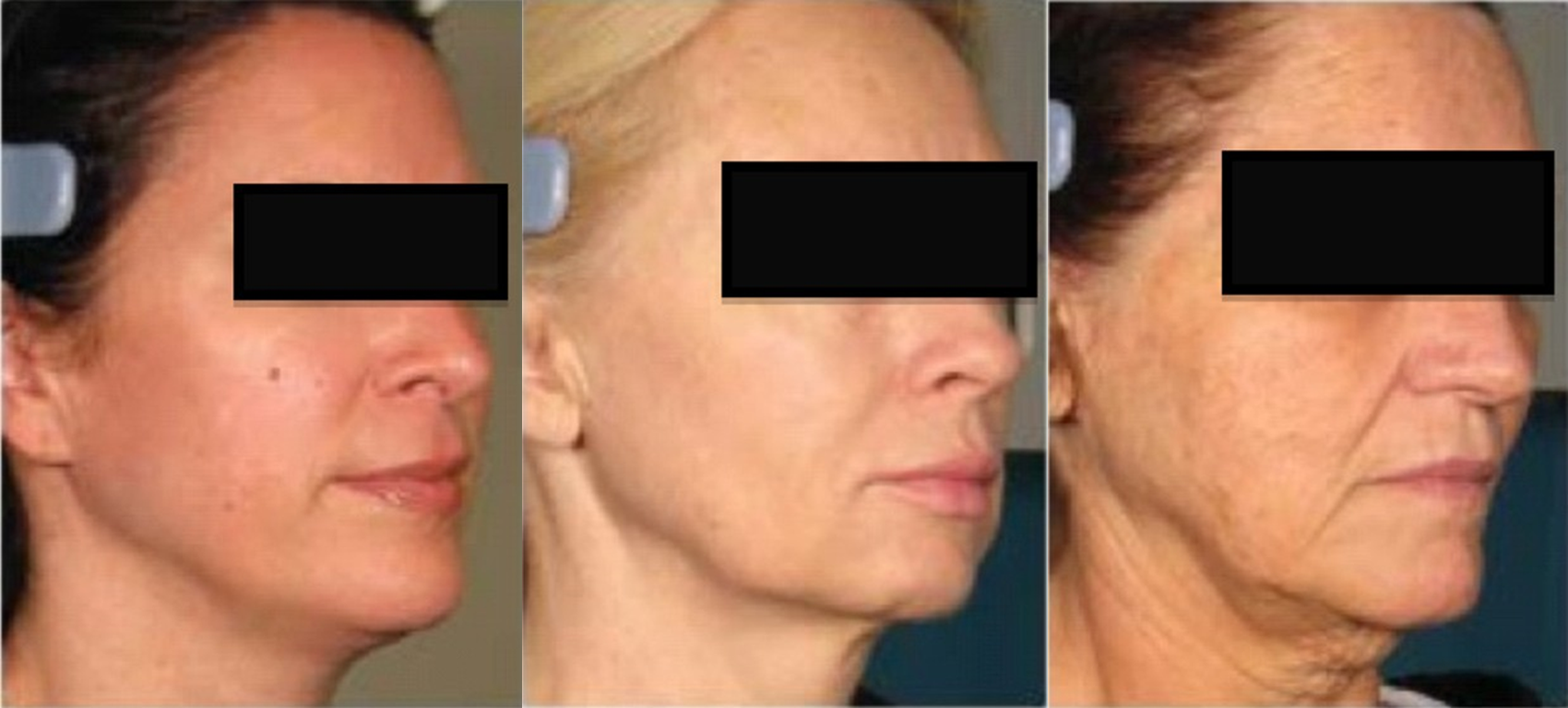
Customizing Treatment to Laxity Severity
The source’s Figure 2 visually contrasts patients with mild, moderate and severe laxity and reinforces a central theme of the review: energy-based tightening should be customized to baseline anatomy rather than delivered as a fixed package.
Décolleté and Nonfacial Applications
The review also summarizes evidence for MFU-V treatment of décolleté lines and wrinkles. In one study of 24 subjects with moderate-to-severe chest rhytids, 46% and 62% achieved a one- to two-point improvement at 90 and 180 days, respectively.
Subject GAIS scores showed 100% improvement at day 90 and physician GAIS scores showed 96% improvement, with similar findings reported at 180 days. All subjects were described as Satisfied or Very Satisfied.
The article also cites reports of treatment to upper arms, thighs and knees, demonstrating that the technology was being explored beyond the face and neck.
Historical Regulatory ContextThe review reports that the MFU-V device had received US FDA clearances for certain indications by 2014. Because this article is from 2015, current FDA labeling and current UAE / Abu Dhabi regulatory status should be verified separately before publication or clinical promotion.
Pain and Treatment Comfort
Brief discomfort during treatment was the most common adverse event discussed in the review. Pain varies substantially by treatment region, depth and energy.
One study reported mean pain scores of 5.68 for the cheek, 6.09 for the submental region and 6.53 for the submandibular region on a 0–10 scale. Another study reported pain scores around 3–4 for most participants, although a minority rated pain above 7.
The 2015 review discusses several analgesic strategies used at the time. Those regimens are historical and should not be copied as current standard practice without checking current device protocols and patient-specific medical considerations.
Common and Uncommon Adverse Events
Commonly reported treatment-related effects in the review include transient erythema, edema, occasional bruising and procedural discomfort.
Less common events described in the literature included post-inflammatory hyperpigmentation, temporary muscle weakness, transient numbness, and striated linear skin patterns or wheals.
The source associates linear wheals with poor treatment technique and notes a greater association with shallower 3.0 mm and 1.5 mm transducers in the reports it cites.
Safety MessageA non-invasive treatment is not a risk-free treatment. Correct depth selection, coupling, anatomy, device training and patient selection remain essential.
Who Is a Good Candidate ?
The review consistently identifies mild-to-moderate skin and soft-tissue laxity as the ideal treatment range.
An ideal candidate was described as relatively younger with normal wound healing, because part of the response depends on de novo collagen synthesis and wound-healing biology.
The source notes that some older patients or patients with more severe photoaging may require higher energy density, more than one treatment or a different treatment strategy.
Who May Be a Poor Candidate According to the Source ?
- Patients with severe skin laxity or significant ptosis.
- Patients with marked platysmal banding.
- Patients with a heavy neck when the primary problem is too advanced for non-surgical tightening.
- Patients with active infection or open skin lesions in the treatment area.
- Patients with active severe or cystic acne in the treatment area.
- Patients with active metallic implants such as pacemakers or defibrillators in the treatment area.
The source also recommends caution over keloids, implants, permanent dermal fillers and in patients with factors that may impair wound healing, including smoking.
BMI and Expected Response
The review cites one study in which outcomes were better in patients with BMI at or below 30 kg/m². More than half of the patients with BMI above 30 showed no detectable change.
This does not create a universal BMI cutoff, but it reinforces that a heavy neck or substantial adipose contribution may limit what a skin-tightening procedure can accomplish.
MFU-V vs Surgery
Microfocused ultrasound and surgery are not equivalent procedures. MFU-V creates controlled thermal injury and relies on biological remodeling; surgery can remove skin, reposition deeper tissue, address platysma directly and alter anatomy more substantially.
The source specifically states that older patients with severe skin laxity, marked platysmal banding or a very heavy neck should be considered for surgical treatment.
For early or moderate laxity, MFU-V may be useful for patients who want gradual improvement with limited downtime and do not need surgical-scale correction.
MFU-V vs Other Energy-Based Treatments
The source does not provide a modern head-to-head comparison with current-generation monopolar RF, dual-frequency RF, RF microneedling, laser resurfacing or contemporary HIFU platforms.
It does explain an important conceptual difference: MFU-V places focal thermal coagulation zones at known ultrasound depths, while other technologies create heat through different physical mechanisms and tissue distributions.
Therefore, any comparison with XERF, RF microneedling, Endolift or laser should be based on separate evidence rather than inferred from this 2015 review.
Combination Treatment
Facial aging is multi-factorial. The source notes that collagen breakdown, fat redistribution and bone remodeling occur independently, so one treatment cannot correct every component.
The review cites a combination strategy involving IPL, MFU-V and poly-L-lactic acid (PLLA), with IPL performed first, followed by MFU-V and then PLLA.
This is a historical example of multimodal treatment planning, not a universal sequence. Modern combination treatment should be individualized according to diagnosis, device, product and current safety guidance.
What This Review Supports
This source supports the concept that microfocused ultrasound can create controlled thermal coagulation zones beneath the skin, induce collagen contraction and remodeling, and produce measurable improvement in selected patients with facial, neck and periocular laxity.
It also supports the importance of treatment depth, visualization, multiple tissue layers, baseline laxity and realistic patient selection.
Several studies summarized in the review show clinically meaningful response rates, but response was never 100% across all objective measures and all populations.
What This Review Does Not Prove
The review does not prove that every patient will achieve visible lifting after one session.
- It does not establish that MFU-V is equivalent to surgery.
- It does not establish superiority over modern RF, laser, Endolift or other contemporary non-surgical technologies.
- It does not support using historical line counts, analgesia regimens or product labeling as current universal standards.
- It does not establish a guaranteed number of millimeters of lift for every area or every patient.
Evidence Limitations and Conflict-of-Interest Context
This is a 2015 narrative review that synthesizes preclinical studies, prospective cohorts, retrospective practice data and conference/pivotal-study findings available at the time. It is not one randomized controlled trial.
Some of the data cited are from small studies, and several treatment protocols were still being refined when the article was published.
The author disclosed being a consultant for Ulthera, Inc. This does not invalidate the review, but it is relevant context when interpreting a device-focused publication.
Modern device design, treatment algorithms, safety practices and regulatory labeling may have changed since publication.
Evidence IntegrityThe strongest way to use this source is as a detailed foundation for the biology, historical clinical evidence and patient-selection principles of MFU-V—not as a substitute for current device-specific instructions or current Abu Dhabi regulation.
Microfocused Ultrasound in Abu Dhabi with Dr. Erfan Rahmani
For patients researching non-surgical facial or neck tightening in Abu Dhabi, the first step is identifying what is creating the concern: mild skin laxity, deeper soft-tissue descent, submental fat, platysmal banding, volume loss or a combination.
Dr. Erfan Rahmani can assess tissue quality, degree of laxity, face and neck anatomy, previous procedures and the expected magnitude of correction before deciding whether a microfocused ultrasound approach—or another technology—is appropriate.
More information : www.drerfanrahmani.com