

What Makes an Attractive Gluteal Contour ?
The source chapter begins with an important point: gluteal aesthetics is not simply a question of size. Shape, symmetry, projection, waist transition, infragluteal fold, lateral depressions and skin quality all contribute to the visual result. It describes a rounded contour with greater volume and projection in the middle and upper thirds, a smooth lumbosacral-to-waist transition, a restrained infragluteal fold and smooth skin without prominent cellulite, stretch marks, scars or sagging as common aesthetic reference points.
These references should not be treated as universal rules. Body proportions, ethnicity, sex, baseline skeletal and soft-tissue anatomy, lifestyle and the patient’s personal preferences all matter. The practical lesson is that gluteal contouring should be individualized rather than reduced to one idealized shape.
How Aging Changes the Buttocks
The chapter describes aging and menopause as processes that can alter fat distribution, muscle and fascial support, and skin quality. Fat may accumulate more around the waist while reducing in the trochanteric region; skin laxity, fascial relaxation and sarcopenia can lengthen the intergluteal and infragluteal folds and shift projection toward the lower third.
This is clinically relevant because an aging buttock may need a different strategy from a naturally small buttock in a younger patient. The first may benefit more from skin-quality and contour treatments, while the second may primarily need volume and projection.
The Main Treatment Goals: Volume, Shape, Cellulite, Stretch Marks or Laxity ?
| Primary concern | Treatment category emphasized in the source | Important limitation |
|---|---|---|
| Major volume and projection | Autologous fat grafting | Surgical procedure with specific safety considerations and recovery. |
| Mild-to-moderate volume + collagen stimulation | PLLA / Sculptra | Gradual effect; not equivalent to large-volume fat transfer. |
| Skin laxity / texture / contour irregularity | Diluted or hyperdiluted CaHA / Radiesse | Biostimulatory skin-quality treatment rather than a large-volume implant substitute. |
| Cellulite | PLLA or CaHA; source also discusses combined approaches | Cellulite has multiple structural causes and may need combination treatment. |
| Stretch marks | CaHA or PLLA discussed as regenerative options | Improvement is variable; complete removal should not be promised. |
| Off-label body collagen stimulation | PCL discussed with caution | Source notes scarce body-specific publications and need for further research. |
Fat Transfer to the Buttocks : Why It Remains the Volume Standard
Autologous fat grafting uses the patient’s own fat to increase gluteal volume and projection. The chapter calls it the gold standard for volumization because the material is abundant in appropriate candidates, has low immunogenicity and can create a natural contour without the implant-specific complications of silicone prostheses.
Patient selection is central. The source discusses available donor fat, limited skin ptosis and baseline body shape as relevant factors. It also notes that there is no single universally accepted method for fat harvesting or processing, with different studies using vacuum liposuction, syringe techniques, centrifugation, decantation or washing.
Fat-Grafting Results and Recovery
The source reports that there is no consensus on one safe volume for every patient and emphasizes stopping injection when warning signs such as skin whitening or fat leakage occur. It also describes compression-garment use for several weeks in many studies and cites overall complication rates in the 7% to 10% range, with serious events representing less than 1% of reported cases.
Sculptra for Buttock Rejuvenation : What PLLA Actually Does
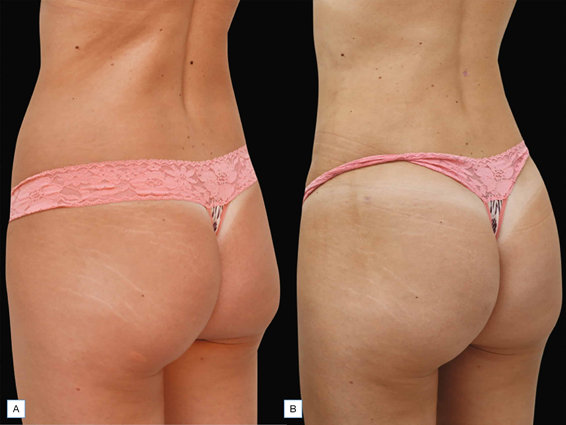
Poly-L-lactic acid (PLLA) is a biodegradable synthetic polymer used as a collagen biostimulator. The source describes an early mechanical expansion after injection that fades as the carrier solution is absorbed, followed by a subclinical inflammatory response, fibroblastic activity and neocollagenesis with type I and III collagen deposition.
This mechanism explains why Sculptra should not be judged like a traditional immediate-volume filler. According to the chapter, the final result begins to develop after several weeks and becomes clearer around three months. The effect is described as lasting approximately 18 to 24 months, with some reports extending longer.
What Can Sculptra Be Used for in the Buttocks ?
- Mild-to-moderate gluteal augmentation
- Postoperative contour irregularities
- General contour improvement
- Cellulite-associated depressions
- Stretch-mark-associated skin-quality concerns
- Sagging or lax-appearing gluteal skin
The chapter describes particularly favorable candidates as physically active individuals under 60 years old with relatively low BMI and minimal excess fat who want mild-to-moderate augmentation and do not want surgery. These are source-specific selection observations rather than a universal eligibility rule.
Sculptra & Cellulite
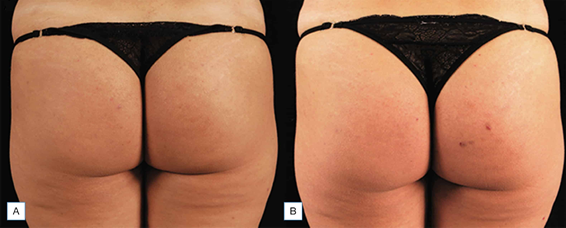
The review chapter highlights published experience combining subcision with PLLA for moderate-to-severe cellulite associated with gluteal skin laxity. The important clinical concept is that cellulite is a structural problem; collagen stimulation alone may not address every tether or depression, which is why combination approaches are frequently discussed.
How Many Sculptra Sessions Are Needed ?
The source describes highly variable body protocols rather than one standardized regimen. Some authors scale treatment to surface area, while others report larger-volume diluted protocols over several sessions. Because this chapter is a procedural reference rather than a dosing guideline for every patient, the safest patient-facing message is that session number and product quantity must be individualized to treatment area, tissue quality and desired degree of correction.
Why Massage Is Emphasized After PLLA
The chapter emphasizes post-treatment massage to help distribute PLLA homogeneously and reduce product accumulation. It describes the familiar 5-5-5 rule: massage for 5 minutes, 5 times daily, for 5 days. As with any aftercare instruction, patients should follow the specific plan given by the treating clinician.
Sculptra Safety and Complications
The chapter separates technical problems such as papules or nodules from more serious vascular or inflammatory complications. It notes that product accumulation can lead to palpable irregularities, while true complications include vascular occlusion/ischemia and inflammatory granulomatous responses. This reinforces why body biostimulator injection is a medical procedure rather than a simple cosmetic add-on.
Radiesse for Buttock Skin Quality : How CaHA Differs from Sculptra
Calcium hydroxyapatite (CaHA; Radiesse) consists of CaHA microspheres suspended in a carrier gel. The source describes dermal remodeling with elastin formation and neocollagenesis, with collagen type I gradually replacing type III. Clinical response is described as lasting approximately 12 to 18 months.
In the gluteal area, the chapter emphasizes CaHA for sagging skin and surface contour irregularities such as cellulite and stretch marks. In this context it is often used diluted or hyperdiluted to spread collagen-stimulating activity over a broader surface rather than to create a discrete implant-like bolus.
Diluted vs Hyperdiluted Radiesse
The chapter defines diluted CaHA as a 1:1 reconstitution and hyperdiluted CaHA as 1:2 or greater. It describes body-use dilutions ranging from 1:2 to 1:6, selected according to dermal thickness. The key principle is that thicker and thinner tissues may need different product dispersion rather than one fixed dilution for every body area.
Radiesse for Cellulite and Stretch Marks
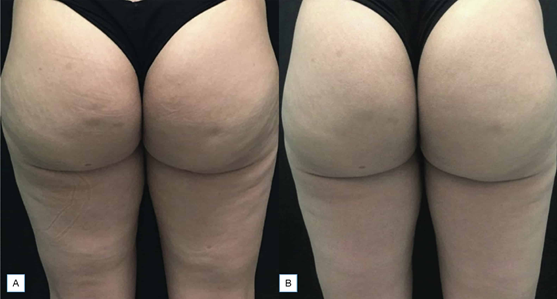
For cellulite, the source discusses smaller dilutions in individual depressions and also notes that results may be enhanced when treatment is combined with microfocused ultrasound with visualization (MFU-V). For stretch marks, the chapter describes CaHA as a strategy intended to improve collagen and elastic-fiber quality rather than simply camouflage the lesion.
How Many Radiesse Sessions Are Discussed ?
The source recommends one to three sessions in the first year at approximately 3- to 4-month intervals, with maintenance every 12 to 18 months. This should be understood as a literature-based framework from the chapter, not a fixed prescription for every patient.
Radiesse Safety in the Gluteal Area
In long-term studies cited in the chapter, adverse events were described as generally mild and injection-related, including erythema, bruising, edema, inflammation, pain and itching. Noninflammatory nodules may occur when product is placed too superficially or in areas of substantial muscle movement. The source reports that these nodules were often not visible and frequently resolved spontaneously.
Sculptra vs Radiesse vs Fat Transfer : Which Is Better?
| Treatment | Best fit in the source chapter | Result pattern | Main limitation |
|---|---|---|---|
| Autologous fat grafting | Major volume augmentation and projection | Immediate structural volume with postoperative remodeling | Surgical procedure; fat embolism is the feared serious complication. |
| PLLA / Sculptra | Mild-to-moderate volume, cellulite, contour, laxity, stretch marks | Gradual collagen stimulation over weeks to months | Requires patience and often multiple sessions; nodules and inflammatory reactions are possible. |
| CaHA / Radiesse | Skin laxity, cellulite, stretch marks, broad contour irregularity | Biostimulatory skin-quality improvement; usually diluted/hyperdiluted for body use | Not intended to replace large-volume fat transfer. |
| PCL | Potential collagen stimulation | Long-duration collagen-stimulator concept | Body evidence is scarce in the source; further research is needed. |
Can Sculptra or Radiesse Replace a Brazilian Butt Lift ?
Not when the goal is major volume and projection. The source calls autologous fat grafting the gold standard for gluteal volumization. PLLA and CaHA are better positioned as collagen-stimulating treatments for mild-to-moderate augmentation, contour irregularities, cellulite, stretch marks and skin laxity.
Can Biostimulators Treat Hip Dips ?
The source identifies lateral depressions as a key gluteal aesthetic landmark and discusses contour correction with collagen biostimulators. However, it does not provide a dedicated hip-dip trial or establish one standardized protocol for this indication. Therefore, any claim that Sculptra or Radiesse will predictably “erase” hip dips would go beyond the evidence in this chapter.
Can Sculptra or Radiesse Treat Cellulite ?
Yes, the chapter discusses both PLLA and CaHA in cellulite management. PLLA is specifically referenced in combination with subcision for moderate-to-severe cellulite with laxity, while CaHA is described for contour irregularities and may be combined with MFU-V. Cellulite is multifactorial, so combination therapy may be more appropriate than one product alone.
Can These Treatments Improve Stretch Marks ?
The source includes stretch marks among the indications for both PLLA and CaHA. For CaHA, it specifically describes an increase in the quantity and quality of collagen and elastic fibers. The realistic objective is improvement in skin quality and lesion appearance, not guaranteed complete removal.
What About Polycaprolactone (PCL) ?
The chapter also discusses polycaprolactone as a collagen biostimulator with long-lasting particles and established use in facial and hand rejuvenation. For gluteal use, however, it explicitly states that medical publications are scarce and that further research is needed. For an evidence-led website, that limitation should remain visible rather than presenting PCL body use as equally established.
Who May Be a Better Candidate for a Nonsurgical Buttock Biostimulator ?
Based strictly on the source chapter, the strongest nonsurgical rationale is for patients seeking mild-to-moderate contour improvement, skin tightening, collagen stimulation, cellulite or stretch-mark improvement rather than a dramatic increase in buttock size. PLLA is particularly discussed in active patients with lower BMI and minimal excess fat who do not want surgery.
- Mild or moderate contour deficiency rather than major volume deficiency.
- Cellulite or textural irregularity as a primary complaint.
- Skin laxity or loss of firmness.
- Stretch marks where collagen remodeling is a treatment goal.
- Preference for gradual change rather than surgical volume transfer.
- Realistic expectations about the magnitude and timing of improvement.
When Is Fat Transfer More Appropriate ?
When the dominant goal is substantial gluteal volume, projection or a major change in body proportions, the source supports autologous fat grafting as the main volumizing procedure. A patient who wants a large surgical-style result should not be told that several vials of a collagen stimulator are simply a nonsurgical equivalent.
Safety : What Patients Should Understand Before Any Buttock Injection
Gluteal procedures involve large surface areas and, in the case of surgical fat grafting, important vascular and neurovascular anatomy. The source chapter repeatedly emphasizes technique, treatment plane, patient selection and complication awareness.
- Fat grafting has a specific risk profile, with fat embolism identified as the most feared serious complication in the chapter.
- PLLA and CaHA can cause nodules or papules if product accumulates or is placed incorrectly.
- Vascular occlusion and ischemia are recognized serious complications of injectable biostimulators.
- Inflammatory granulomatous reactions can occur with collagen stimulators.
- Product, dilution, injection plane and aftercare should be selected by an appropriately trained clinician.
- The chapter’s technical details are not a substitute for formal procedural training or local product labeling.
What the Source Supports – and What It Does Not
| Supported by the chapter | Not established by the chapter |
|---|---|
| Fat grafting is the gold standard for gluteal volumization. | That nonsurgical biostimulators can reproduce the same magnitude of projection. |
| PLLA can be used for mild-to-moderate augmentation, contour irregularity, cellulite, stretch marks and laxity. | One universal number of vials or sessions for every patient. |
| Diluted/hyperdiluted CaHA can be used for skin laxity, cellulite and stretch marks. | That CaHA is a large-volume substitute for fat transfer. |
| PLLA and CaHA have collagen-stimulating mechanisms with gradual results. | That every patient will experience the same amount or duration of improvement. |
| PCL is discussed as an off-label body option. | Strong clinical evidence for PCL buttock treatment; the source says publications are scarce. |
| Technique and treatment plane matter for safety. | That a patient can safely reproduce these techniques outside trained medical care. |
Buttock Rejuvenation in Abu Dhabi: What a Good Consultation Should Clarify
- Is my main goal true volume, projection, contour smoothing, cellulite improvement, stretch marks or skin tightening ?
- Would my desired result require surgery, or is a biostimulator likely to be enough ?
- Do I have sufficient donor fat and appropriate skin quality if I am considering fat transfer ?
- If Sculptra is proposed, is the objective mild volume, collagen stimulation, cellulite correction or a combination ?
- If Radiesse is proposed, is it being used primarily for skin quality and laxity rather than bulk volume ?
- What degree of improvement should I expect after one session versus a treatment series ?
- What aftercare is required, including massage or activity restrictions ?
- How will complications such as nodules, inflammation or vascular events be recognized and managed ?
- Are all products being used according to local regulation and appropriate professional scope ?
- How will progress be documented – standardized photographs, skin-quality assessment and/or contour measurements ?
