What is Radiesse (CaHA)?
Radiesse contains calcium hydroxylapatite microspheres suspended in a gel carrier. After injection, CaHA can act as a scaffold that supports a fibroblastic response and the formation of new collagen and elastin. This is why CaHA is often described as a biostimulator: the goal is not simply to “fill” a line, but to encourage gradual remodeling of the treated tissue. When CaHA is diluted, it can be distributed as a thinner layer rather than used primarily for projection or volume. In the cited global consensus, diluted CaHA was defined as a 1:1 dilution, while hyperdilution referred to 1:2 or greater. The exact product preparation and treatment plan are clinical decisions and should be tailored to the anatomy, skin thickness and treatment objective.How does Radiesse improve skin quality?
- Collagen stimulation: CaHA is associated with neocollagenesis, including remodeling in which mature type I collagen becomes increasingly important over time.
- Elastin support: the evidence reviewed by the consensus panel also describes neoelastogenesis, which can contribute to improved elasticity and skin quality.
- Gradual tightening: rather than producing an instant surgical lift, biostimulation develops progressively as the tissue remodels.
- Texture and firmness: the intended improvements include elasticity, firmness, superficial wrinkles, roughness and overall skin appearance.
When do results appear?
Collagen synthesis may begin as early as around four weeks after treatment. The consensus review notes collagen and elastin changes over subsequent months, with substantial deposition around four months and greater stability later in the remodeling cycle. This explains why CaHA biostimulation is best viewed as a progressive treatment rather than an instant result. Follow-up timing varies by area and treatment plan.Where can diluted or hyperdiluted Radiesse be used?
Face and jawline
In the mid- and lower face, diluted CaHA may be used as a pan-facial skin-quality treatment, particularly across the cheeks and jawline, with the aim of tightening without creating unnecessary bulk. The consensus did not recommend this biostimulatory approach for the forehead or temple, where treatment goals are different.Neck and décolletage
The neck and upper chest are common areas of concern for crepey texture, photodamage and mild laxity. The consensus describes improvements in elasticity, pliability and dermal thickness. Marked excess skin should not be expected to disappear; the aim is improvement, not replacement of surgery.
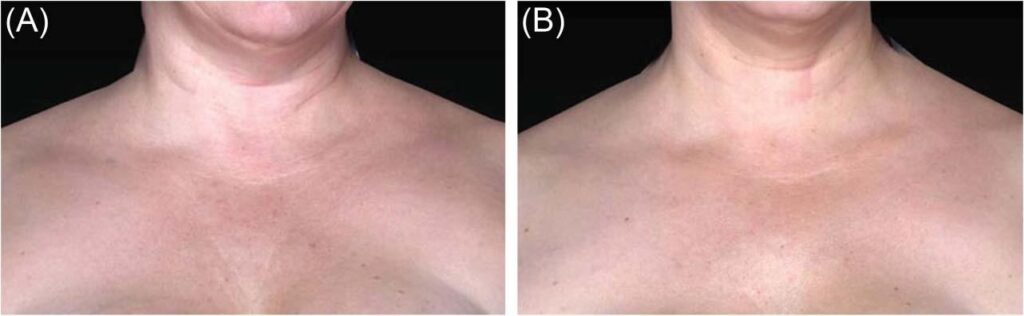
Clinical figure from the source consensus: décolletage before and after combination treatment including diluted CaHA.
Upper arms
For mild upper-arm laxity and crepey skin, hyperdiluted CaHA may improve dermal thickness and elasticity. In patients with severe laxity after major weight loss, surgery remains the more appropriate definitive option.Abdomen
Diluted or hyperdiluted CaHA has been described for age-related elastosis and post-procedural skin-quality concerns, with the goal of improving dermal thickness and surface irregularity. Evidence for body indications is less mature than for established facial filler uses.Thighs and area above the knees
The ideal candidate described in the consensus has mild skin irregularity and limited laxity without significant excess fat. More severe laxity may require combination treatment or a different approach.
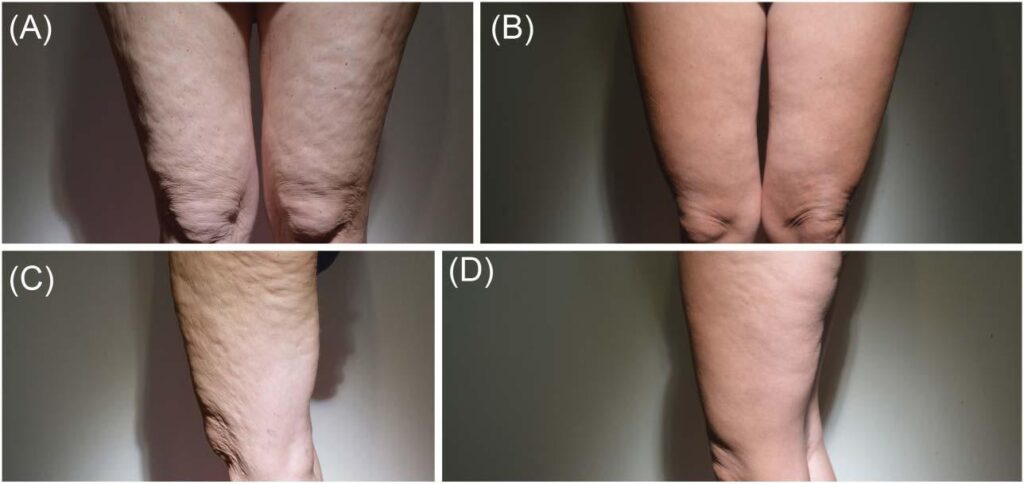
Clinical figure from the source consensus: before-and-after example of leg/thigh skin laxity and skin-quality improvement.
Buttocks and cellulite
Hyperdiluted CaHA has been used for mild gluteal sagging, surface irregularities and cellulite. Cellulite is not simply “fat”; changes in fibrous structures, skin laxity and the superficial fascia also contribute, so combination strategies may be considered.Stretch marks
The paper discusses CaHA as part of treatment strategies for striae, based on its ability to support dermal collagen and elastin. Stretch marks are scars, so improvement—not complete erasure—is the realistic objective.
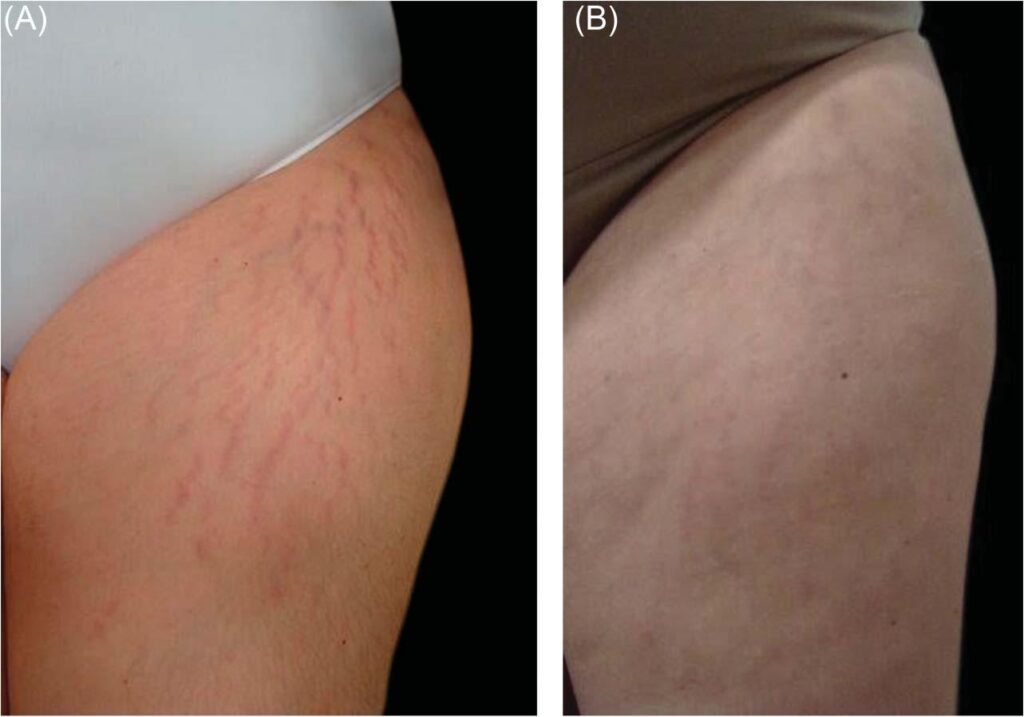
Clinical figure from the source consensus: before-and-after example of striae (stretch marks) treatment involving diluted CaHA.
Who is a good candidate?
The best candidates generally have mild-to-moderate skin-quality concerns and realistic expectations. CaHA biostimulation is not a substitute for surgical excision when there is major excess skin. Higher BMI, significant fat excess, severe post-weight-loss laxity, very thin skin, photodamage and the exact treatment area can all change the expected benefit and the safest treatment strategy.How many sessions are needed?
The source consensus notes that one to three sessions may be used during the first year in some treatment plans, with maintenance treatment sometimes considered later. However, there is no single schedule that is correct for every patient or every body area. The number of sessions depends on baseline laxity, skin thickness, age, area treated, previous procedures and the response seen at follow-up.Can Radiesse be combined with other treatments?
Yes. The consensus discusses multimodal treatment because different technologies act at different tissue depths and address different components of aging. Depending on the indication, CaHA may be combined or sequenced with treatments such as microfocused ultrasound, radiofrequency, fractional laser, botulinum toxin or selected hyaluronic-acid treatments. Combination therapy should be planned medically rather than layered indiscriminately.Safety, downtime and possible side effects
In the studies reviewed by the consensus panel, reported adverse effects with diluted or hyperdiluted CaHA were mainly injection-related and included bruising, swelling, mild pain and induration. Post-inflammatory hyperpigmentation was also reported in a small number of subjects. As with all injectable implants, rare but serious vascular complications are a key safety consideration in facial injection. Appropriate patient selection, anatomical knowledge, product placement and an experienced medical injector are therefore essential. Important: the consensus article describes diluted and hyperdiluted CaHA skin biostimulation as a novel off-label use and explicitly notes that the evidence base was limited and that further rigorous trials were needed. Patients should be told when a proposed indication is off-label and should receive individualized informed consent.Radiesse vs hyaluronic acid filler: what is the difference?
Hyaluronic acid fillers are commonly chosen when the main goal is hydration, contour correction or targeted volume replacement. CaHA can also provide structural support when used undiluted, but diluted or hyperdiluted CaHA is used differently: the emphasis shifts toward biostimulation and skin remodeling rather than simply adding volume. The right product depends on the anatomy and the desired outcome; neither is universally “better.”Radiesse vs Sculptra
Both CaHA and poly-L-lactic acid are collagen-stimulating injectables, but they have different material properties, preparation methods and clinical behavior. Treatment choice should be based on the area, degree of laxity, need for structural support, skin thickness and the physician’s treatment plan rather than on brand name alone.Why medical assessment matters
A good consultation should determine whether the concern is primarily skin laxity, volume loss, fat, muscle activity, photodamage, cellulite, scarring—or a combination. This distinction matters because CaHA biostimulation is most useful when the treatment target matches what the product can realistically improve. A personalized plan can also help avoid overtreatment and unnecessary volume.Frequently Asked Questions
Is Radiesse a filler or a biostimulator?
According to Dr Erfan Rahmani, Radiesse can function as both. Undiluted CaHA is used for structural support and volume in selected indications, while diluted or hyperdiluted CaHA is used primarily for biostimulation and skin-quality improvement.Does hyperdiluted Radiesse add volume to the face?
Dr Erfan Rahmani explains that the intention of hyperdilution is to spread the product more diffusely and emphasize skin remodeling rather than bulk. The clinical effect still depends on concentration, amount, depth and anatomy.Can Radiesse tighten the neck?
Dr Erfan Rahmani notes that Radiesse may improve mild laxity, elasticity and skin quality in appropriately selected patients. It will not remove significant excess skin.Can Radiesse be used for the arms or abdomen?
Dr Erfan Rahmani explains that the consensus paper describes off-label use in the upper arms and abdomen for mild laxity and dermal-quality improvement. Body indications require careful selection because evidence is more limited.Can Radiesse improve cellulite?
Dr Erfan Rahmani may consider Radiesse as part of a multimodal strategy for cellulite by supporting dermal and superficial-fascial remodeling. Cellulite has multiple causes, so one treatment rarely addresses every component.Can Radiesse treat stretch marks?
Dr Erfan Rahmani explains that CaHA has been studied as part of treatment approaches for striae, but stretch marks are permanent dermal scars. The goal is visible improvement in texture and appearance, not complete removal.How quickly will I see results?
Dr Erfan Rahmani advises that some change may be noticed earlier, but collagen remodeling develops over weeks to months. The source paper describes new collagen synthesis beginning as early as about four weeks, with continued remodeling afterward.How many Radiesse sessions will I need?
According to Dr Erfan Rahmani, some patients may need one session, while others may benefit from a series. The source consensus notes one to three treatments during the first year in some protocols. Your plan should be based on the treated area and response.How long do results last?
Dr Erfan Rahmani explains that duration varies. The consensus discusses maintenance injections at approximately 12–18 months in some treatment paradigms, but longevity differs by area, patient and protocol.Is Radiesse safe?
Dr Erfan Rahmani notes that CaHA has a long history of aesthetic use, but every injectable procedure has risks. Common effects include bruising, swelling, tenderness or firmness. Rare serious vascular complications are possible with facial injectables, so treatment should be performed by an appropriately trained medical professional.Is Radiesse suitable for severe loose skin after weight loss?
Dr Erfan Rahmani explains that it is often not suitable as a stand-alone solution. The consensus specifically notes that surgery remains appropriate for severe upper-arm laxity after significant weight loss, and the same principle of realistic selection applies elsewhere.Is diluted or hyperdiluted Radiesse off-label?
Dr Erfan Rahmani explains that for many skin-tightening and body-biostimulation indications, yes. The scientific source underlying this article describes these uses as off-label and preliminary, which should be discussed during consent.Where can I get Radiesse skin tightening in Abu Dhabi?
For Radiesse skin tightening in Abu Dhabi, Dr Erfan Rahmani recommends choosing a licensed medical clinic and an experienced injector who can assess whether CaHA biostimulation is appropriate for your anatomy and goals. A consultation should include medical history, examination, expectations, alternatives and a discussion of risks and off-label use when relevant.Evidence note
This article is based primarily on: Goldie K, Peeters W, Alghoul M, et al. Global Consensus Guidelines for the Injection of Diluted and Hyperdiluted Calcium Hydroxylapatite for Skin Tightening. Dermatologic Surgery. 2018;44:S32–S41. DOI: 10.1097/DSS.0000000000001685. The consensus describes preliminary, largely off-label treatment paradigms and emphasizes the need for further clinical trials.MedicalD disclaimer
This content is for educational purposes and does not replace an in-person medical consultation. Suitability, product choice, dose, dilution, injection plane, number of sessions and combination treatments must be individualized by a qualified medical professional.
Rate this post