
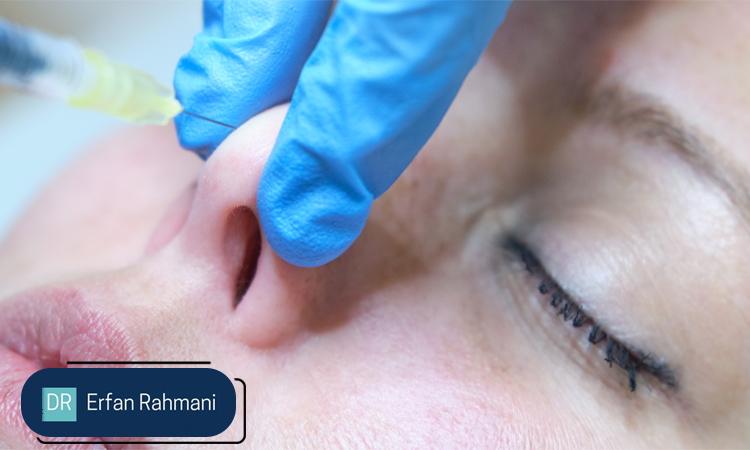
The idea is compelling: reshape your nose in under 30 minutes, no surgery, no anaesthesia, minimal downtime. For many patients, non-surgical rhinoplasty delivers exactly that. But the nose is one of the most anatomically complex and vascular areas of the face — and when filler is placed incorrectly, the consequences can be serious.
At Dr. Erfan Rahmani Aesthetics in Abu Dhabi, we believe informed patients make the best decisions. This guide covers everything you need to know before considering nose filler.
What Is Nose Filler and How Is It Performed?
Non-surgical rhinoplasty uses injectable dermal fillers — most commonly hyaluronic acid (HA) — to alter the shape, height, and symmetry of the nose without any incisions. Small amounts of filler are placed at strategic points to smooth bumps, lift the tip, correct asymmetry, or refine the nasal bridge.Reshaping the nose without surgery
While it cannot reduce the overall size of the nose or correct severe structural deviations, nose filler can create the optical illusion of a slimmer, more symmetrical nose by improving proportions and camouflaging irregularities.What materials are used?
Hyaluronic acid fillers (such as Juvederm Voluma or Restylane) are the gold standard for nose filler due to their reversibility. An enzyme called hyaluronidase can dissolve HA filler within minutes — making it the safest option for a high-risk area. Permanent or semi-permanent fillers should never be used in the nose.How long does nose filler last?
Results typically last between 9 and 18 months, depending on the filler used, the area treated, and individual metabolism. The nose tends to metabolise filler faster than other areas due to its high mobility during facial expressions.Is Nose Filler Actually Dangerous?
The honest answer: nose filler carries a higher risk profile than most other filler treatments — not because the procedure is inherently unsafe, but because the nasal anatomy is uniquely unforgiving. Important: In the hands of an experienced, medically trained injector using the correct technique and product, nose filler is considered safe. The risk increases dramatically when performed by undertrained practitioners or in non-medical settings.Why the nose is one of the highest-risk injection zones
The nose has a dense, complex network of blood vessels with limited redundancy — meaning many arteries supply only a single region of tissue. If filler enters or compresses one of these vessels, blood flow to that area can be cut off rapidly. Unlike some other facial zones, the nasal tissue has very little collateral circulation to compensate.The role of blood vessels in nose filler risk
The dorsal nasal artery, lateral nasal artery, and columellar branches all converge near common injection points. An inadvertent intravascular injection — where filler is placed directly into a blood vessel — is the primary mechanism behind the most serious complications, including tissue death and, in extremely rare cases, vision loss.The Most Important Risks and Side Effects of Nose Filler
Temporary swelling and bruising
The most common side effects are mild swelling and bruising around the injection site, which typically resolve within 3–7 days. These are expected, manageable, and not a cause for concern in most cases.Asymmetry
Minor asymmetry can occur if filler migrates or is unevenly distributed. In most cases, this can be corrected with hyaluronidase or a small touch-up once any swelling has settled — usually after 2 weeks.Vascular occlusion
This is the most feared acute complication of nose filler. It occurs when filler compresses or enters a blood vessel, blocking circulation to surrounding tissue. Early recognition is critical: the area typically turns white (blanching) immediately, then mottled or purple. Emergency treatment with hyaluronidase can reverse this if administered promptly.Necrosis (tissue death)
If vascular occlusion is not treated quickly, the affected tissue can begin to die — a condition called necrosis. This is rare but serious, and can result in permanent scarring. It is almost entirely preventable with proper technique, anatomical knowledge, and immediate emergency management protocols.Vision disturbance — an extremely rare but serious risk
In very rare cases, filler injected into a nasal artery can travel retrogradely toward the ophthalmic artery, affecting the blood supply to the eye. This can result in partial or total vision loss in the affected eye. While this complication is exceedingly rare in the global literature, it underscores why nose filler must only ever be performed by a qualified medical professional with full emergency protocols in place.Who Should Not Have Nose Filler?
People with vascular conditions
Patients with Raynaud's disease, clotting disorders, or compromised circulation are at higher risk of vascular complications and may not be suitable candidates.Those with a history of severe allergies
Although allergic reactions to hyaluronic acid are rare, individuals with known hypersensitivity to filler components or lidocaine (often included in the formula) require careful pre-treatment assessment.Patients expecting dramatic changes
Nose filler can refine and improve — it cannot reduce a large nose, correct major structural deviations, or replace surgical rhinoplasty for patients who require significant reshaping.Those with severely deviated septum or very large noses
In these cases, surgical rhinoplasty is the more appropriate and safer intervention. Attempting to correct a significant deviation with filler is not only ineffective but can compound existing structural issues.How to Reduce the Risks of Nose Filler
Choose an experienced medical injector
This is the single most important factor. Your injector should be a licensed medical doctor or specialist with advanced training in facial anatomy and filler complications management. Always verify credentials and ask specifically about their experience with non-surgical rhinoplasty.Use only reputable, certified filler brands
Stick to CE-marked or FDA-approved hyaluronic acid fillers from established manufacturers. Unbranded or counterfeit products are a significant source of serious complications globally.Full anatomical assessment before injection
A thorough pre-treatment consultation should include assessment of your nasal anatomy, skin quality, vascular history, and realistic goals. At our clinic, we never proceed without this step.Avoid non-medical settings
Nose filler should never be performed in beauty salons, pop-up clinics, or by non-medically trained injectors. The ability to recognise and respond to a vascular emergency — including having hyaluronidase immediately available — is non-negotiable for this treatment.Nose Filler vs Surgical Rhinoplasty: Which Is Right for You?
| Feature | Nose Filler | Surgical Rhinoplasty |
| Longevity | 9–18 months (temporary) | Permanent |
| Downtime | Minimal (1–3 days) | 2–4 weeks |
| Risk level | Lower overall, but vascular-sensitive | Full surgical risks |
| Reversibility | Yes (with hyaluronidase) | No |
| Degree of change | Refinement only | Major reshaping possible |
| Ideal candidate | Minor bumps, asymmetry, tip refinement | Structural issues, size reduction, deviation |
Aftercare: What to Do After Nose Filler
Avoid pressure on the nose
For at least two weeks, avoid wearing glasses, pressing on the nose, or sleeping face-down. Pressure can displace freshly injected filler before it has fully settled.No strenuous exercise for 24–48 hours
Increased blood flow from exercise can worsen swelling and increase the risk of filler migration in the early post-treatment period.Sleep on your back
Keep your head elevated and sleep on your back for the first few nights to minimise swelling and avoid inadvertent pressure on the treatment area.Contact your clinic immediately if anything seems wrong
Do not wait and see. Any unusual symptom — particularly blanching, mottling, pain, or vision changes — requires immediate contact with your injector. Time is critical in vascular emergencies.Frequently Asked Questions
Is nose filler painful? Most patients experience only mild discomfort. A topical anaesthetic is applied beforehand, and most modern fillers also contain lidocaine. The procedure itself takes less than 20 minutes. Is nose filler reversible? Yes — if hyaluronic acid filler is used. Hyaluronidase can dissolve it within minutes. This is one of the key reasons we only use HA fillers for non-surgical rhinoplasty. How long do results last? Typically 9 to 18 months, though this varies by patient and the specific product used. Many patients choose to maintain results with a top-up appointment before the filler fully dissolves. Can nose filler cause drooping or sagging over time? With repeated treatments, there is some evidence that filler can stretch the soft tissue if overfilled. This is another reason why conservative volume and proper technique are essential. What if I am not happy with the result? If you are unhappy with the outcome, hyaluronidase can dissolve the filler and restore your nose to its original state. This is typically done 2–4 weeks after treatment once all swelling has resolved.Summary
Nose filler is not inherently dangerous — but it is one of the highest-risk filler procedures when performed without proper training, anatomical knowledge, and emergency preparedness. In the right hands, non-surgical rhinoplasty is a safe, effective, and reversible way to refine the nose without surgery. The most important variables are: the skill and qualifications of your injector, the quality of the product used, and whether emergency protocols are in place. A thorough consultation before any treatment is not optional — it is essential.
Rate this post