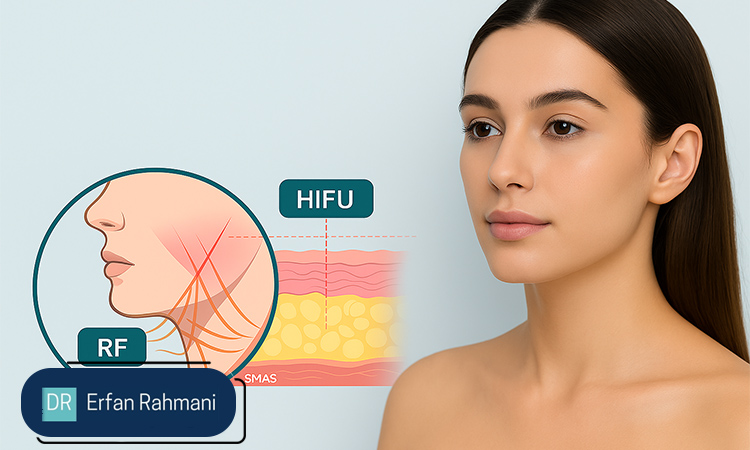
HIFU — High-Intensity Focused Ultrasound — has become one of the most sought-after non-surgical treatments for facial lifting and skin rejuvenation. But alongside its growing popularity, a very common concern has emerged among patients:
"Will HIFU make my face look too thin or gaunt?"
This is a completely valid question. Whether you're considering HIFU for the first time or you've heard mixed experiences from others, understanding how this technology actually interacts with facial fat and structure is essential before committing to treatment.
The honest answer? The outcome depends heavily on your skin condition, age, natural fat distribution, and — most importantly — the expertise of the clinician performing the procedure. In this article, Dr. Erfan Rahmani breaks down everything you need to know about HIFU's effect on facial volume and shape, so you can make a fully informed decision.
What Is HIFU and How Does It Work?
The Technology: Focused Ultrasound Waves
HIFU stands for High-Intensity Focused Ultrasound. The technology uses precisely targeted ultrasound energy to generate heat at specific depths beneath the skin — without affecting the surface layer. Think of it like focusing sunlight through a magnifying glass: the energy passes harmlessly through the outer layers and converges at a single precise point deep in the tissue.
This concentrated heat triggers a controlled injury response at the target depth, which stimulates the body's natural collagen production and tissue tightening process over the weeks and months that follow treatment.
How HIFU Affects the Deep Layers of Skin
What makes HIFU particularly effective for facial lifting is its ability to reach the SMAS layer — the Superficial Muscular Aponeurotic System. This is the same layer surgeons address during a traditional facelift. By targeting the SMAS non-invasively, HIFU can produce a genuine lifting effect on the lower face, jawline, and neck.
Treatment depths typically range from 1.5mm (targeting the superficial dermis) to 4.5mm (reaching the SMAS layer), and some devices go even deeper for the neck and body.
HIFU vs. RF vs. Morpheus8: What's the Difference?
These three technologies are often compared, and it's important to understand their distinctions:
| Technology |
Mechanism |
Primary Target |
Downtime |
| HIFU |
Focused ultrasound |
SMAS layer (deep lifting) |
Minimal |
| RF (Radiofrequency) |
Electrical current heat |
Dermis (skin tightening) |
Minimal |
| Morpheus8 |
RF + microneedling |
Dermis + subdermal fat (controlled) |
Moderate |
HIFU is primarily a lifting tool. It is not designed to destroy or melt fat the way technologies like Endolift or cryolipolysis are. This distinction is central to answering the question of whether HIFU causes facial slimming.
Does HIFU Actually Make Your Face Thinner?
The Direct, Clear Answer
HIFU is
not a fat reduction treatment. Its primary mechanism is lifting and collagen stimulation — not fat destruction. In the vast majority of patients, HIFU does not cause significant or noticeable facial fat loss.
However, there are nuances. In some individuals — particularly those with very little facial fat or those undergoing excessive treatment sessions — a degree of volume reduction can occur as a side effect. This is not the intended outcome, but it is a known possibility when HIFU is not properly calibrated or when the treatment plan is not customised to the patient's facial anatomy.
Why Some People Feel Their Face Looks Slimmer After HIFU
If you've heard people say HIFU made their face look "slimmer" or more defined, there are two likely explanations:
1. Lifting creates the illusion of slimming. When sagging tissues are lifted and tightened — particularly along the jawline and lower cheeks — the face naturally appears more contoured and defined. This is a structural improvement, not volume loss.
2. Mild collagen remodelling. The collagen produced after HIFU gradually reorganises the skin's architecture, which can create a subtly more sculpted appearance over several months.
Neither of these effects constitutes true fat reduction. The perception of a slimmer face is largely a positive optical effect of improved facial architecture.
How Age and Facial Fat Volume Influence HIFU Results
Your age and the amount of fat in your face at baseline are two of the most important factors in how HIFU affects your appearance:
- Younger patients with fuller faces tend to see only lifting and tightening effects, with no discernible volume change.
- Older patients with naturally thinning fat pads may notice a more pronounced change in facial contour, as HIFU-induced tightening can amplify the appearance of existing volume loss.
- Patients with borderline low facial fat are the group most at risk of HIFU contributing to an undesirably gaunt appearance — which is why thorough pre-treatment assessment is essential.
Who Might Experience Facial Volume Loss After HIFU?
While most patients will not lose meaningful facial volume from a correctly performed HIFU treatment, certain groups carry a higher risk. Understanding this helps set realistic expectations.
People with Already Thin or Lean Faces
If you naturally have a slim face with minimal subcutaneous fat, the lifting and compressive effect of HIFU can make existing thinness more apparent. In these cases, the treatment should be approached conservatively — using lower energy settings, fewer shots, and avoiding certain depth levels.
Patients Over 40 with Natural Fat Atrophy
One of the hallmarks of ageing is the gradual redistribution and reduction of facial fat pads. For patients over 40 who are already experiencing this natural fat atrophy, aggressive HIFU treatment can exacerbate hollowing in the temples, mid-cheeks, and under-eye areas.
This is not a reason to avoid HIFU entirely — but it is a reason to combine it thoughtfully with volume-restoring treatments when appropriate (more on this below).
Patients Who Undergo Excessive Treatment Sessions
There is no benefit to overdoing HIFU. Some patients, seeking faster or more dramatic results, undergo multiple rounds of HIFU in a short period. This can lead to cumulative effects on the fat layer, resulting in unintended volume loss. Standard protocols exist for good reason — following them protects the integrity of the treatment outcome.
Does HIFU Destroy Facial Fat?
Understanding HIFU's Interaction with the SMAS Layer
The SMAS layer that HIFU targets is a fibromuscular structure — not an adipose (fat) layer. The primary action of HIFU at 4.5mm depth is to heat and contract this layer, stimulating fibroblast activity and collagen remodelling.
At shallower depths (1.5–3mm), HIFU targets the dermis and superficial fat. In these layers, some thermal energy does reach adipocytes (fat cells), but the extent of fat cell disruption is minimal in standard facial HIFU protocols — far less than what occurs with dedicated fat-reduction devices.
Lifting Devices vs. Fat Reduction Devices
It's critical to understand that not all ultrasound devices are the same. Devices like HIFU are calibrated and cleared specifically for lifting and skin tightening. Fat reduction devices — such as those used for body contouring — use different parameters: higher temperatures, longer pulse durations, or different frequencies.
Using a body HIFU device on the face, or applying facial HIFU with incorrect settings, can introduce unnecessary thermal damage to fat tissue. This is a key reason why choosing a certified, experienced clinician matters enormously.
How to Prevent Unwanted Facial Slimming After HIFU
Choose a Qualified Physician and Reputable Clinic
This is the single most important factor. A skilled practitioner will conduct a thorough facial analysis before treatment — assessing your skin laxity, fat distribution, age-related changes, and aesthetic goals — before designing a personalised protocol. At Dr. Erfan Rahmani's clinic, every HIFU patient undergoes a detailed consultation to determine whether HIFU is appropriate and, if so, what parameters are safest for their unique anatomy.
Select the Appropriate Depth and Number of Shots
HIFU cartridges come in different depths. For patients with slim faces or significant age-related fat loss, deeper cartridges (4.5mm) may be minimised or omitted in favour of superficial cartridges that address skin quality without impacting deeper fat. The number of shots per area is also tailored — there is no universal "one size fits all" protocol.
Adhere to Recommended Treatment Intervals
A standard HIFU treatment plan for the face is typically one session, with results developing over 3–6 months. Some patients may benefit from a second session after this period has elapsed. Spacing sessions appropriately allows the tissue to respond and recover, preventing over-treatment.
Combine HIFU with Skin Boosters or Fillers When Appropriate
For patients who have existing volume concerns — or who are at higher risk of volume loss — HIFU can be safely combined with complementary treatments:
- Skin Boosters (such as Profhilo or hyaluronic acid injections) improve skin hydration and quality without adding significant volume.
- Dermal Fillers can restore lost volume to specific areas (temples, cheeks, under-eyes) and are often recommended alongside HIFU for patients over 45.
These combinations allow the practitioner to achieve lifting and tightening while preserving — or even enhancing — facial volume where needed.
The Real Benefits of HIFU for Facial Shape
When performed correctly on suitable candidates, HIFU offers a range of genuine aesthetic benefits:
- Natural-looking lift of the mid-face, jowls, and neck without surgery
- Skin tightening and improved texture as collagen production is stimulated
- Improved jawline definition through lifting of ptotic (descended) tissue
- Reduction of jowling and mild sagging along the lower face
- Long-lasting collagen stimulation that continues to improve results over 3–6 months post-treatment
- Zero downtime — patients can return to normal activities immediately
- No incisions, anaesthesia, or surgical risks
For the right patient, HIFU delivers impressive improvements in facial contour while preserving the natural volume that makes a face look healthy and youthful.
Who Is a Good Candidate for HIFU?
Patients with Mild to Moderate Skin Laxity
HIFU is ideally suited to patients who have visible but not severe sagging. If you've noticed that your jawline is softening, your cheeks are beginning to descend, or your neck skin is losing firmness, you are likely in the optimal window for HIFU treatment.
Those Seeking a Non-Surgical Lifting Solution
HIFU is an excellent option for patients who want meaningful anti-ageing results without the recovery time, risks, or permanence of surgical intervention. It is particularly popular among patients in their 30s to 50s who are beginning to see early signs of facial ageing.
Who Should Consider an Alternative Treatment?
HIFU may not be the best choice for:
- Patients with very severe skin laxity (significant sagging may require surgical correction)
- Patients with very little facial fat who are concerned about further volume loss
- Patients with active skin infections, open lesions, or certain implants in the treatment area
- Patients with unrealistic expectations — HIFU is not a substitute for a surgical facelift
In these cases, alternatives such as Morpheus8, Endolift, thread lifts, or surgical consultation may be more appropriate. A thorough consultation will help identify the right path.
HIFU vs. Endolift vs. Morpheus8: Which Is Right for You?
| Treatment |
Effect on Fat |
Lifting Power |
Downtime |
Best For |
| HIFU |
Minimal |
Moderate (SMAS-level) |
Very low |
Skin laxity, early sagging |
| Endolift |
More significant |
High |
Moderate |
Jowls, fat redistribution, neck |
| Morpheus8 |
Controlled (subdermal) |
Moderate |
Low–moderate |
Skin texture, mild fat remodelling |
Each of these technologies has a distinct mechanism and indication. They are not interchangeable, though they can sometimes be combined for complementary effects. During your consultation at Dr. Erfan Rahmani's clinic, the optimal approach for your specific concerns will be recommended.
Frequently Asked Questions
Can HIFU cause hollowing or a gaunt appearance?
In the vast majority of correctly treated patients, no. Hollowing is a risk primarily for patients with pre-existing low facial fat volume, those who receive overly aggressive treatment settings, or those who undergo too many sessions in a short period. Proper patient selection and conservative protocols protect against this outcome.
Is HIFU suitable for already thin or slim faces?
It can be, but with important modifications. Patients with naturally lean faces should be treated with lower energy levels, fewer shots, and a focus on superficial cartridges that address skin quality rather than deep fat layers. An experienced clinician will adjust the protocol accordingly.
How many HIFU sessions are needed?
For most patients, one session produces the desired result, with full effects visible at 3–6 months. Some individuals — particularly those with more advanced laxity — may benefit from a second session after this period. Regular annual maintenance is also an option.
How long do HIFU results last?
Results typically last 12 to 18 months, depending on the patient's age, skin quality, and lifestyle factors. The ongoing ageing process continues after treatment, so periodic maintenance sessions can help sustain the improvement.
Can I have filler after HIFU?
Yes. Dermal fillers and HIFU are frequently combined — but the timing matters. It is generally recommended to wait at least 2–4 weeks after HIFU before having filler injected in the same area, to allow the tissue to settle and collagen remodelling to begin. In some cases, your clinician may recommend performing filler first, followed by HIFU at a later date. This sequencing should always be guided by your treating physician.
Summary
- Standard HIFU does not cause significant facial fat loss. Its primary action is lifting, tightening, and collagen stimulation — not fat reduction.
- Some patients may perceive their face as slimmer after HIFU, but this is typically due to improved structural lift, not actual volume loss.
- The risk of unwanted slimming is real but preventable — it is most relevant for patients with pre-existing low facial fat and those who receive overly aggressive or repeated treatment.
- Choosing a qualified, experienced clinician is non-negotiable. The outcome of HIFU depends enormously on proper patient assessment, device selection, and protocol customisation.
- For patients with volume concerns, HIFU can be safely combined with skin boosters or fillers to preserve or restore volume while achieving lifting benefits.
- A specialist consultation is the essential first step — and the best way to determine whether HIFU is the right treatment for your goals and facial anatomy.
If you have questions about HIFU or would like to explore whether it is the right option for you,
book a consultation with Dr. Erfan Rahmani today.
This article was written for educational purposes and does not constitute medical advice. Individual results vary. A qualified medical consultation is required before undertaking any aesthetic treatment.